In 4th grade, students are multiplying and dividing by more numbers and larger numbers, using fractions with operations, and applying those lessons to decimals.
Duolingo Math guides your 4th grader through these topics and more by slowly building on their 3rd grade knowledge and helping them apply what they’ve learned to increasingly challenging problems. Here’s what you’ll find in the Duolingo course for 4th graders!
In this post:
Using operational thinking
Learning more advanced multiplication and division
Practicing factors and least common multiple
Working with fractions
Relating fractions and decimals
Understanding rounding
Using operational thinking
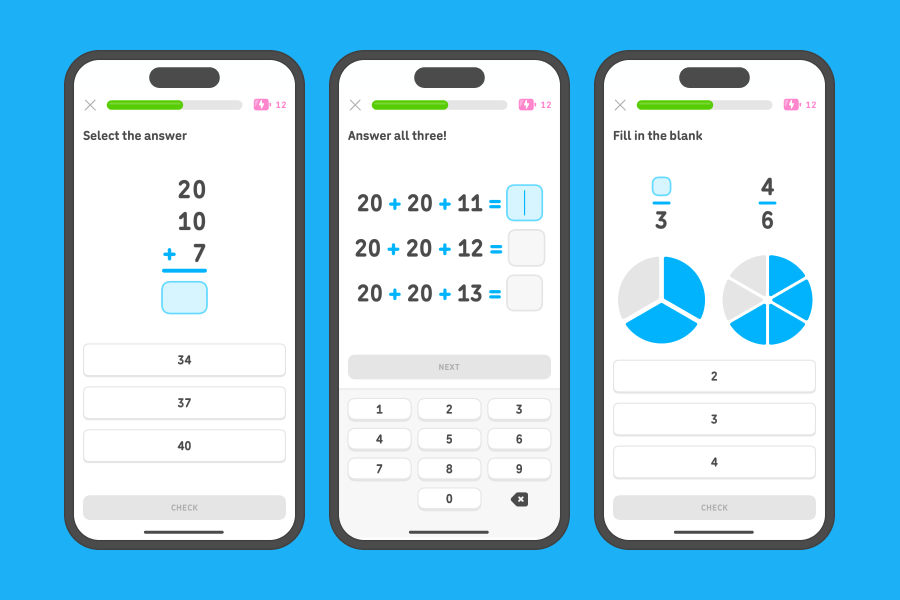
Duolingo’s Operational thinking unit gets students thinking about the skills that they’ve learned in previous grades and that they’ll continue building on in 4th grade, including multiplying by 2, comparing equivalent fractions, and adding tens and ones.
Learning more advanced multiplication and division
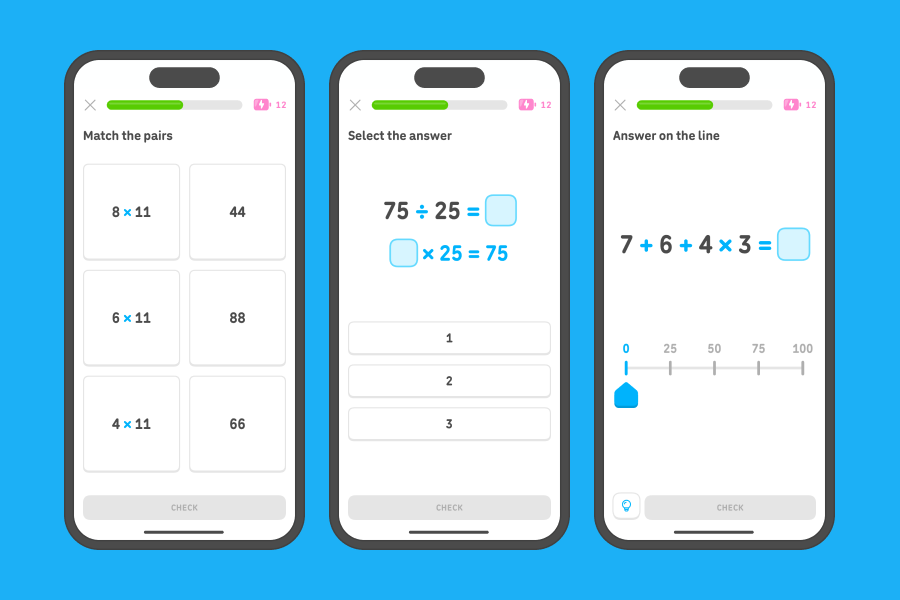
In Duolingo Math, your learner will work through sections that reinforce and build on the skills they learned in 3rd grade, moving from the unit Multiply and divide whole numbers to Multiply and divide large numbers, where they’ll begin multiplying and dividing by numbers above 10. Starting in 4th grade, your learner will begin combining these principles to multiply and divide by three numbers.
Learners will also begin to practice the Order of Operations. This section is taught in steps so the student will build up to solving equations in the correct order following PEMDAS.
Practicing factors and least common multiple
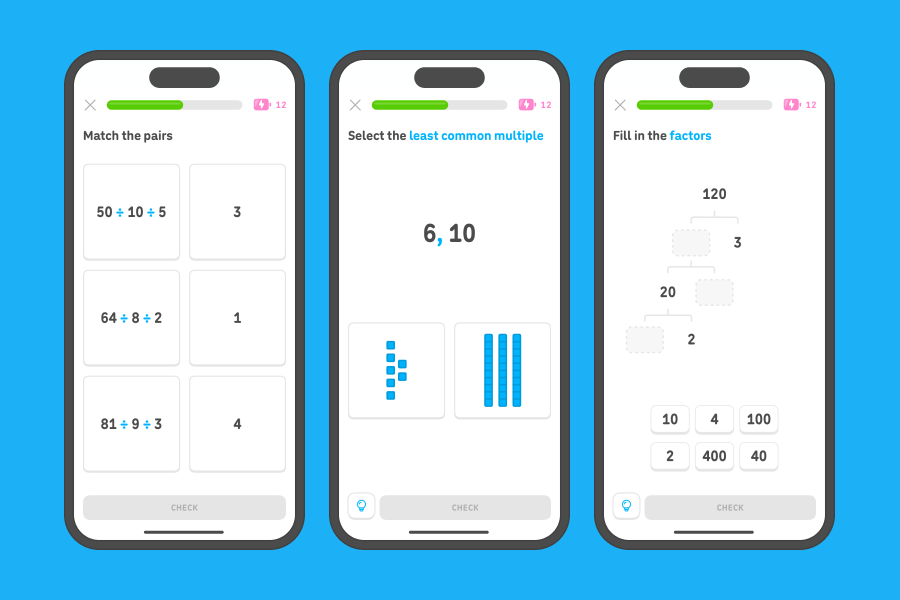
In 4th grade, students will begin to think more flexibly about multiplying and dividing. In the Duolingo unit Intro to factors, your learner will practice counting up or down by a certain number, multiplying and dividing three numbers, and multiplying larger numbers. Students will begin to recognize common facts and numbers that are in the same “fact family.”
In the Intro to least common multiple unit, students will use factor trees to break a number into its smallest parts. These skills will not only support them in gaining more numerical fluency, but will also be used when thinking about fraction operations later in the year.
Working with fractions
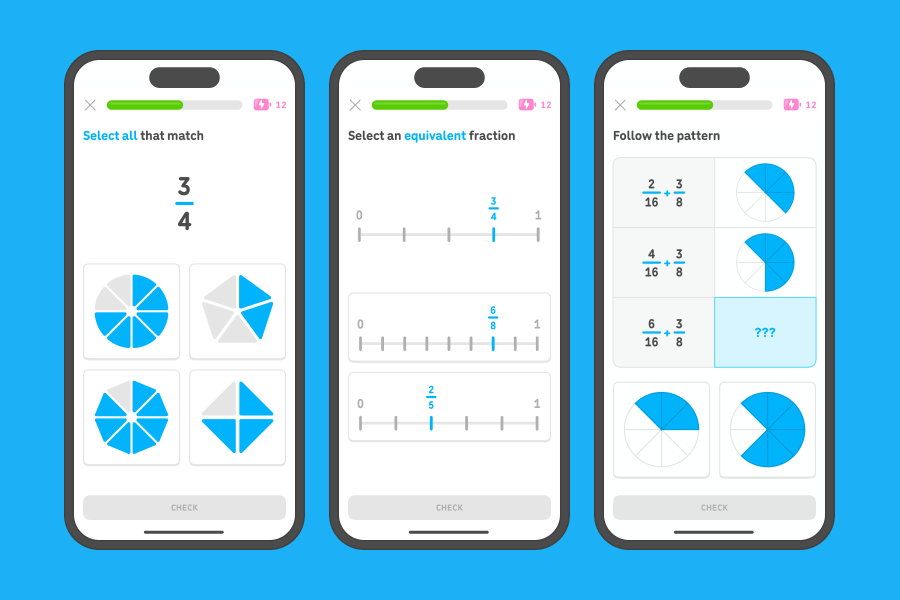
Fractions can be intimidating for many students. Duolingo Math breaks down this important topic using visuals to help your learner develop the foundational skills they’ll rely on throughout 4th grade math and beyond.
For example, the Duolingo unit Compare equivalent fractions starts with pictures so that learners can visualize which fractions are equal. Then, fractions with similar numerators and denominators can be compared.
The unit Simplify fractions takes these concepts a step further by applying what has been learned previously about the greatest common factor and showing how to use this knowledge to simplify fractions. Lessons use number lines and pictures to illustrate multiplication and division of the numerator and denominator and to show how to find equivalent fractions.
Relating fractions and decimals
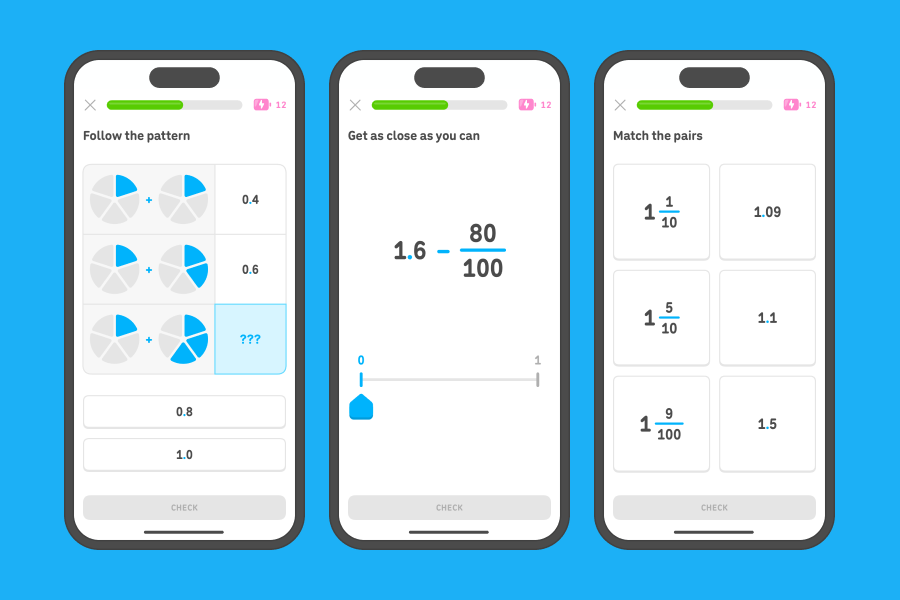
This year, your learner will also practice recognizing the connections between Fractions and decimals. Duolingo units such as Intro to fraction operations and Intro to decimals use pictures as the backbone for learning to add and subtract fractions and decimals, multiplying fractions by whole numbers, moving between improper fractions and mixed numbers, and converting between fractions and decimals. Your learner will reinforce these skills by using number lines, fractions, and decimals together in the same problems.
Understanding rounding
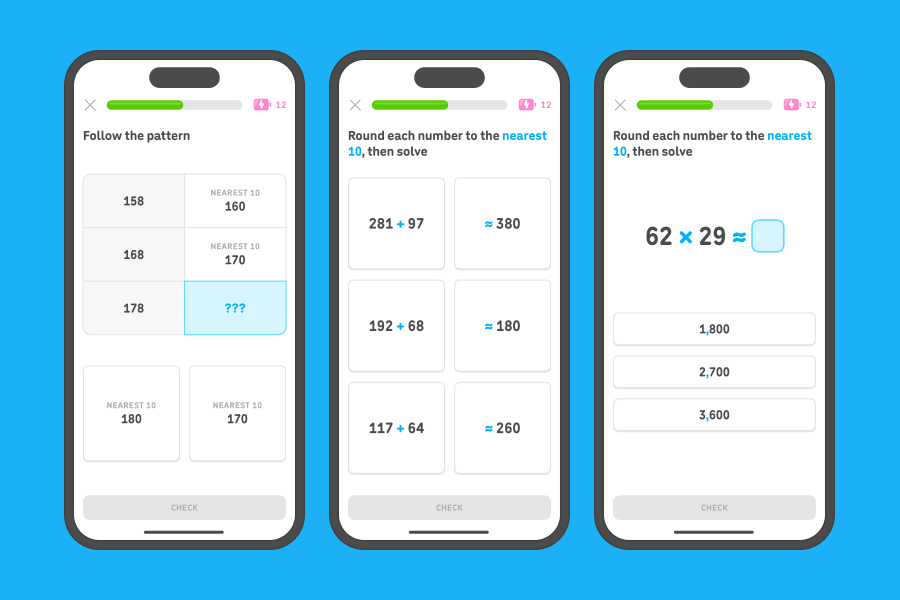
Rounding is an important skill for solving math problems mentally. It can be used by students to check their work and see if an answer makes sense, and it’s a tool they’ll use in real-world situations, too. Your 4th grader will practice core rounding skills so that they get comfortable rounding to the nearest 10 and the nearest 100 to mentally add, subtract, and multiply numbers.
Duolingo Math helps your 4th grader build new skills
Duolingo Math gives your learner tools to practice and polish their 4th grade math skills, giving them confidence as they learn to combine fundamental concepts in new, advanced ways. 💪