
In 7th grade, students begin to combine previous knowledge about operations, fractions, decimals, and negative numbers to think algebraically. It can seem intimidating at first, but with Duolingo math, each topic is broken down into manageable steps and explained so that students can learn each concept piece-by-piece and gain the confidence to solve problems with success!
Discover what 7th grade math has in store for your learner.
Understanding ratios and proportions
In the Duolingo Math course for 7th graders, the learner will start tackling situations involving ratios, rates, and proportions. They will begin by using pictures to label ratios:
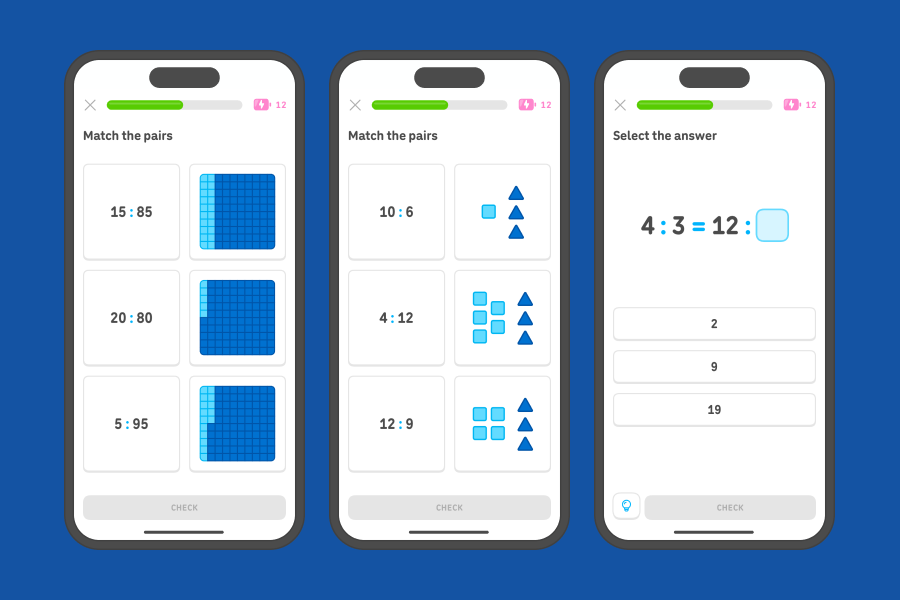
When more challenging applications of ratios are presented, they start with a step-by-step guide to solving the problem before giving students practice on their own.

In the Duolingo units Ratios and algebra, Equivalent ratios, Rates and unit rates, and Proportions applications, learners will practice:
- Making equivalent ratios
- Converting fractions to percentages
- Completing unit rate tables
- Finding unit rates
- Graphing ratios
- Scaling drawings
Thinking in algebraic terms
In 7th grade, students learn how to simplify and solve equations that will prepare them for many of the skills they’ll build on in future grades.
They also learn to simplify expressions with decimals and work with factors and distributions in expressions before moving on to more advanced equations that combine these skills or ask them to graph the solution on a number line.
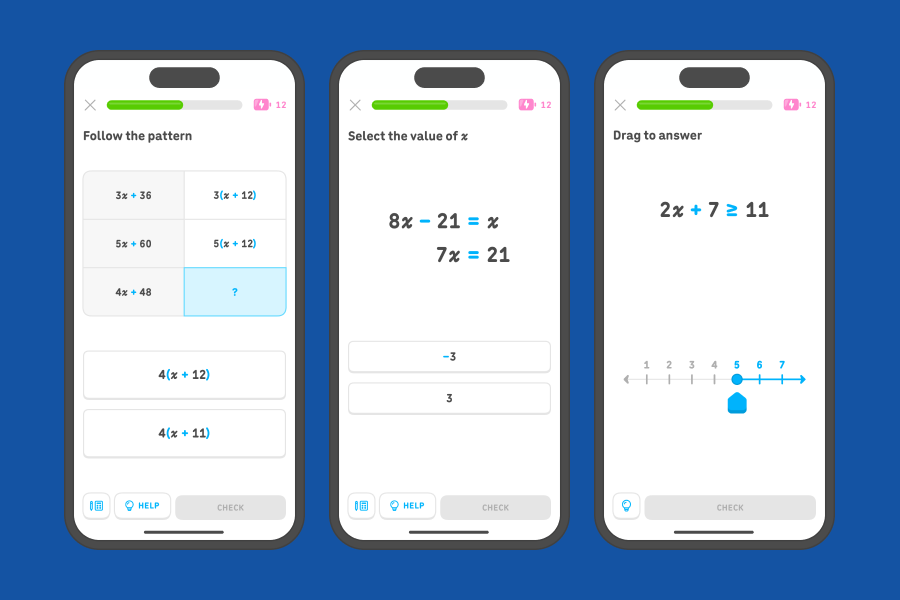
In the Duolingo units Rewrite and evaluate expressions, Two-step equations, and Two-step inequalities, learners will gain confidence with:
- Combining like terms, factoring, and distributing
- Solving inequalities
- Graphing solutions on a number line
Visualizing negative numbers
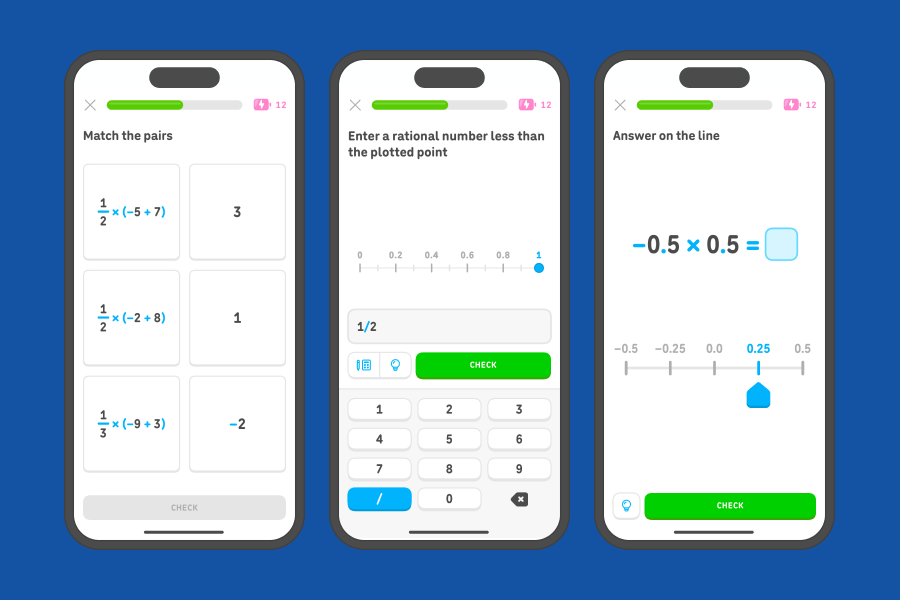
In 7th grade, students will become more comfortable with negative numbers, start plotting fractions and decimals on a number line, and learn how positives and negatives relate to each other. Then, students begin working with operations with negatives, such as adding negative whole numbers, subtracting from a negative, and multiplying and dividing by negatives. Throughout the lessons, students will also compare negative numbers and plot their answers on a number line, honing their understanding of negative numbers.
Once students are comfortable with these operations, they can begin to combine what they have already learned with the order of operations, decimals, and fractions.
In the Duolingo units Represent rational numbers, Add and subtract negatives, Multiply and divide negatives, Negative number operations, and Negative decimal operations, learners will practice:
- Adding, subtracting, multiplying, and dividing negatives
- Comparing negatives and plotting answers on a number line
- Incorporating the order of operations, decimals, and fractions into equations with negative numbers
Making sense of geometry
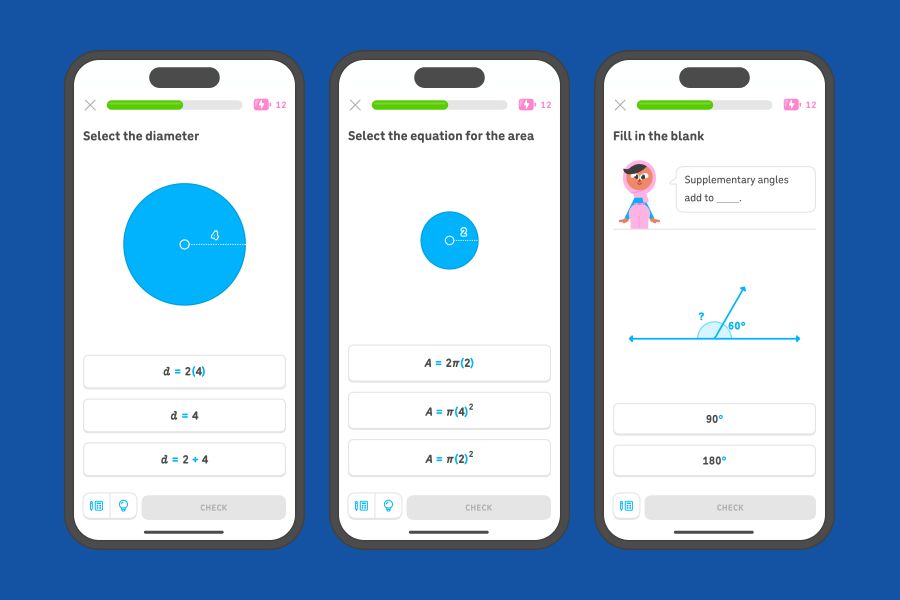
The 7th grade curriculum advances students’ command of geometry, specifically circles and angles.
In the Duolingo units Circles and Angle relationships, learners will work on:
- Learning the vocabulary of circle measurements (radius, diameter, circumference, and area), and how to calculate each one
- Finding complementary angles
- Finding supplementary angles
Exploring probability
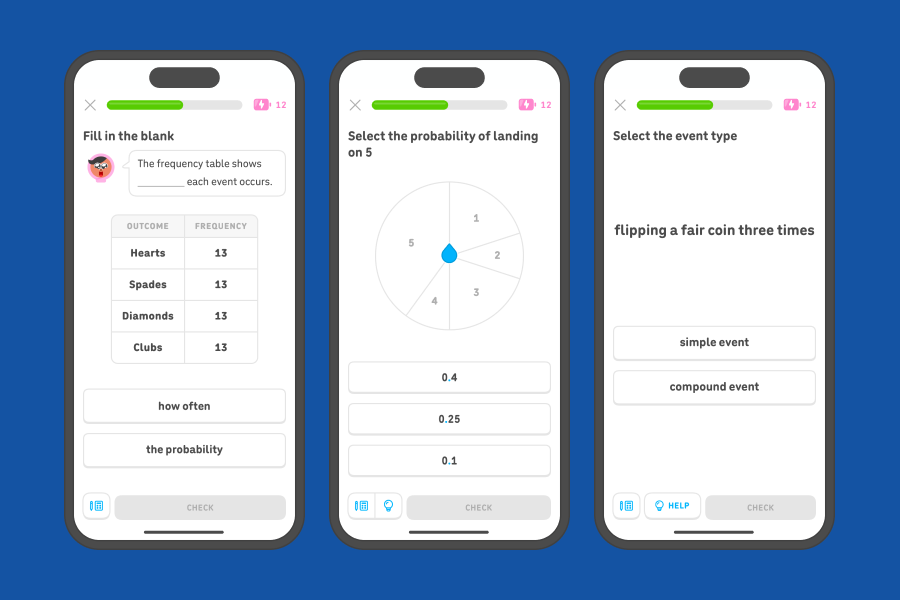
Your 7th grader will begin learning probability, and Duolingo Math breaks down complicated problems with step-by-step guidance.
In the Duolingo units Intro to probability, Probability models, and Compound events, learners will dive into:
- Vocabulary for discussing probability
- How to find simple probability
- How to find non-uniform probability (when events don’t have the same likelihood)
- The probability of compound events (the likelihood of multiple events occurring)
Duolingo Math helps your 7th grader build new skills
The Duolingo 7th grade curriculum teaches ratios, solving equations, using negative numbers, geometry, and probability in a logical way for all students. It breaks down everything students will need to know to grow in their math skills and be confident mathematicians!