In 8th grade math, your learner will take a big step into advanced topics like linear equations, functions, geometry, and data analysis. Building confidence now will help them stay steady as they transition into high school.
Duolingo Math is here to support your 8th grader with fun, effective exercises that will help them breeze through their last year of middle school. Here’s a quick breakdown of what the 8th grade course covers!
In this post:
Getting comfortable with lines and slopes
Learning the ins and outs of inputs and outputs
Tackling radicals and scientific notation
Exploring exponent rules
Navigating the laws of angles and triangles
Flipping, turning, and resizing shapes
Making sense of real-world data
Getting comfortable with lines and slopes
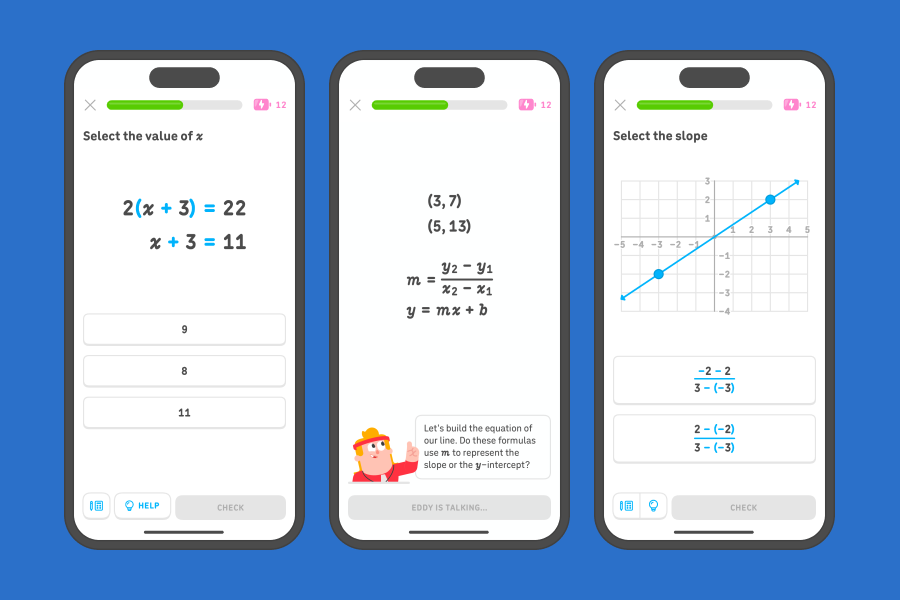
In 8th grade, learners expand their algebra skills to study how variables interact on the coordinate plane. They’ll learn how to use slope to represent real-world situations, and they’ll compare the features of different linear equations and graphs.
In the Duolingo units Equations and graphing, Graphs of proportional relationships, Slope, Slope of lines, Slope-intercept lines, and One-variable linear equations, learners will practice:
- Solving linear equations with one variable
- Recognizing the slope of lines given two points or a point and a slope
- Connecting different forms of a linear equation with corresponding graphs
- Comparing different proportional relationships using equations and graphs
Learning the ins and outs of inputs and outputs
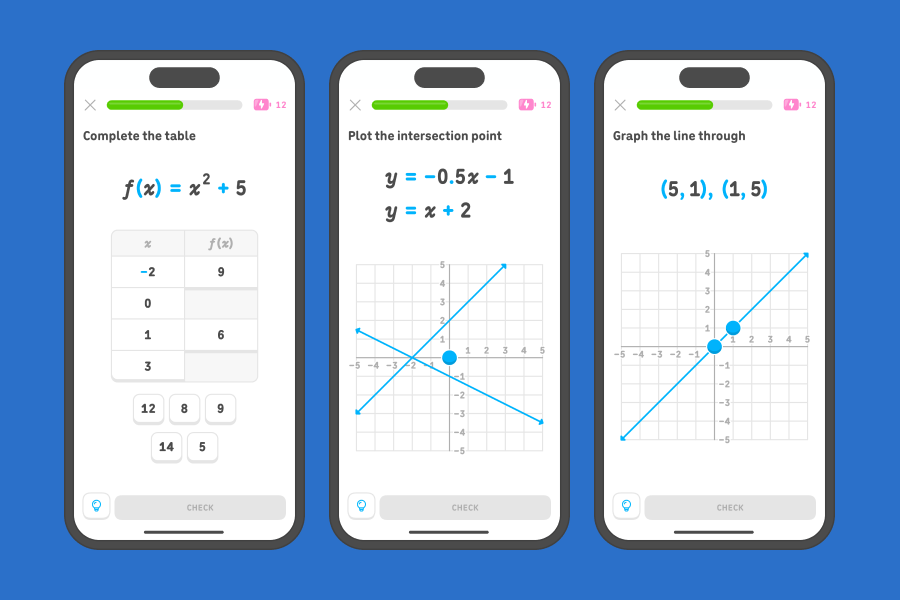
In 8th grade math, learners are introduced to functions: mathematical machines that pair every input with exactly one output. They’ll use functions to describe real-life relationships and predict how quantities change together.
In the Duolingo units Intro to functions, Linear functions, and Linear models, learners will study:
- Using function notation to represent the relationship between quantities
- Pairing inputs with outputs by using a given rule, pattern, or function
- Using linear functions as models to show real-world situations
- Defining a function by matching tables, equations, and simple graphs
Tackling radicals and scientific notation
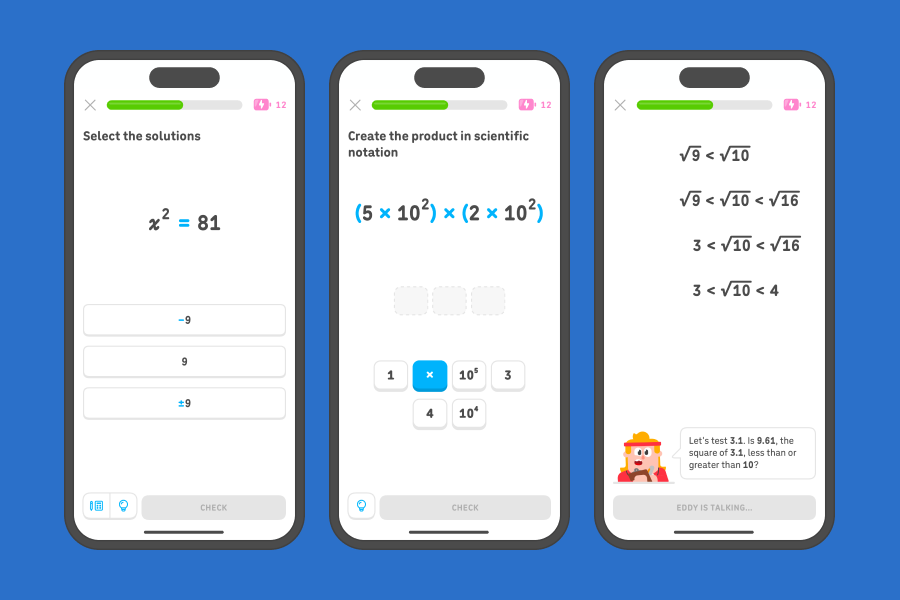
In 8th grade, learners will begin working with new types of numbers. They’ll learn how to use scientific notation to represent extremely large or small values, and they’ll discover irrational numbers and how they relate to roots and other types of numbers.
In the Duolingo units Roots, Irrational numbers, and Scientific notation, learners will practice:
- Finding the square roots of perfect squares
- Performing basic operations with scientific numbers
- Writing large and small numbers using scientific notation
- Placing irrational numbers in the right spot on a number line
Exploring exponent rules
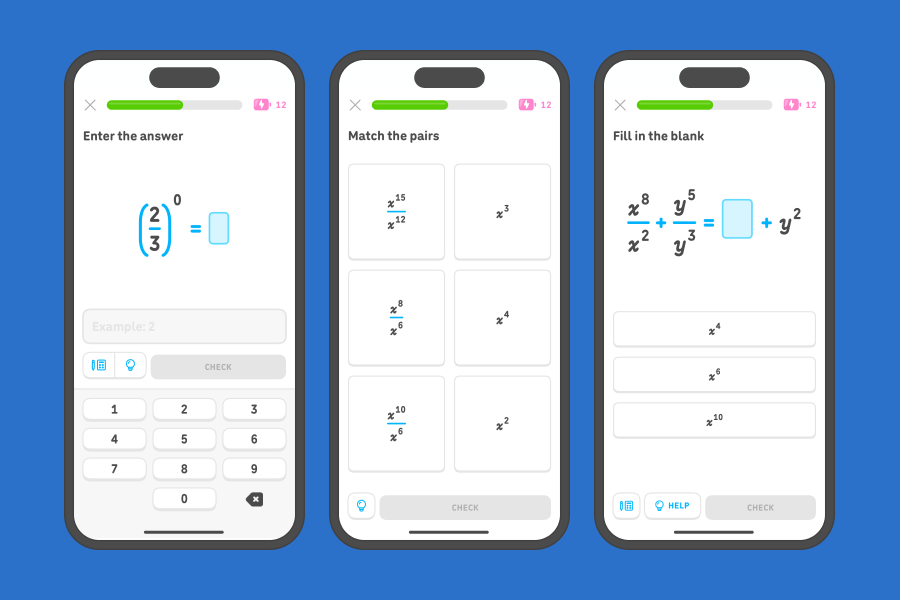
Your 8th grader will expand their knowledge of exponents to include the power of 0 and negative exponents. They’ll use new rules to rewrite single exponent terms and simplify complex exponent expressions.
In the Duolingo units Negative exponents, Zero exponent rule, Product rule, and Quotient rule, learners will work on:
- Recognizing that any number raised to the power of 0 is 1
- Multiplying and dividing powers that share the same base
- Rewriting expressions to convert negative exponents to positive exponents
- Combining product, quotient, and negative exponent rules to rewrite expressions
Navigating the laws of angles and triangles
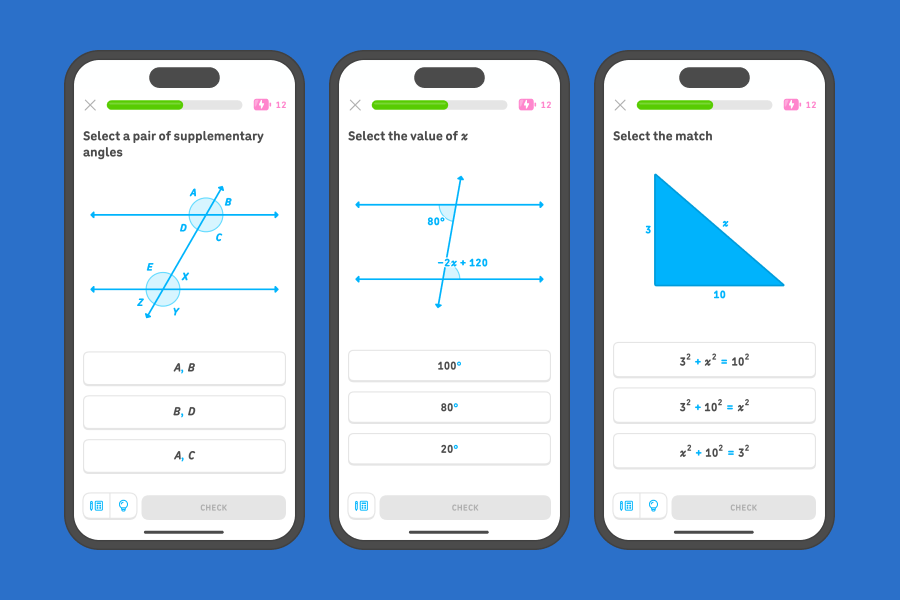
8th grade learners will apply geometric laws to help them find missing angles, both inside triangles and in figures formed by crisscrossing lines. They’ll also practice calculating the side lengths of triangles and solve puzzles using their geometric knowledge.
In the Duolingo units Angles with parallel lines, Triangles, and The Pythagorean Theorem, learners will practice:
- Calculating unknown angles and side lengths in right triangles
- Finding missing angles formed when parallel lines are cut by a transversal
- Applying the principles of triangle similarity to find missing angles or side lengths
- Using the Pythagorean Theorem to determine the distance between coordinate points
Flipping, turning, and resizing shapes
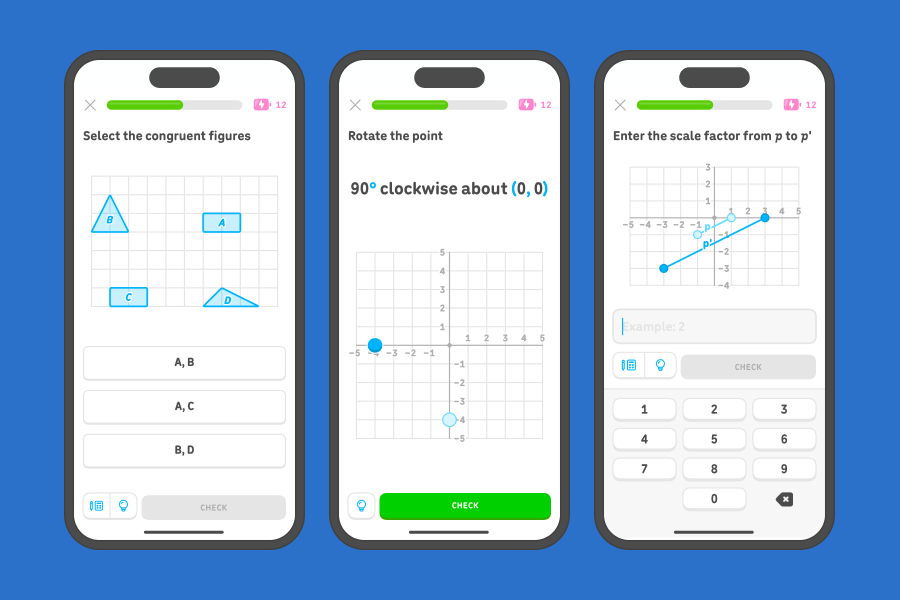
In 8th grade, learners will slide, flip, rotate, and scale shapes to explore how figures can look different but still be similar or congruent. They’ll also use the coordinate plane to track how a shape can shift position or size relative to the x-axis, y-axis, or other figures.
In the Duolingo units Translations of the plane, Reflect across axes, Reflect across lines, Rotations of the plane, Congruence, and Dilations and similarity, learners will practice:
- Rotating shapes around a fixed point
- Determining whether figures are similar or congruent
- Reflecting shapes across the x-axis, y-axis, or specific lines
- Calculating the new coordinates of a translated figure
Making sense of real-world data
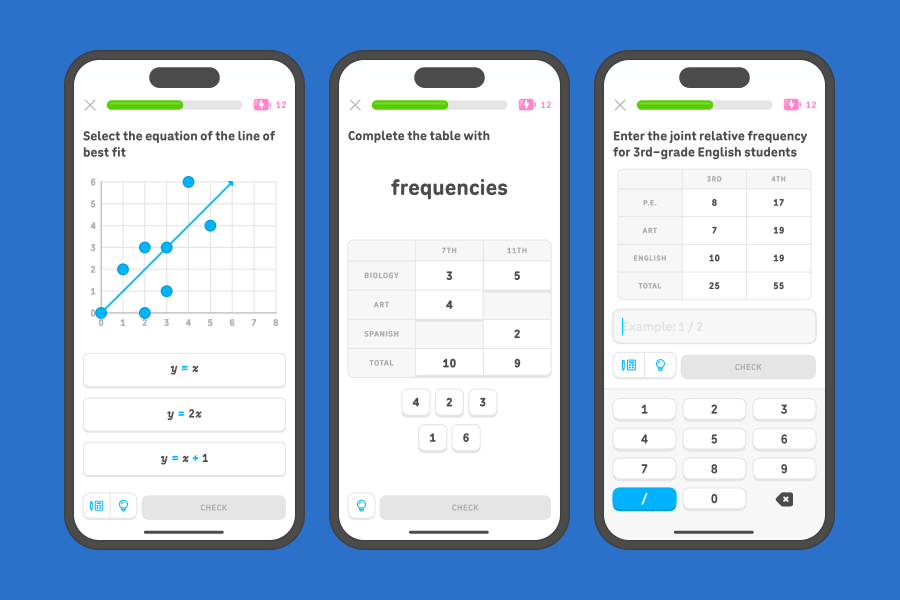
Your 8th grade learner will examine real-life data to spot trends, correlations, and hidden patterns. They’ll use visual charts to summarize facts and draw accurate conclusions about real situations.
In the Duolingo units Bivariate data and Bivariate categorical data, learners will study:
- Identifying a line of best fit for a given dataset
- Using a linear model to solve problems about a dataset
- Completing two-way tables to represent categorical information
- Matching scatter plots to corresponding sets of measurement data
Duolingo Math helps your 8th grader build new skills
Duolingo Math provides a fun, comfortable space for your 8th grader to hone the math skills they’ll need throughout the year. We’ll ensure your learner has everything they need to feel prepared, both for tomorrow’s class and for the high school math ahead.