📣 Certify your English today with Duolingo English Test—anytime, anywhere.
When speaking or writing, you’ll often need to point to a specific person, place, thing, or idea. That’s where demonstrative adjectives—this, that, these, and those—come in! They help you show exactly which person, place, thing, or idea you mean.
With four different forms to pick from, you might feel unsure about which one to use. Fortunately, this guide breaks it all down, so you can choose the right demonstrative adjective with confidence!
In this post:
- What are demonstrative adjectives?
- The difference between this, that, these, and those
- Distance of the noun (far vs. close)
- Number of the noun (singular vs. plural)
- How to know if a noun is considered “close” or “far”
- Demonstrative adjectives vs. demonstrative pronouns
What are demonstrative adjectives in English?
In English, there are four demonstrative adjectives:
- this
- that
- these
- those
How to use this, that, these, and those
Demonstrative adjectives always appear before the noun they’re referring to. However, they can be a little tricky because they change based on two factors: the noun’s distance and whether it’s a singular or plural noun.
1) Distance of the noun in time or space
For example:
| DISTANCE | NUMBER | |
|---|---|---|
| SINGULAR | PLURAL | |
| CLOSE | This coat is too small! | These trees are beautiful. |
| FAR | That coat is too small! | Those trees are beautiful. |
2) Number (singular or plural)
| NUMBER | DISTANCE | |
|---|---|---|
| CLOSE | FAR | |
| SINGULAR | You can sit in this chair. | Is she in that class too? |
| PLURAL | You can sit in these chairs. | Is she in those classes too? |
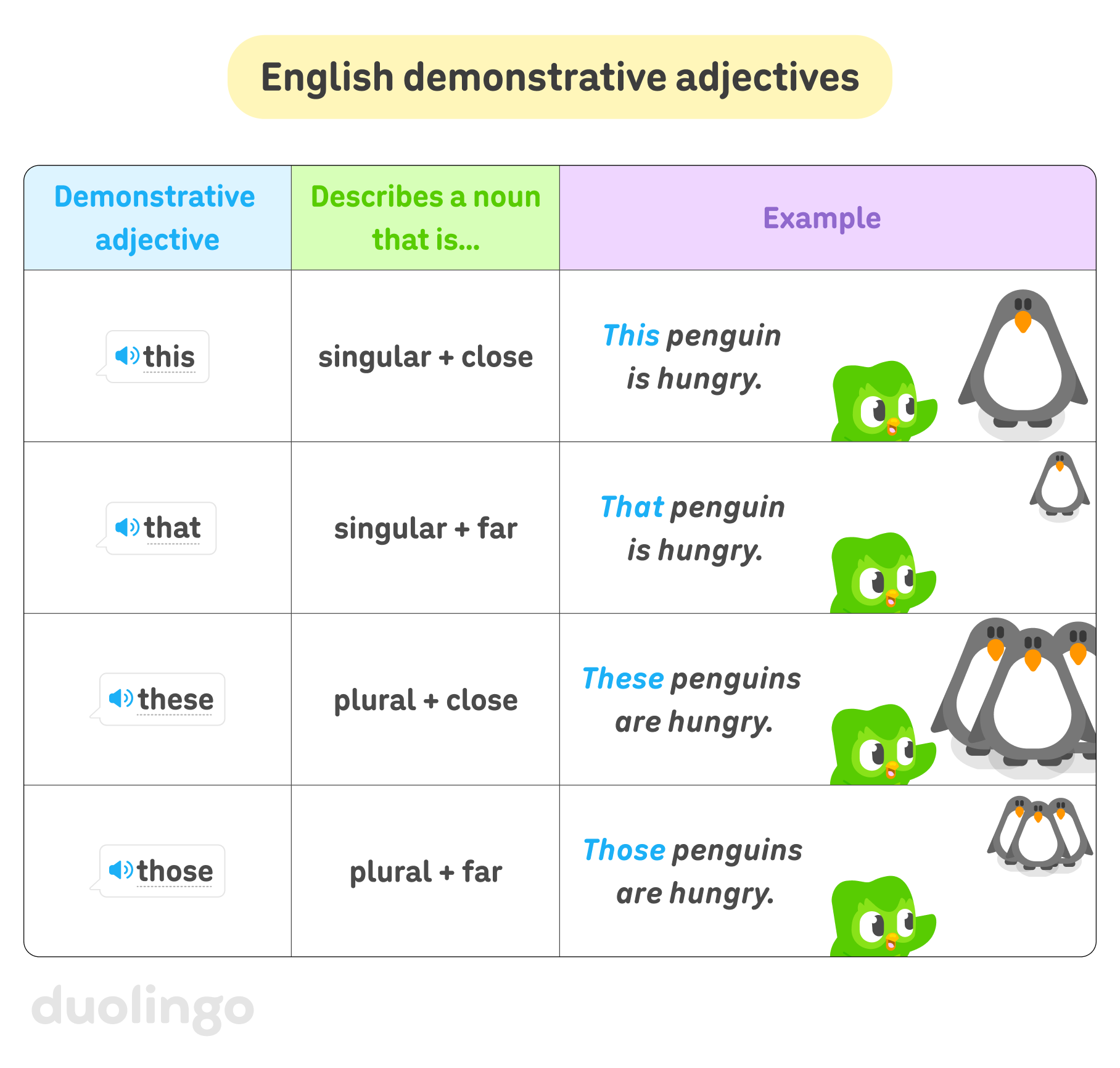
Putting these two factors—distance and number—together, each demonstrative adjective has a specific use case:
How do I know if a noun is considered “close”?
Don’t worry, you don’t need to pull out a yardstick to know which demonstrative adjective to use! See the examples below to understand when to use close demonstrative adjectives (this, these) and when to use far demonstrative adjectives (that, those):
| YOU SAY… | I love this shirt! | I love that shirt! |
|---|---|---|
| IF… | you’re holding or wearing the shirt | you are talking about someone else’s shirt |
| YOU SAY… | This evening was amazing! | That evening was amazing! |
|---|---|---|
| IF… | you are talking about today | you are talking about an evening in the past |
| YOU SAY… | Please put this blanket on the bed. | Please put that blanket on the bed. |
|---|---|---|
| IF… | you are holding the blanket | the other person is holding the blanket |
| YOU SAY… | Junior went to school this morning. | Junior went to school that morning. |
|---|---|---|
| IF… | you are talking about today | you are talking about a day in the past |
| YOU SAY… | These cookies are delicious. | Those cookies were delicious. |
|---|---|---|
| IF… | you are eating the cookies now | you already ate the cookies |
| YOU SAY… | Do you know these kids over here? | Do you know those kids over there? |
|---|---|---|
| IF… | the kids are playing close to you | the kids are playing further away from you |
Advanced English: other uses of demonstrative adjectives
In conversational English, demonstrative adjectives can also be used to highlight information or put emphasis on the noun.
For example, this and these can be used to introduce a new topic. If you’re telling a friend a story about a person you met, you might say So I met this guy at the bookstore yesterday—even if the guy isn’t close to you in time or space. It lets the listener know to pay attention because the guy is going to be the topic of this story!
Similarly, you can use that to refer to a shared memory you have with your friend. If you ask them Remember that guy I met at the bookstore last week?, you’re showing that you have previously talked about the guy in question.
Another way to use this and that is for contrast. You might point at some sweaters in a store and say I don’t like this sweater, but I like that one—even if both of them are right in front of you! In this case, the demonstrative adjectives are helping you make a distinction between the two sweaters.
Demonstrative adjectives vs. demonstrative pronouns
Demonstrative adjectives always come before a noun. However, you will sometimes see the words this, that, these, and those not followed by a noun. When they are used this way, these words are called demonstrative pronouns. Demonstrative pronouns change for distance and number in the same way as demonstrative adjectives. Compare the use of this, that, these, and those as demonstrative pronouns vs. demonstrative adjectives:
| DEMONSTRATIVE PRONOUN EXAMPLE | DEMONSTRATIVE ADJECTIVE EXAMPLE |
|---|---|
| This is my grandma, Lucy. | This lady is my grandma. |
| That is a great idea! | That idea is great! |
| I love these! | I love these cookies! |
| Those are too small. | Those shoes are too small. |
You’ve learned a lot about these adjectives!
Demonstrative adjectives can be very useful for making it clear exactly which thing (or things!) you’re talking about. And while you might feel a little unsure at first whether you should use this demonstrative adjective or, well, that one, with a little bit of practice, you’ll be a demonstrative adjective expert in no time!
To learn more about adjectives, check out all of Duolingo's adjective guides:
- 80+ of the most common English adjectives
- How to use -ed and -ing adjectives in English
- What are comparatives and superlatives in English?
- How to use possessive adjectives in English
- How to describe nouns with adjectives in English
- What order to put English adjectives in
- The difference between gradable and non-gradable adjectives in English
Certify your English proficiency with the Duolingo English Test. It’s fast, affordable, and accepted by thousands of institutions worldwide. It takes only one hour, and you can do it at home—anytime, anywhere.