
You may know that adjectives are words that help us describe nouns. They can include everything from descriptive adjectives to possessive adjectives and demonstrative ones, too. But what happens when you want to use more than one adjective to describe the same noun?
In English, adjectives follow a specific order, and this order might be different from what you’re used to in your first language. With this guide and a little practice, you’ll be ready in no time!
In this post:
- Where to put adjectives in English sentences
- How to use multiple adjectives for one noun
- Rules for commas when using multiple adjectives
- How to use multiple adjectives after verbs like be, seem, or look
Where do adjectives go in English?
Before we dive into the details of adjective order, let’s review the typical word order in English.
You can think of this as a sort of formula—with some flexibility. For example, both the subject and the object can be just a single word (like kids or cake) or multi-word phrases about a noun (like the kids in his class or cake with sprinkles):
| SUBJECT | ➕ | VERB | ➕ | OBJECT |
|---|---|---|---|---|
| Kids | ➕ | love | ➕ | cake |
| 🟰 | ||||
| Kids love cake. | ||||
| SUBJECT | ➕ | VERB | ➕ | OBJECT |
|---|---|---|---|---|
| The kids in his class | ➕ | love | ➕ | cake with sprinkles |
| 🟰 | ||||
| The kids in his class love cake with sprinkles. | ||||
Adjectives before a noun (or noun phrase)
If you want to add an adjective to a sentence, you can often put it directly before the noun it describes. For example:
| SUBJECT | ➕ | VERB | ➕ | OBJECT |
|---|---|---|---|---|
| Little kids | ➕ | love | ➕ | cake |
| 🟰 | ||||
| Little kids love cake. | ||||
| SUBJECT | ➕ | VERB | ➕ | OBJECT |
|---|---|---|---|---|
| The little kids in his class | ➕ | love | ➕ | cake |
| 🟰 | ||||
| The little kids in his class love cake. | ||||
| SUBJECT | ➕ | VERB | ➕ | OBJECT |
|---|---|---|---|---|
| I | ➕ | made | ➕ | two delicious cakes |
| 🟰 | ||||
| I made two delicious cakes. | ||||
Adjectives after certain verbs
Adjectives can also come after certain verbs, such as forms of be, seem, look, and get. These verbs can link the subject to an adjective that describes it, which is why they’re often called linking verbs.
| SUBJECT | ➕ | VERB | ➕ | ADJECTIVE |
|---|---|---|---|---|
| Cake | ➕ | is | ➕ | delicious |
| 🟰 | ||||
| Cake is delicious. | ||||
| SUBJECT | ➕ | VERB | ➕ | ADJECTIVE |
|---|---|---|---|---|
| This cake your brother made | ➕ | is | ➕ | delicious |
| 🟰 | ||||
| This cake your brother made is delicious. | ||||
How do you use multiple adjectives in English?
Sometimes, a single adjective just doesn’t cut it. Maybe the cake you’re eating is not only round but also delicious. Whenever you want to use more than one adjective to modify a noun in English, they need to go in a specific order.
So, which one comes first: square or delicious? To answer this question, you’ll need to know which order the different categories of adjectives go in:
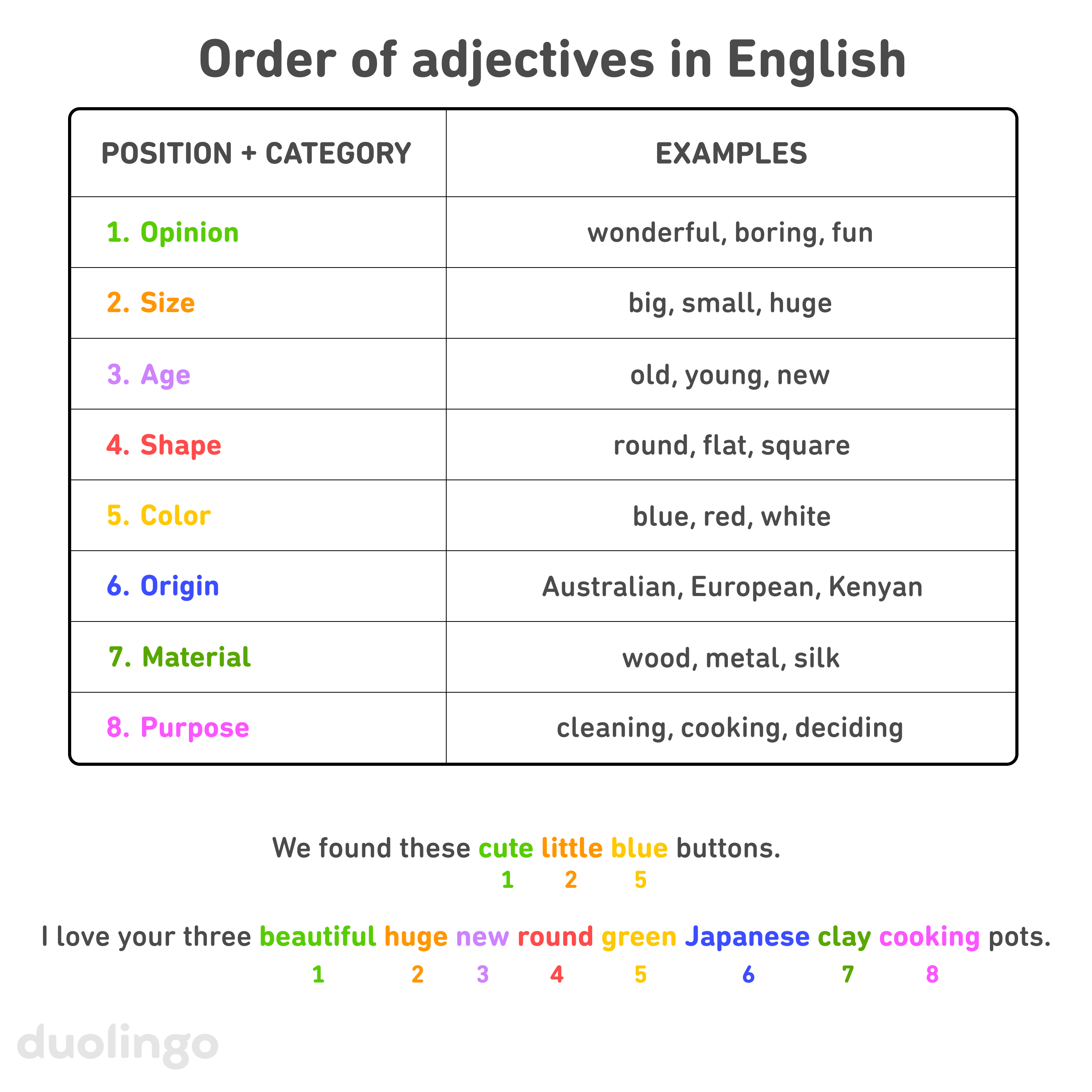
Describing a cake as delicious expresses an opinion (position 1), while calling it round describes its shape (position 4). When we combine the two adjectives in the right order, we get:
He made a delicious square cake.
That’s because we order the adjectives according to the positions of the different categories mentioned above:
| POSITION | CATEGORY | ADJECTIVE |
|---|---|---|
| 1 | opinion | delicious |
| 4 | shape | square |
Once you know the correct order of adjective categories, you can use as many adjectives as you like:
We found these cute little blue buttons.
| POSITION | CATEGORY | ADJECTIVE |
|---|---|---|
| 1 | opinion | cute |
| 2 | size | little |
| 5 | color | blue |
I love your three beautiful huge new round green Japanese clay cooking pots.
| POSITION | CATEGORY | ADJECTIVE |
|---|---|---|
| 1 | opinion | beautiful |
| 2 | size | huge |
| 3 | age | new |
| 4 | shape | round |
| 5 | color | green |
| 6 | origin | Japanese |
| 7 | material | clay |
| 8 | purpose | cooking |
(Okay, this last example might not be the kind of sentence you would hear often, but isn’t it fun to see all those adjectives together?)
Do you need commas when using multiple adjectives?
You may have noticed in the examples above that you typically do not use commas when using multiple adjectives. However, there is one exception:
For example, funny and interesting are both opinion adjectives, so they are separated by a comma:
We saw a funny, interesting movie.
Another way to separate adjectives that belong to the same category is by using the word and between them. This means that the sentence above could also be written as:
We saw a funny and interesting movie.
How do you use multiple adjectives after a verb?
When multiple adjectives describe the subject after a verb such as be, seem, look, smell, etc., their order is more flexible. For example, both of the following sentences are correct:
Her shoes look old and dirty.
Her shoes look dirty and old.
If three or more adjectives follow the verb, and is only used before the final adjective. Commas are generally placed between the others:
Their friend is funny, energetic, and kind.
(The comma before and in lists—called the Oxford comma—is optional. It’s more common in the U.S. and less common in the U.K., but whether it’s used is mainly a style choice.)
Adjectives galore!
Whether it’s an adorable little puppy or an enormous magnificent mountain, there’s a whole world out there! Now you can describe it with as many adjectives as you need!
To learn more about adjectives:
- How to use -ed and -ing adjectives in English
- What are comparatives and superlatives in English?
- The most important demonstrative adjectives in English
- How to use possessive adjectives in English
- How to describe nouns with adjectives in English
- The difference between gradable and non-gradable adjectives in English
- 80+ of the most common English adjectives