📣 Certify your English today with Duolingo English Test—anytime, anywhere.
From predicting a snow storm to discussing your next vacation abroad, the future tense has many important uses. But with more than one way to talk about the future in English, it can be confusing! With this guide, you’ll feel ready to talk about all your exciting future plans!
In this post:
The future with will
The future with will is formed with the modal verb will followed by the bare form of the main verb:
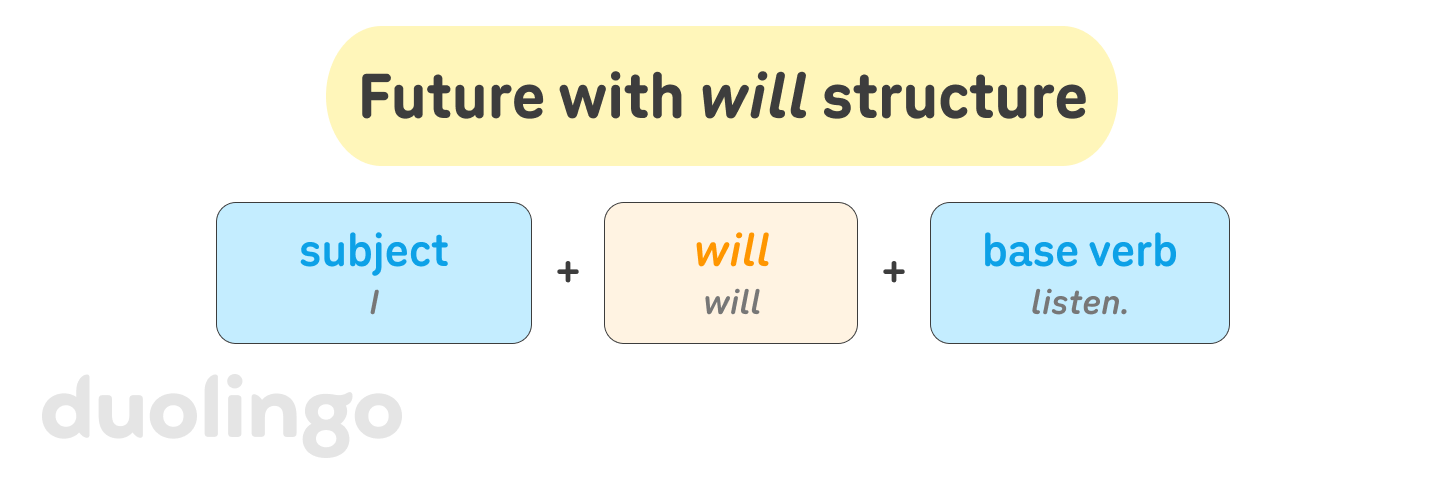
The modal verb will stays the same no matter the subject, and the main verb always appears in its base form without any changes.
You’ll often see and hear will shortened to ’ll—a form known as a contraction, which is a shorter form that uses an apostrophe and the last sound of will. Compare the two forms in the table below:
| SUBJECT | EXAMPLE WITH FULL FORM | EXAMPLE WITH CONTRACTION |
|---|---|---|
| I | I will bring chips. | I’ll bring chips. |
| you | You will be great. | You’ll be great. |
| he/she/it | He will see you later. | He’ll see you later. |
| we | We will visit next week. | We’ll visit next week. |
| you (plural) | You will need warm coats. | You’ll need warm coats. |
| they | They will lend you their car. | They’ll lend you their car. |
When to use the future with will
While their meanings are similar, the future with will and the future with going to tend to be used in different situations.
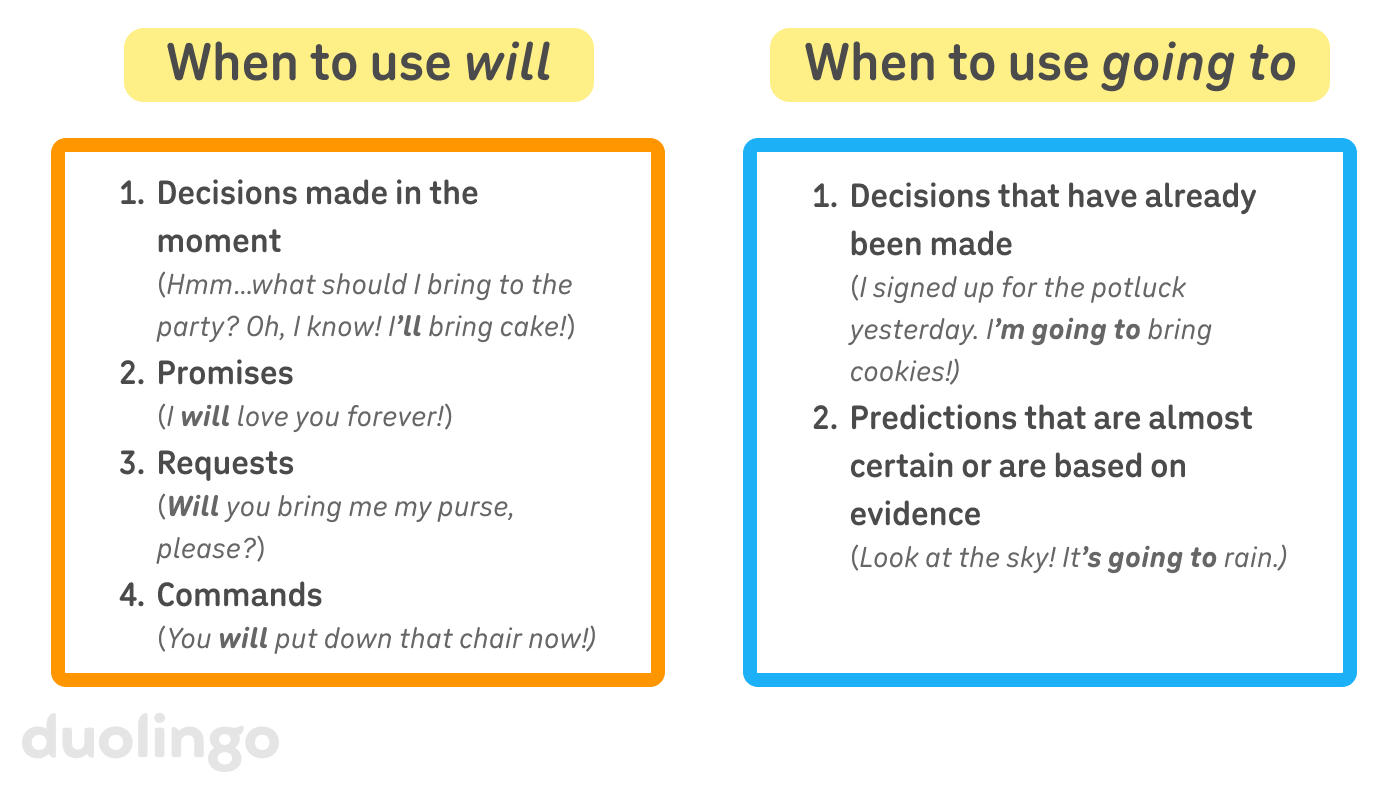
The future with will is more commonly used for:
1. Decisions made in the moment
Hmm…what should I bring to the party? Oh, I know! I’ll bring cake!
2. Promises
I will love you forever!
3. Requests
Lily, will you bring me my purse, please?
4. Commands
You will put down that chair now!
Negation of the future with will
To negate sentences using the future with will, use not between will and the base verb:
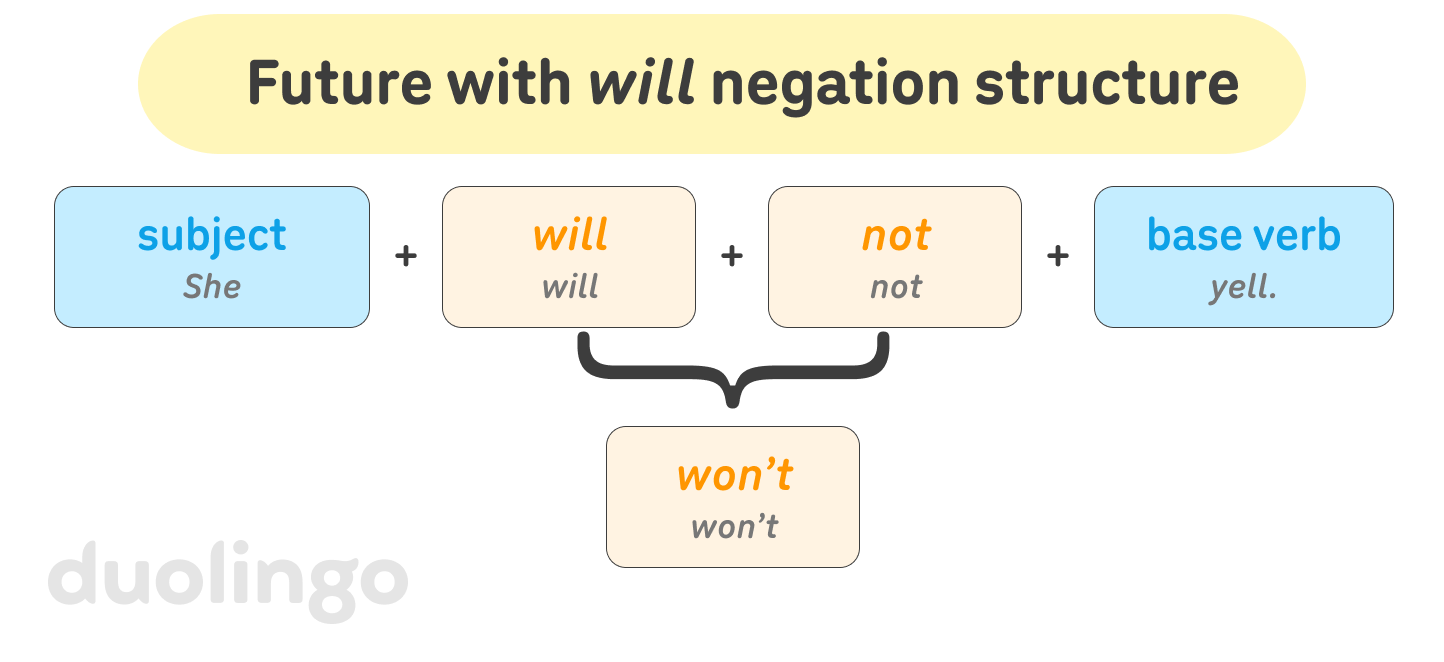
While will contracts to ’ll, the contracted form of will not is won’t. Here’s how the two forms look in sentences:
| SUBJECT | EXAMPLE WITH FULL FORM | EXAMPLE WITH CONTRACTION |
|---|---|---|
| I | I will not go to school. | I won’t go to school. |
| you | You will not be late. | You won’t be late. |
| he/she/it | He will not lose the key. | He won’t lose the key. |
| we | We will not drive fast. | We won’t drive fast. |
| you (plural) | You will not be hungry. | You won’t be hungry. |
| they | They will not stop. | They won’t stop. |
Questions in the future with will
In questions with will, will takes the place that is occupied by a form of the verb be or do in present tense questions. Unlike be and do, will does not change its form depending on the subject. It remains the same for all pronouns in all types of questions:
In yes/no questions, will is followed by the subject and the base verb:
| QUESTION | Will Junior be excited? |
|---|---|
| ANSWER | Yes, Junior will be excited. |
Wh-questions begin with a question word, followed by will, the subject, and finally the base verb:
| QUESTION | When will they come home from work? |
|---|---|
| ANSWER | They will come home from work at 6 pm. |
For tag questions, the question tag is made up of will or won’t followed by the subject pronoun:
| QUESTION | Eddy won’t be tired after the race, will he? |
|---|
| QUESTION | You will bring your kids, won’t you? |
|---|
The future with going to
You can also talk about future events using the phrase going to. This structure looks a little different from sentences with will:
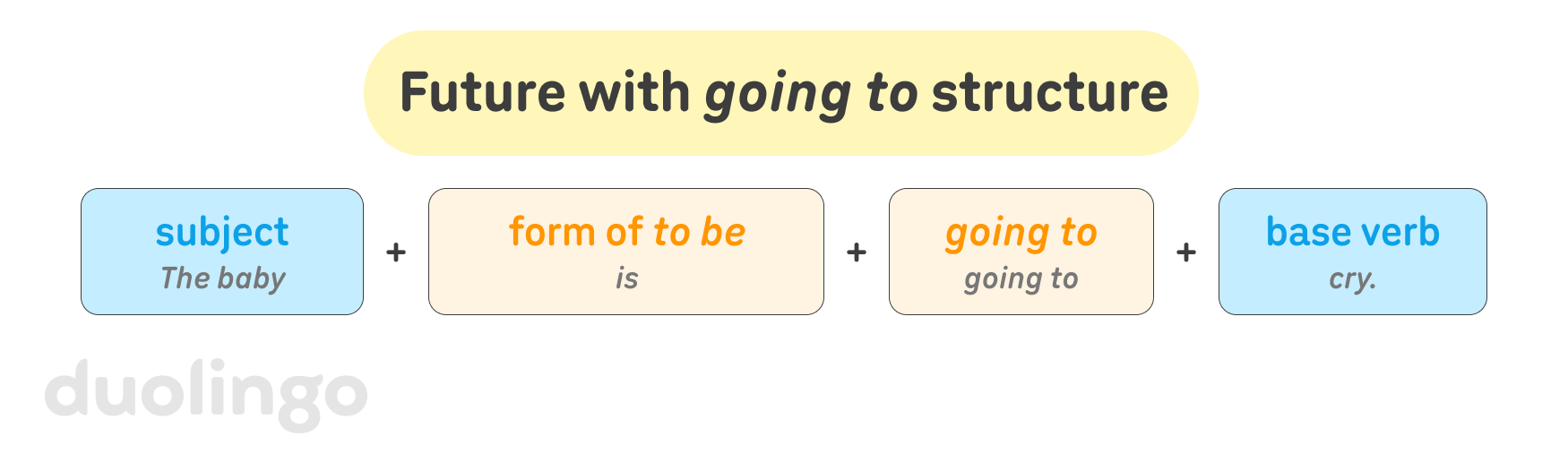
While will stays the same for all pronouns, the verb to be must be conjugated according to the subject for talking about the future with going to. Similar to will, the future with going to often uses a contraction where the subject and the verb to be are written together:
| SUBJECT | EXAMPLE WITH FULL FORM | EXAMPLE WITH CONTRACTION |
|---|---|---|
| I | I am going to watch TV. | I’m going to watch TV. |
| you | You are going to stay here. | You’re going to stay here. |
| he/she/it | He is going to take the train. | He’s going to take the train. |
| we | We are going to buy a car. | We’re going to buy a car. |
| you (plural) | You are going to be quiet. | You’re going to be quiet. |
| they | They are going to study. | They’re going to study. |
When to use the future with going to
The future with going to is commonly used for:
1. Decisions that have already been made
I signed up for the potluck yesterday. I’m going to bring cookies!
2. Predictions that are almost certain or are based on evidence
Look at the sky! It’s going to rain.
Negation of the future with going to
For negating sentences with going to, use not between the form of to be and going to:
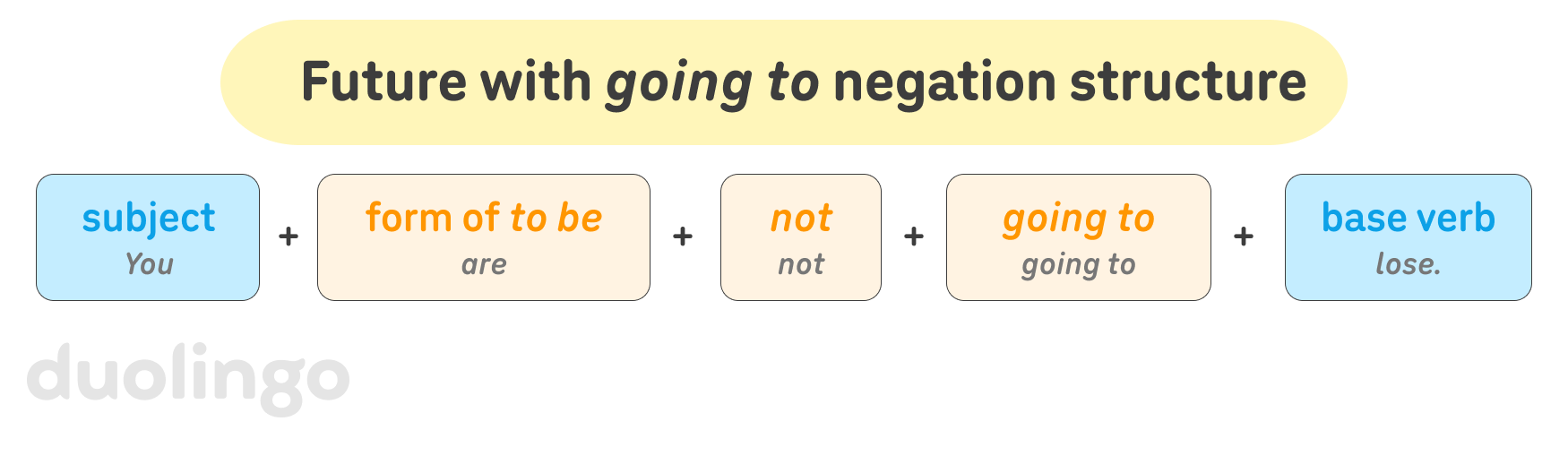
As with affirmative sentences, the verb be must be conjugated according to the subject.
Also, notice in the table below that there are two ways to form contractions for negative sentences with going to. You can either contract the subject and to be, or to be and not:
| SUBJECT | EXAMPLE WITH FULL FORM | EXAMPLE WITH CONTRACTION |
|---|---|---|
| I | I am not going to do any work. | I’m not going to do any work. |
| you | You are not going to play golf. | You’re not going to play golf. You aren’t going to play golf. |
| he/she/it | He is not going to come. | He’s not going to come. He isn’t going to come. |
| we | We are not going to eat lunch. | We’re not going to eat lunch. We aren’t going to eat lunch. |
| you (plural) | You are not going to be cold. | You’re not going to be cold. You aren’t going to be cold. |
| they | They are not going to visit. | They’re not going to visit. They aren’t going to visit. |
Note that the first person singular (I) has only one possible contraction: I am not becomes I’m not. However, in Irish English, you might hear I amn’t for I am not!
You will also hear another contraction for going to in spoken English: gonna! For example, instead of saying I’m going to wash the dishes, in informal situations you can also use I’m gonna wash the dishes.
Questions in the future with going to
To ask questions about the future with going to, focus on the form of the verb to be: It’s the part that will be moved to form questions! But *where* it moves depends on the kind of question you want to ask:
In yes/no questions, the form of to be is followed by the subject, going to, and the base verb:
| QUESTION | Is she going to visit? |
|---|---|
| ANSWER | Yes, she’s going to visit. |
Wh‑questions begin with a question word, followed by the form of to be, the subject, going to, and the base verb:
| QUESTION | When is Junior going to do his homework? |
|---|---|
| ANSWER | He’s going to do his homework after dinner. |
For tag questions, the question tag begins with aren’t or isn’t, followed by the subject pronoun:
| QUESTION | You are going to bring your kids, aren’t you? |
|---|
| QUESTION | Lucy is going to attend another secret meeting, isn’t she? |
|---|
When to use will vs. when to use going to
While their meanings are similar, the future with will and the future with going to tend to be used in different situations:
Your future is bright!
With two ways to talk about the future in English, this tense is going to feel a little tricky at first! But after a little practice, you will be great! 😉
Feeling more confident with your grammar? Take the next step by certifying your English proficiency with the Duolingo English Test. It’s fast, affordable, and accepted by thousands of institutions worldwide.