
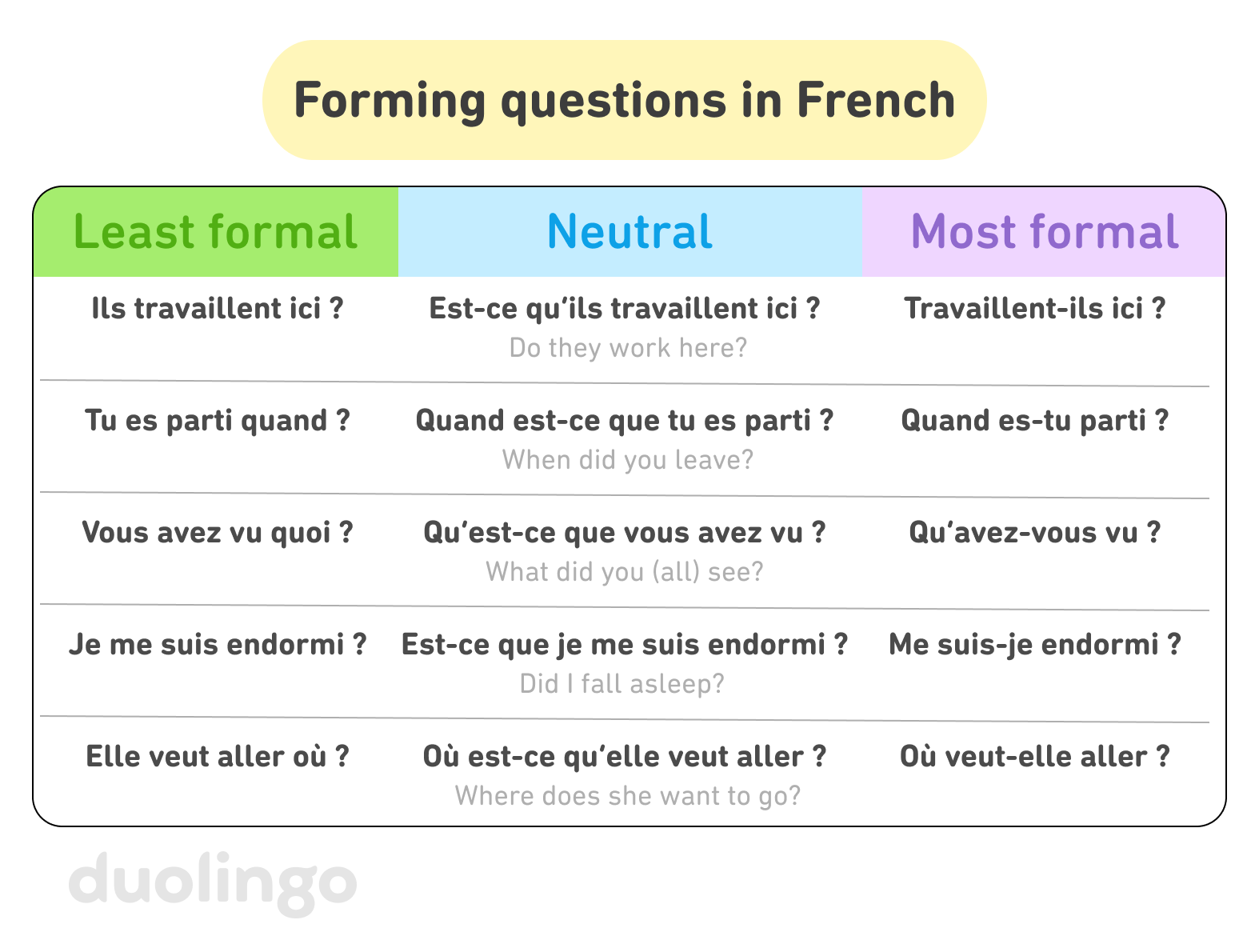
Asking questions in a new language can be a challenge! In French, there are three ways to form questions. They all technically mean the same thing, but you’ll find that they have slightly different uses and levels of formality. Let’s take a look!
In this post:
Question words in French
Least formal: Change in intonation
Neutral: Questions with est-ce que
Most formal: Inversion
Overview of examples
Question words in French
Just like in English, French has closed questions, also known as “yes/no” questions, and open questions that include a question word and can’t be answered with just “yes” or “no.” Here are the main question words you’ll need to know in French:
| French | Translation |
|---|---|
| qui | who |
| que / quoi | what (que at the beginning of a phrase and quoi after a preposition or verb) |
| où | where |
| pourquoi | why |
| comment | how |
| quand / à quelle heure | when / what time |
| quel / quelle / quels / quelles | which |
| combien | how many / how much |
Change in intonation
Formality level: least formal (used in casual conversation)
You’ll be happy to know that the simplest way to form questions is also the one you’ll hear most often in spoken French. There’s (almost) nothing you need to change!
Listen to the difference between the following examples:
- Ils sont à Berlin.They’re in Berlin.
- Ils sont à Berlin ?Are they in Berlin?
In these informal questions, you’ll often hear the question word after the verb, unlike in English.
| French | Translation |
|---|---|
| Tu connais qui ici ? | Who do you know here? |
| Il a dit quoi ?* | What did he say? |
| Vous allez où ? | Where are you (all) going? |
| Vous vous connaissez comment ? | How do y’all know each other? |
| On la voit quand ? | When are we seeing her? |
| Tu utilises quelles assiettes ? | Which plates do you use? |
| Les chaussures coûtent combien ? | How much do the shoes cost? |
* Note that que becomes quoi when it comes after the verb!
When the question word has a preposition (like with, at, about, from, to, around, on, etc.), the preposition stays in front of the question word, no matter where in the question they appear. This is unlike English, where putting the preposition before the question word or at the end of the sentence are both totally fine!
| French | Translation |
|---|---|
| Tu pars en Espagne avec qui ? | Who are you going to Spain with? |
| Ils arrivent à quelle heure ? | (At) what time do they get here? |
| Vous parliez de quoi ?* | What were you all talking about? |
* Note that que becomes quoi after the preposition!
There are two main exceptions where you probably won’t hear the question word after the verb: qui (who) when it acts as the subject of the question, and pourquoi (why).
- Qui veut de la glace ?Who wants ice cream?
- Pourquoi tu prends ma voiture ?Why are you taking my car?
Questions with est-ce que
Formality level: neutral (safe with just about anyone!)
Using est-ce que to form a question is slightly more formal than a change in intonation, but is still very common in spoken French.
To turn a statement into a yes/no question with est-ce que, you’ll just add est-ce que to the beginning. It works kind of like do in English!
- J’ai un rendez-vous.I have an appointment.
- Est-ce que j’ai un rendez-vous ?Do I have an appointment?
If you’re asking an open question, put the question word at the beginning, followed by est-ce que, followed by the rest of the question:
| French | Translation |
|---|---|
| Quand est-ce que je peux rencontrer ton copain ? | When can I meet your boyfriend? |
| Où est-ce que tu as trouvé ces clés ? | Where did you find these keys? |
| Pourquoi est-ce que le restaurant est fermé ? | Why is the restaurant closed? |
Because of French spelling and pronunciation rules, the word que becomes qu’ if the next word starts with a vowel sound. This is true if que is being used as a question word, like Qu’est-ce que tu as dit ? (What did you say?) or as part of est-ce que, like Est-ce qu’il est sept heures ? (Is it seven o’clock?).
Est-ce que occasionally becomes est-ce qui instead! This happens when it’s preceded by the question words que or qui if these question words stand in as the subject of the phrase. This table explains it in more detail:
| Statement | Possible Question |
|---|---|
| Tu veux un stylo. You want a pen. Tu is the subject of the sentence, and un stylo is the object. |
Qu’est-ce que tu veux ? What do you want? Use qu’est-ce que because the question is asking about the object (in this case, un stylo). |
| Le frigo fait un bruit bizarre. The fridge is making a weird noise. Le frigo is the subject of the sentence. |
Qu’est-ce qui fait un bruit bizarre ?* What’s making a weird noise? Use qu’est-ce qui because the question is asking about the subject (in this case, le frigo). |
| Julie a vu Simon. Julie saw Simon. Julie is the subject of the sentence, and Simon is the object. |
Qui est-ce que Julie a vu ? Who did Julie see? Use qu’est-ce que because the question is asking about the object (in this case, Simon). |
| Paul va nous aider. Paul is going to help us. Paul is the subject of the sentence. |
Qui est-ce qui va nous aider ? Who is going to help us? Use qu’est-ce qui because the question is asking about the subject (in this case, Paul). |
* Questions with qu’est-ce qui can’t easily be turned into informal questions using the “change in intonation” rules above! They also aren’t usually used with the more formal inversion rules below. For these, just stick with qu’est-ce qui 😉
Inversion
Formality level: most formal (limited mostly to writing and formal speech)
To form a question using inversion, you’ll swap the position of the verb and the pronoun, adding a hyphen to connect the two.
| Statement | Question |
|---|---|
| Vous saviez que Marc serait là. You (all) knew that Marc would be there. |
Saviez-vous que Marc serait là ? Did you (all) know that Marc would be there? |
| Tu veux une part de gâteau. You want a piece of cake. |
Veux-tu une part de gâteau ? Do you want a piece of cake? |
| Je suis ton meilleur ami. I am your best friend. |
Suis-je ton meilleur ami ? Am I your best friend? |
| Ils travaillent en Belgique. They work in Belgium. |
Travaillent-ils en Belgique ? Do they work in Belgium? |
When you have multiple verbs in a row—like the passé composé or the future with aller (to go), you’ll only invert the first verb. The rest of the phrase will follow the way they would in any other sentence or question:
| Statement | Question |
|---|---|
| Elle est partie avec Camille. She left with Camille. |
Est-elle partie avec Camille ? Did she leave with Camille? |
| J’ai reçu une bonne note. I got a good grade. |
Ai-je reçu une bonne note ? Did I get a good grade? |
| Nous allons les voir. We’re going to see them. |
Allons-nous les voir ? Are we going to see them? |
| Tu dois recommencer. You must start again. |
Dois-tu recommencer ? Must you start again? |
| Vous venez de m’appeler. You (all) just called me. |
Venez-vous de m’appeler ? Did you (all) just call me? |
Just like for questions with est-ce que, open questions with inversion put the question word at the beginning.
| French | Translation |
|---|---|
| Que fais-tu aujourd’hui ? | What are you doing today? |
| Comment connaissez-vous sa sœur ? | How do you (all) know his sister? |
| À qui parlaient-ils ? | Who were they talking to? |
| Pourquoi écrit-elle autant de lettres ? | Why is she writing so many letters? |
And that’s it! There are a few extra rules and exceptions that we’ll tackle separately—until then, you’re ready to start asking and answering questions in French 💪
Don’t question yourself!
Now that you know how to ask questions, qu’est-ce qui t’empêche (what’s stopping you) from strengthening your French even more? Check out these other helpful guides, learn the more advanced rules of inversion in French questions, and take a look at the table of all the examples from this post below!
- Your Guide to the French Alphabet
- What are the most common mistakes French learners make?
- How French Accent Marks Can Improve Your Pronunciation
- The History of French language: From the Gauls to Globalization
Examples of French question structures
| Informal (change in intonation) | Neutral (est-ce que) | Formal (inversion) |
|---|---|---|
| Ils sont à Berlin ? | Est-ce qu’ils sont à Berlin ? | Sont-ils à Berlin ? |
| Tu connais qui ici ? | Qui est-ce que tu connais ici ? | Qui connais-tu ici ? |
| Il a dit quoi ? | Qu’est-ce qu’il a dit ? | Qu’a-t-il dit ?* |
| Vous allez où ? | Où est-ce que vous allez ? | Où allez-vous ? |
| Vous vous connaissez comment ? | Comment est-ce que vous vous connaissez ? | Comment vous connaissez-vous ? |
| On la voit quand ? | Quand est-ce qu’on la voit ? | Quand la voit-on ? |
| Tu utilises quelles assiettes ? | Quelles assiettes est-ce que tu utilises ? | Quelles assiettes utilises-tu ? |
| Les chaussures coûtent combien ? | Combien est-ce que les chaussures coûtent ? | Combien les chaussures coûtent-elles ?* |
| Tu pars en Espagne avec qui ? | Avec qui est-ce que tu pars en Espagne ? | Avec qui pars-tu en Espagne ? |
| Ils arrivent à quelle heure ? | À quelle heure est-ce qu’ils arrivent ? | À quelle heure arrivent-ils ? |
| Vous parliez de quoi ? | De quoi est-ce que vous parliez ? | De quoi parliez-vous ? |
| Qui veut de la glace ? | Qui est-ce qui veut de la glace ? | Qui veut de la glace ? |
| Pourquoi tu prends ma voiture ? | Pourquoi est-ce que tu prends ma voiture ? | Pourquoi prends-tu ma voiture ? |
| J’ai un rendez-vous ? | Est-ce que j’ai un rendez-vous ? | Ai-je un rendez-vous ? |
| Tu es triste ? | Est-ce que tu es triste ? | Es-tu triste ? |
| Je peux rencontrer ton copain quand ? | Quand est-ce que je peux rencontrer ton copain ? | Quand puis-je rencontrer ton copain ?* |
| Tu as trouvé ces clés où ? | Où est-ce que tu as trouvé ces clés ? | Où as-tu trouvé ces clés ? |
| Pourquoi le restaurant est fermé ? | Pourquoi est-ce que le restaurant est fermé ? | Pourquoi le restaurant est-il fermé ?* |
| Tu as dit quoi ? | Qu’est-ce que tu as dit ? | Qu’as-tu dit ? |
| Il est sept heures ? | Est-ce qu’il est sept heures ? | Est-il sept heures ? |
| Tu veux quoi ? | Qu’est-ce que tu veux ? | Que veux-tu ? |
| Julie a vu qui ? | Qui est-ce que Julie a vu ? | Qui Julie a-t-elle vu ?* |
| Qui va nous aider ? | Qui est-ce qui va nous aider ? | Qui va nous aider ? |
| Vous saviez que Marc serait là ? | Est-ce que vous saviez que Marc serait là ? | Saviez-vous que Marc serait là ? |
| Tu veux une part de gâteau ? | Est-ce que tu veux une part de gâteau ? | Veux-tu une part de gâteau ? |
| Je suis ta meilleure amie ? | Est-ce que je suis ta meilleure amie ? | Suis-je ta meilleure amie ? |
| Ils travaillent en Belgique ? | Est-ce qu’ils travaillent en Belgique ? | Travaillent-ils en Belgique ? |
| Elle est partie avec Camille ? | Est-ce qu’elle est partie avec Camille ? | Est-elle partie avec Camille ? |
| J’ai reçu une bonne note ? | Est-ce que j’ai reçu une bonne note ? | Ai-je reçu une bonne note ? |
| Nous allons les voir ? | Est-ce que nous allons les voir ? | Allons-nous les voir ? |
| Tu dois recommencer ? | Est-ce que tu dois recommencer ? | Dois-tu recommencer ? |
| Vous venez de m’appeler ? | Est-ce que vous venez de m’appeler ? | Venez-vous de m’appeler ? |
| Tu fais quoi aujourd’hui ? | Qu’est-ce que tu fais aujourd’hui ? | Que fais-tu aujourd’hui ? |
| Vous connaissez sa sœur comment ? | Comment est-ce que vous connaissez sa sœur ? | Comment connaissez-vous sa sœur ? |
| Pourquoi elle écrit autant de lettres ? | Pourquoi est-ce qu’elle écrit autant de lettres ? | Pourquoi écrit-elle autant de lettres ? |
| Ils parlaient à qui ? | À qui est-ce qu’ils parlaient ? | À qui parlaient-ils ? |
* These forms are exceptions that we explain in part two of this post!