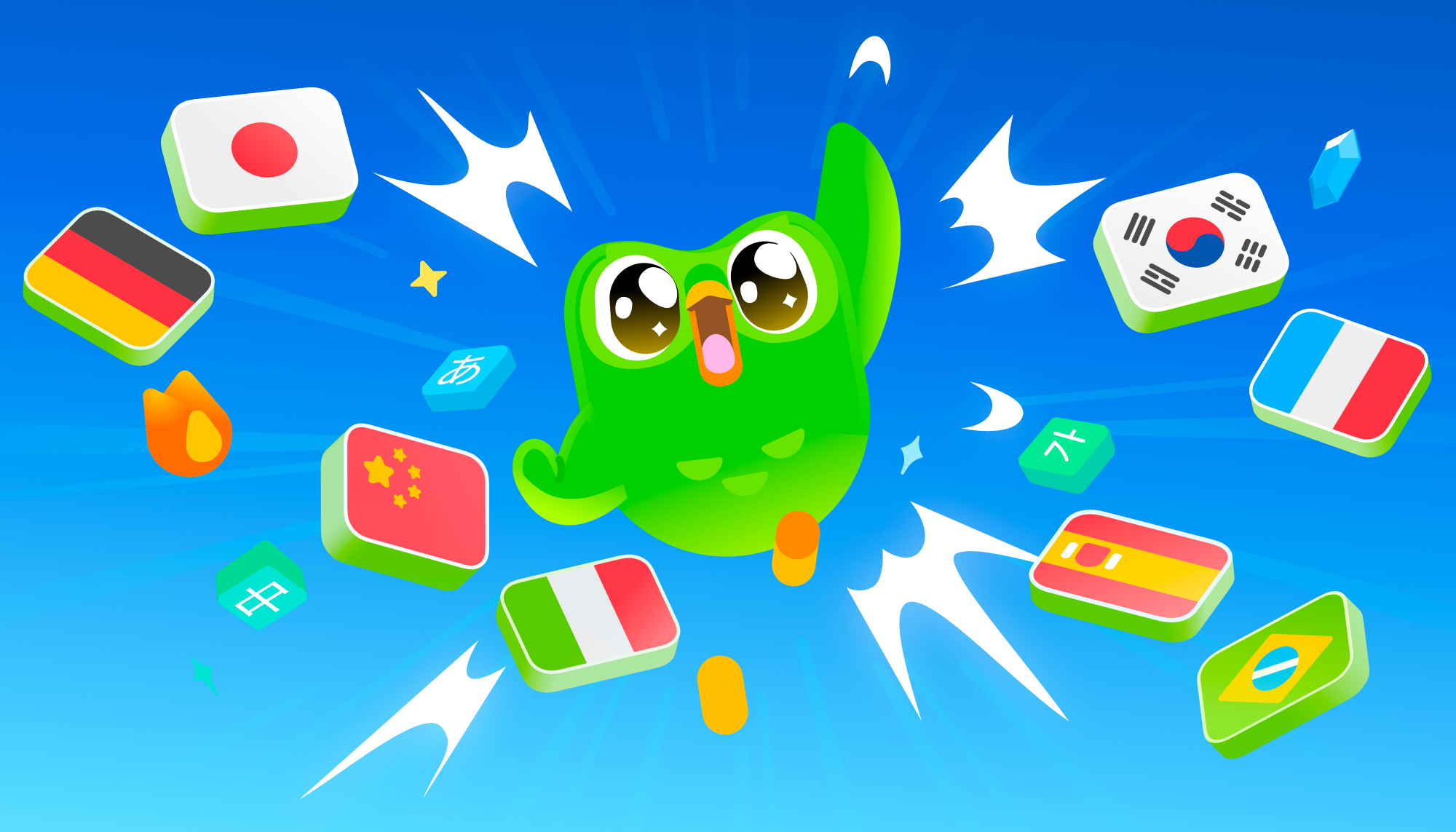
We just hit a major milestone: Nine of our most popular language courses now teach advanced content.
How advanced? Almost anyone on Duolingo who is learning English, Spanish, French, German, Italian, Portuguese, Japanese, Korean, or Chinese can now learn through B2 on the CEFR scale, or a Duolingo Score of 129. Previously, most of these learners could only complete content up to A2 (Duolingo Score 59).
Here’s how it impacts learners.
What does “advanced content” actually mean?
B2 is the fourth of six levels that make up the CEFR, or the Common European Framework of Reference for Languages, and corresponds to the Duolingo Scores 100-129.
By the time you reach a Duolingo Score of 129 (or the end of B2 on the CEFR scale), you’re considered an “independent user” of the language: You’re able to interact with other speakers, understand certain complex texts, and express your viewpoints on a wide range of topics. You might not understand everything you hear or read 100% of the time, and you may still have to search for your words occasionally, but you have all the tools you need to communicate effectively in most situations.
What can I do with advanced content?
There’s a reason we pushed to make B2 content available for our most popular courses: In general, that’s the level of proficiency that allows you to get a job in that language!
As part of our mission to make free education universally available, this is a huge milestone. Being able to get a job—or attend university—in another language opens doors for millions of learners around the world, providing them with opportunities that wouldn’t be possible without accessible, high-quality language education. This is especially true for the learners from language backgrounds that are typically unsupported on language-learning platforms and who want to learn a language other than English.
How our expanded content can bridge the language gap:
- A Ukrainian speaker who has recently arrived in Germany can now reach a level of German advanced enough to navigate the administrative system.
- A Spanish speaker studying Japanese can now learn enough to apply to and attend university in Japan.
- A Chinese speaker seeking work in France can now bolster their skills and confidence enough to apply for roles at French-speaking companies.
What courses have new content?
This content is now available for most learners of the following languages, regardless of the language they’re learning from:
- English
- Spanish
- French
- German
- Italian
- Portuguese
- Japanese
- Korean
- Chinese
What’s new in these courses?
In these expanded courses, you’ll find more advanced content, including lessons that will enable you to understand news, movies, and jokes in your new language, as well as advanced Stories and DuoRadio episodes, plus Explain My Answer and mini-units to keep you motivated while you reach your language goals.
Keep advancing!
Whether you’re picking up where you left off or starting one of our newly-expanded courses from the beginning, our advanced content is here to take your learning to new heights!