Learning a language doesn't have to mean learning everything in the language you're studying. (Even in your first language, you have to learn new words!)
What does “being fluent” in a language mean?
That's why it's so hard to decide what exactly it means to be "fluent" in a new language. The vocabulary and grammar you need to plan a weekend at the beach with your best friend are really different from the vocabulary and complex structures you would need to write a dissenting opinion for the U.S. Supreme Court.
How do we measure progress?
At Duolingo, we use both the Common European Framework of Reference for Languages (CEFR) and Duolingo Score to measure your progress toward your language goals.
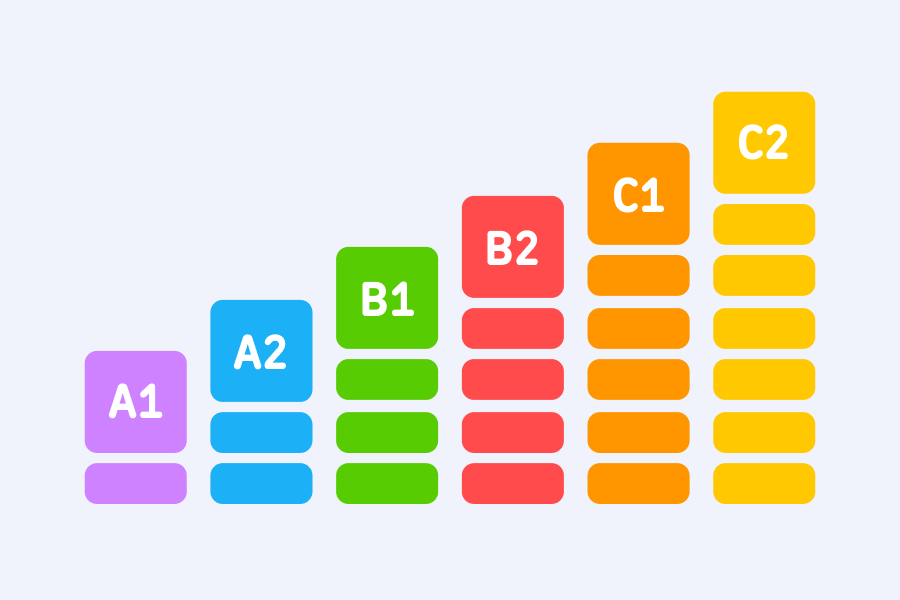
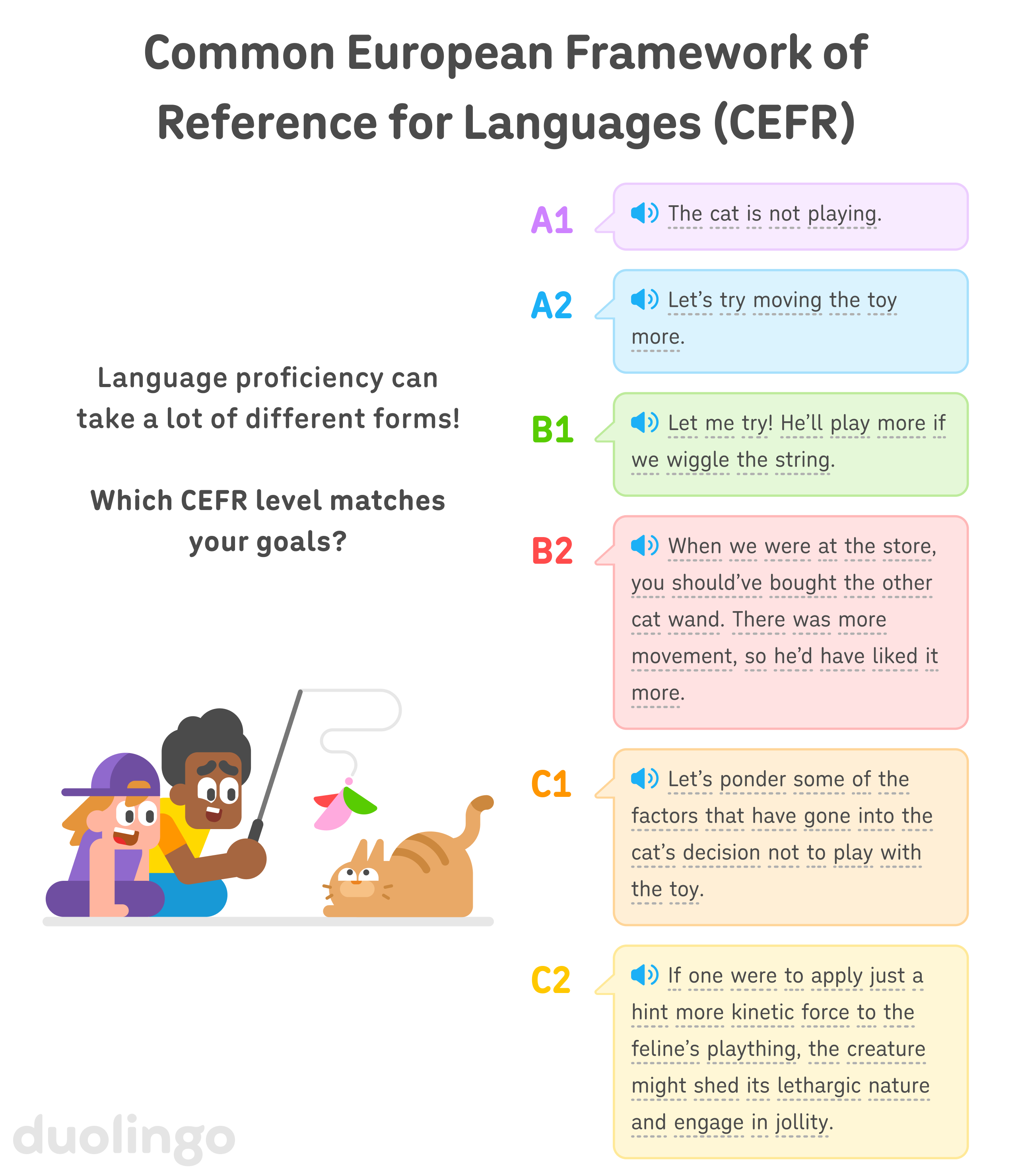
The CEFR scale is divided into six levels: A1, A2, B1, B2, C1, and C2. If you’re new to a language, you’ll start at A1, where you’ll learn the fundamentals. Each level builds on the previous one, covering increasingly complex language skills and topics. If you study a language all the way through C2, you’ll have reached the highest possible level of language proficiency.
The Duolingo Score is aligned with the CEFR but provides a more fine-grained measure of your progress. It goes up to 160 points, with our most popular courses teaching up to Duolingo Score 129 (which corresponds to the end of CEFR level B2). Your Score gives you a more precise sense of how far you’ve come on your language learning journey.
Which CEFR level should you aim for?
Most people don't need to master all, or even most, of the levels! To make those beach plans, you can probably manage fairly well at B1. But to give Ruth Bader Ginsburg a run for her money, you'll need to work your way up to C2, the highest level on the CEFR scale. Keep in mind, though, that in many contexts, speakers don't use C1 or C2 vocabulary and grammar, even in their first language.
And you might be surprised by how much you can achieve at each level! For example, Academy Award-winning filmmaker Bong Joon Ho used A1 English to express thanks in his acceptance speech for Best Director ("Thank you. I will drink until next morning."), but in order to express more complex sentiments about his cinematic inspiration, he spoke in B1 Korean and used an interpreter.
We’ll level with you
People often use "fluent" to describe their language goals, but "comfortable" might be what they're really getting at—and you can feel "comfortable" at a lot of those CEFR levels! Which level aligns best with what you'll be doing in the language you're studying?