
Welcome to another week of Dear Duolingo, an advice column just for learners. Catch up on past installments here.
Hello, readers! It’s me again, Stefanie Schantl, and I’m back to take you on a journey from numbers to ancient gods to the solar system. Why, you ask? Because today we’re uncovering the secrets behind the names of the days of the week. Let’s get right to it!
Our question this week:
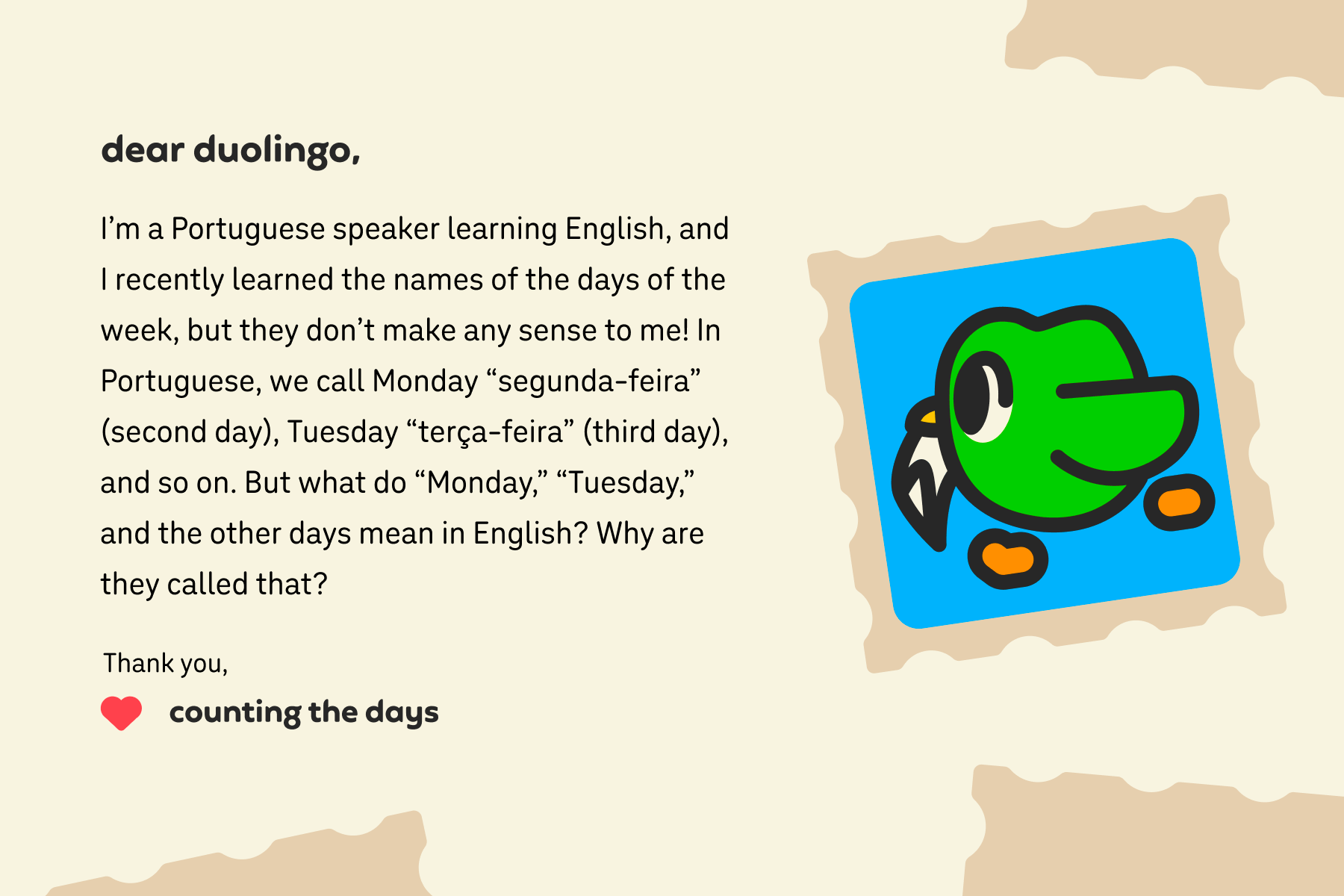
Oh, what a wonderful question, Counting the Days! You’re definitely not the first to struggle with learning the names of the days of the week, and you won’t be the last. Fortunately, these names generally have deeper meanings—some might just be a little harder to spot.
Most of the world’s languages use one of two naming conventions for the days of the week. Some base them on numbers (like Portuguese), while others base them on the names of planets and stars (like English). Let’s break it down!
Names based on celestial bodies 🪐
In many languages, the names of the days of the week might seem random—but that’s only until you take a closer look. For example, English Friday, Spanish viernes, and even Hindi शुक्रवार (shukravaar) all derive their name for the day before Saturday from Venus. That’s right—in many languages, Friday is the day of the brightest planet in the sky.
This tradition goes back to ancient Babylonia, where people observed seven celestial bodies visible to the naked eye: the sun, the moon, Mars, Mercury, Jupiter, Venus, and Saturn. Each of the seven days of the week was named after one of these heavenly bodies, which in turn were associated with Babylonian deities.
The Romans later adopted this practice, calling the days by the Latin names for the celestial bodies and their corresponding gods:
| English | Latin | Meaning |
|---|---|---|
| Sunday | dies Solis | day of the sun |
| Monday | dies Lunae | day of the moon |
| Tuesday | dies Martis | day of Mars |
| Wednesday | dies Mercurii | day of Mercury |
| Thursday | dies Iovis | day of Jupiter |
| Friday | dies Veneris | day of Venus |
| Saturday | dies Saturni | day of Saturn |
In many of today’s Romance languages (which all stem from Latin), this pattern is still present. However, Saturday and Sunday ended up with their own special names, reflecting the influence of religion. The name for Saturday comes from the Jewish Sabbath (the traditional day of rest), while Sunday’s name means “the Lord’s Day” in Romance languages.
| English | French | Italian | Spanish | Meaning |
|---|---|---|---|---|
| Sunday | dimanche | domenica | domingo | day of the sun |
| Monday | lundi | lunedì | lunes | day of the moon |
| Tuesday | mardi | martedì | martes | day of Mars |
| Wednesday | mercredi | mercoledì | miércoles | day of Mercury |
| Thursday | jeudi | giovedì | jueves | day of Jupiter |
| Friday | vendredi | venerdì | viernes | day of Venus |
| Saturday | samedi | sabato | sábado | day of Saturn |
Germanic languages (like English and German) also adopted the Roman naming system. However, they replaced the Roman deities with Germanic ones. For example, the Germanic god Thor corresponds to the Roman god Jupiter, so he became the namesake of English Thursday, German Donnerstag, and Danish torsdag, among others.
| English | German | Danish | Meaning |
|---|---|---|---|
| Sunday | Sonntag | søndag | day of the sun |
| Monday | Montag | mandag | day of the moon |
| Tuesday | Dienstag | tirsdag | day of Tiw / Týr (corresponds to the Roman god Mars) |
| Wednesday | Mittwoch* | onsdag | day of Woden / Odin (corresponds to the Roman god Mercury) |
| Thursday | Donnerstag | torsdag | day of Thor / Donar (corresponds to the Roman god Jupiter) |
| Friday | Freitag | fredag | day of Frigg (corresponds to the Roman god Venus) |
| Saturday | Samstag | lørdag** | day of Saturn |
* German Mittwoch literally means “middle of the week.”
** Danish lørdag comes from an Old Norse word that meant “bath day.”
Many Indic languages also named the days of the week after celestial bodies and their corresponding gods. In these languages, the names of the deities come from Sanskrit—an ancient Indic language.
| English | Hindi | Marathi | Meaning |
|---|---|---|---|
| Sunday | रविवार / सूर्यवार (ravivaar / suuryavaar) |
रविवार (ravivaar) |
day of Surya / Ravi (Hindu sun god) |
| Monday | सोमवार / चन्द्रवार (somvaar / chandravaar) |
सोमवार (somavaar) |
day of Soma / Chandra (Hindu moon god) |
| Tuesday | मंगलवार (mangalvaar) |
मंगळवार (mangaḷavaar) |
day of Mangala (Mars) |
| Wednesday | बुधवार (budhavaar) |
बुधवार (budhavaar) |
day of Budha (Mercury) |
| Thursday | गुरुवार (guruvaar) |
गुरूवार (guruvaar) |
day of Brihaspati / Guru (Jupiter) |
| Friday | शुक्रवार (shukravaar) |
शुक्रवार (shukravaar) |
day of Shukra (Venus) |
| Saturday | शनिवार (shanivaar) |
शनिवार (shanivaar) |
day of Shani (Saturn) |
Names based on numbers 🔢
Some languages—like Portuguese—take a different approach and count the days of the week. Often, Monday through Friday are numbered, while Saturday and/or Sunday have their own special names (like sábado and domingo in Portuguese).
This tradition also traces back to Babylonia, where many Judeans were living in exile. In their scripture, the Hebrew Bible, Sunday through Friday were named numerically, and Saturday was called Sabbath.
Portuguese is a special case among the Romance languages, because it doesn’t use the naming system based on celestial bodies. This is largely due to a 6th-century bishop, Martin of Braga, who had a strong dislike for pagan planetary names for the days of the week. As part of his push for Christianization, he managed to enforce a switch to names that were based on Church Latin.
| English | Church Latin | Portuguese | Meaning |
|---|---|---|---|
| Sunday | Dominica | domingo | Lord’s Day |
| Monday | feria secunda | segunda-feira | second day |
| Tuesday | feria tertia | terça-feira | third day |
| Wednesday | feria quarta | quarta-feira | fourth day |
| Thursday | feria quinta | quinta-feira | fifth day |
| Friday | feria sexta | sexta-feira | sixth day |
| Saturday | sabbatum | sábado | Sabbath |
Apart from Portuguese, this system also appears in Arabic, Greek, Mandarin, Polish, Turkish, and many other languages! However, they can differ in which day is counted as the “first.”
First day: Sunday
| English | Arabic | Greek | Meaning |
|---|---|---|---|
| Sunday | الأحد (al-ahad)* |
Κυριακή (Kyriakí) |
Lord’s Day |
| Monday | الاثنين (al-ithnayn) |
Δευτέρα (Deftéra) |
second day |
| Tuesday | الثلاثاء (ath-thulaathaa) |
Τρίτη (Tríti) |
third day |
| Wednesday | الأربعاء (al-arbi’aa) |
Τετάρτη (Tetárti) |
fourth day |
| Thursday | الخميس (al-khamiis) |
Πέμπτη (Pémpti) |
fifth day |
| Friday | الجمعة (al-jum’a)** |
Παρασκευή (Paraskeví)*** |
sixth day |
| Saturday | السبت (as-sabt) |
Σάββατο (Sávato) |
Sabbath |
* Arabic الأحد (al-ahad) means “first day.”
** Arabic الجمعة (al-jum’a) means “Day of Assembly,” from the Muslim practice of gathering for the Friday prayer.
*** Greek Παρασκευή (Paraskeví) means “preparation,” signaling that it’s the day of preparation for Sabbath.
First day: Monday
| English | Mandarin | Polish | Meaning |
|---|---|---|---|
| Sunday | 星期日 (xīngqīrì) |
niedziela* | day of the sun |
| Monday | 星期一 (xīngqīyī) |
poniedziałek** | first day |
| Tuesday | 星期二 (xīngqī'èr) |
wtorek | second day |
| Wednesday | 星期三 (xīngqīsān) |
środa | third day |
| Thursday | 星期四 (xīngqīsì) |
czwartek | fourth day |
| Friday | 星期五 (xīngqīwǔ) |
piątek | fifth day |
| Saturday | 星期六 (xīngqīliù) |
sobota*** | sixth day |
* Polish niedziela literally means “no work.”
** Polish poniedziałek literally means “after Sunday.”
*** Polish sobota comes from Sabbath.
First day: Saturday
| English | Georgian | Persian | Meaning |
|---|---|---|---|
| Sunday | კვირა (kvira)* |
یَکشَنبه (yakshanbah) |
one day after Saturday |
| Monday | ორშაბათი (orshaba-ti) |
دوشنبه (duushanbah) |
two days after Saturday |
| Tuesday | სამშაბათი (samshaba-ti) |
سَهشَنبه (sishanbah) |
three days after Saturday |
| Wednesday | ოთხშაბათი (otkhshaba-ti) |
چهارشنبه (chahaar shanbah) |
four days after Saturday |
| Thursday | ხუთშაბათი (khutshaba-ti) |
پنجشنبه (panj shanbah) |
five days after Saturday |
| Friday | პარასკევი (paraskevi) |
جمعه (jum'a)** |
preparation |
| Saturday | შაბათი (shaba-ti) |
شَنبه (shanbah) |
Sabbath |
* Georgian კვირა (kvira) means “the Lord’s Day.”
** Persian جمعه (jum'a) means “Day of Assembly,” from the Muslim practice of gathering for the Friday prayer.
Taking it one day at a time
When it comes to languages, there’s often more than meets the eye. Understanding patterns—like those behind the names of the days of the week—can make your learning a little easier!
For more answers to your language and learning questions, get in touch with us by emailing dearduolingo@duolingo.com.