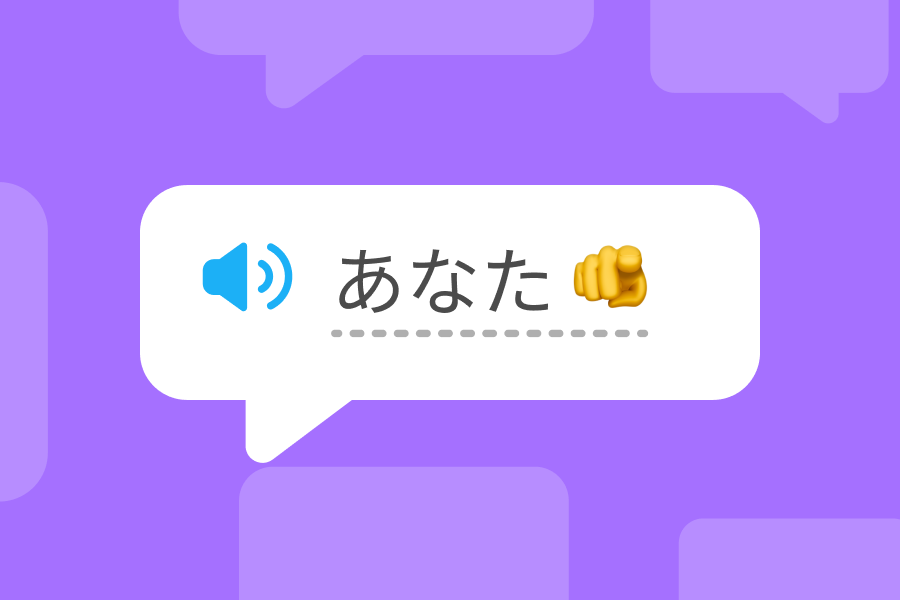
If you’re learning Japanese, you may know that あなた (anata) means you. But watch out—Japanese speakers rarely use this pronoun in everyday conversation! And when they do, it can convey different emotions depending on the context. Let’s look at how Japanese handles second-person references in general, and when あなた (anata) is actually appropriate.
How Japanese speakers say you
Some languages (like English) rely heavily on the second person pronoun you—you’ll see and hear it everywhere. Japanese, however, treats these references very differently. While there are a few Japanese pronouns that mean you, it is much more common to choose one of three strategies that don’t use a pronoun:
Using the person’s name and honorific
Calling someone by their name and a honorific like さん (san) or ちゃん (chan) is often the most common and socially smooth option. For example, you might say 田中さんは?(Tanaka‑san wa?), meaning How about (you), Mr. Tanaka? Instead of saying “you” directly, you address the person as Tanaka-san (Mr. Tanaka).
Using a role or relationship term
Addressing someone with a term like 先生 (sensei, teacher), 部長 (buchō, manager), or お母さん (okaasan, mom) feels natural, but respectful. You could say それは先生の車ですか。(Sore wa Sensei no kuruma desu ka?), meaning Is that (your) teacher’s car? to ask about the owner of the car in a polite way, and without using a direct you(r).
Omitting the subject entirely
Japanese grammar allows you to leave out the subject entirely, especially in more casual situations. However, this is only possible when the context makes it clear who the subject is! For example, when you’re talking to a friend, you could ask them お腹空いた?(Onaka suita?), meaning (Are you) hungry?
When it’s appropriate to use あなた (anata)
In polite or formal situations
In customer service, presentations, or formal writing, あなた (anata) can function as a respectful you when you don’t know the listener’s name. It sounds polite but somewhat distant, so it’s appropriate for strangers, but not for colleagues or friends.
When you want to create emotional distance
Because あなた (anata) can feel impersonal, it can signal coolness or detachment. Depending on your tone, it may come across as pointed or even confrontational.
As a term of endearment between couples
In romantic contexts, a woman can use あなた (anata) to address her husband, similar to dear or honey in English.
Beware: あなた can sound rude or aggressive!
In casual speech, especially among men, あなた (anata) can sound stiff or accusatory if used unexpectedly. In these types of situations, tone and context determine whether it feels confrontational.
You set the tone
The pronoun あんた (anata) may look simple, but it carries a surprising amount of social nuance that depends entirely on the relationship and situation. Understanding when to use it—and when to avoid it—is just as important as knowing what it means!