
The passé composé is one of the most important verb tenses in French, but it can be confusing for learners! In this guide, we’ll tell you all about passé composé conjugation, as well as when to use it, and important exceptions.
In this post:
- What is the passé composé?
- How do you conjugate passé composé?
- Passé composé with avoir
- Passé composé with être
- Verbs that can take avoir or être
- Negation of passé composé
- Examples of regular past participles
- Examples of irregular past participles
What is the passé composé?
The passé composé is one way to talk about things in the past in French, and it’s an important one to know! For example, the phrase J’ai mangé, from manger (to eat) can be used as the equivalent of any of these three English phrases:
- I ate
- I did eat
- I have eaten
How do you conjugate passé composé?
The passé composé requires two parts: an auxiliary verb, and the past participle of the verb you want to use. For example, the past participle of eat is eaten.
The auxiliary verb, or “helping verb,” is always either avoir (to have) or être (to be). Most verbs take avoir, while être is limited to certain verbs and certain verb forms.
Forming the past participle
French verbs are divided into three categories, depending on the last two letters of their infinitive form: -er verbs, -ir verbs, and -re verbs. Regular past participles of each of these verb categories are formed as follows:
| -er verbs | -ir verbs | -re verbs | |
|---|---|---|---|
| Infinitive | manger to eat |
finir to finish |
attendre to wait (for) |
| Past participle | mangé | fini | attendu |
| Example sentence | J’ai mangé des pâtes. I ate pasta. |
J’ai fini mes devoirs. I finished my homework. |
J’ai attendu le bus. I waited for the bus. |
There are also many important irregular past participles to learn. Check out our table of common irregular past participles at the end of this post!
Passé composé with avoir
Most verbs use the auxiliary verb avoir in passé composé. Here’s how it looks with the verb fermer (to close):
| Pronoun | Form of avoir | Past participle of fermer | Example sentence |
|---|---|---|---|
| je | ai | fermé | J’ai fermé la fenêtre. I closed the window. |
| tu | as | Tu as fermé la fenêtre. You closed the window. |
|
| il elle on |
a | Il a fermé la fenêtre. He closed the window. Elle a fermé la fenêtre. She closed the window. On a fermé la fenêtre. We closed the window. |
|
| nous | avons | Nous avons fermé la fenêtre. We closed the window. |
|
| vous | avez | Vous avez fermé la fenêtre. You (all) closed the window. |
|
| ils elles |
ont | Ils ont fermé la fenêtre. They closed the window. Elles ont fermé la fenêtre. They closed the window. |
Passé composé with être
A small number of verbs use être instead of avoir as an auxiliary verb, and you can remember them using the DR. & MRS. VANDERTRAMPP acronym:
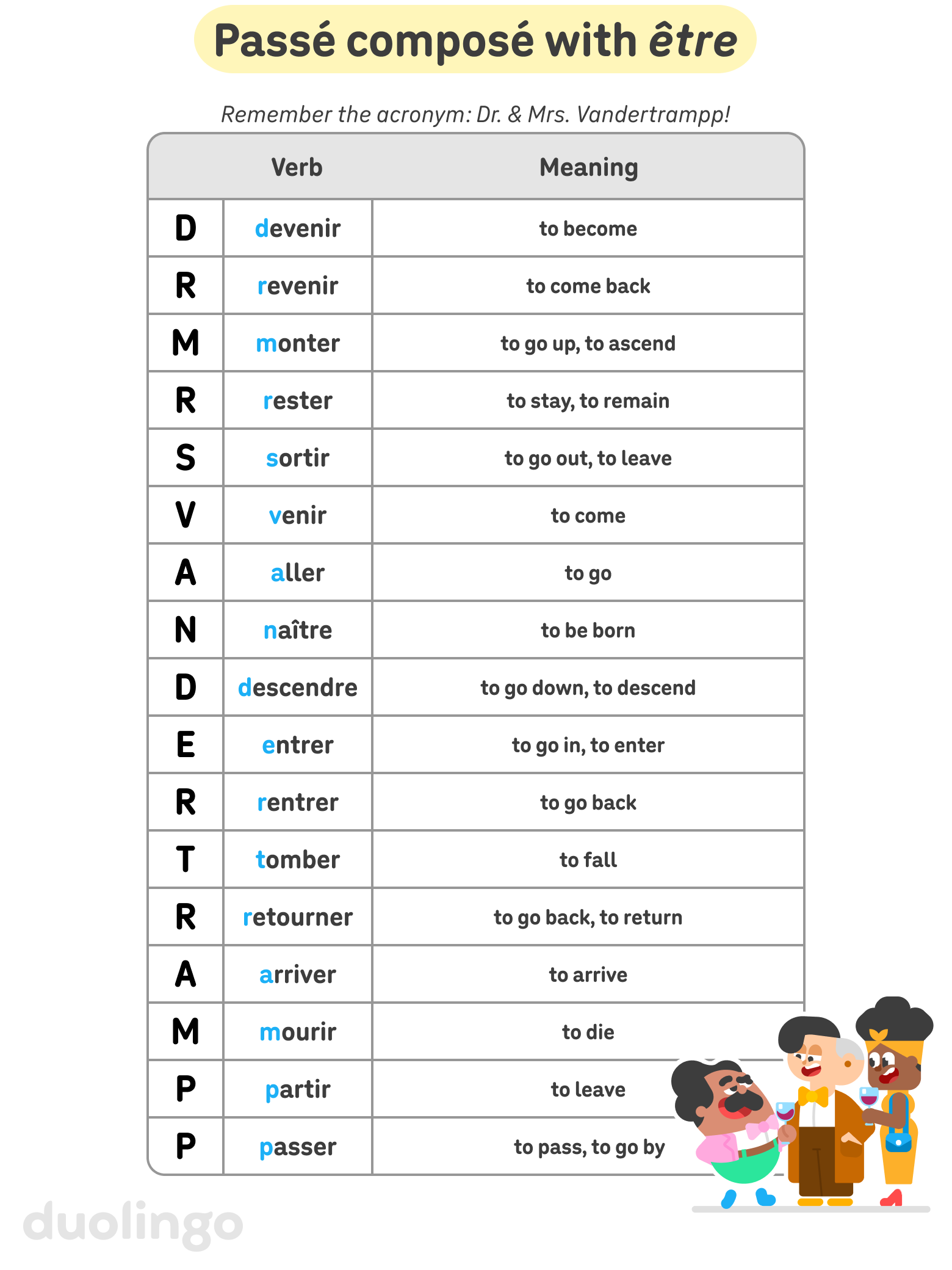
Here are the past participles for all of the “Dr. & Mrs. Vandertrampp” verbs that take être in the passé composé:
| Infinitive | Past participle | Example sentence |
|---|---|---|
| devenir | devenu | Je suis devenu comptable. I became an accountant. |
| revenir | revenu | Je suis revenu de mes vacances lundi. I came back from vacation on Monday. |
| monter | monté | Je suis monté au quatrième étage. I went up to the fourth floor. |
| rester | resté | Je suis resté chez moi samedi. I stayed at home on Saturday. |
| sortir | sorti | Je suis sorti me balader. I went out to go for a walk. |
| venir | venu | Je suis venu parce que je voulais te voir. I came because I wanted to see you. |
| aller | allé | Je suis allé au Mexique l’année dernière. I went to Mexico last year. |
| naître | né | Je suis né à Paris. I was born in Paris. |
| descendre | descendu | Je suis descendu au sous-sol. I went down to the basement. |
| entrer | entré | Je suis entré dans cette maison. I went into that house. |
| rentrer | rentré | Je suis rentré à la maison vers minuit. I got back to the house around midnight. |
| tomber | tombé | Je suis tombé, mais je ne suis pas blessé. I fell, but I’m not injured. |
| retourner | retourné | Je suis retourné au Maroc cet été. I went back to Morocco this summer. |
| arriver | arrivé | Je suis arrivé à l’heure pour mon vol. I arrived on time for my flight. |
| mourir | mort | Je suis mort de rire. I died of laughter. |
| partir | parti | Je suis parti du parc vers dix heures. I left the park around ten o’clock. |
| passer | passé | Je suis passé par ton bureau ce matin. I passed by your office this morning. |
Agreement with the past participle
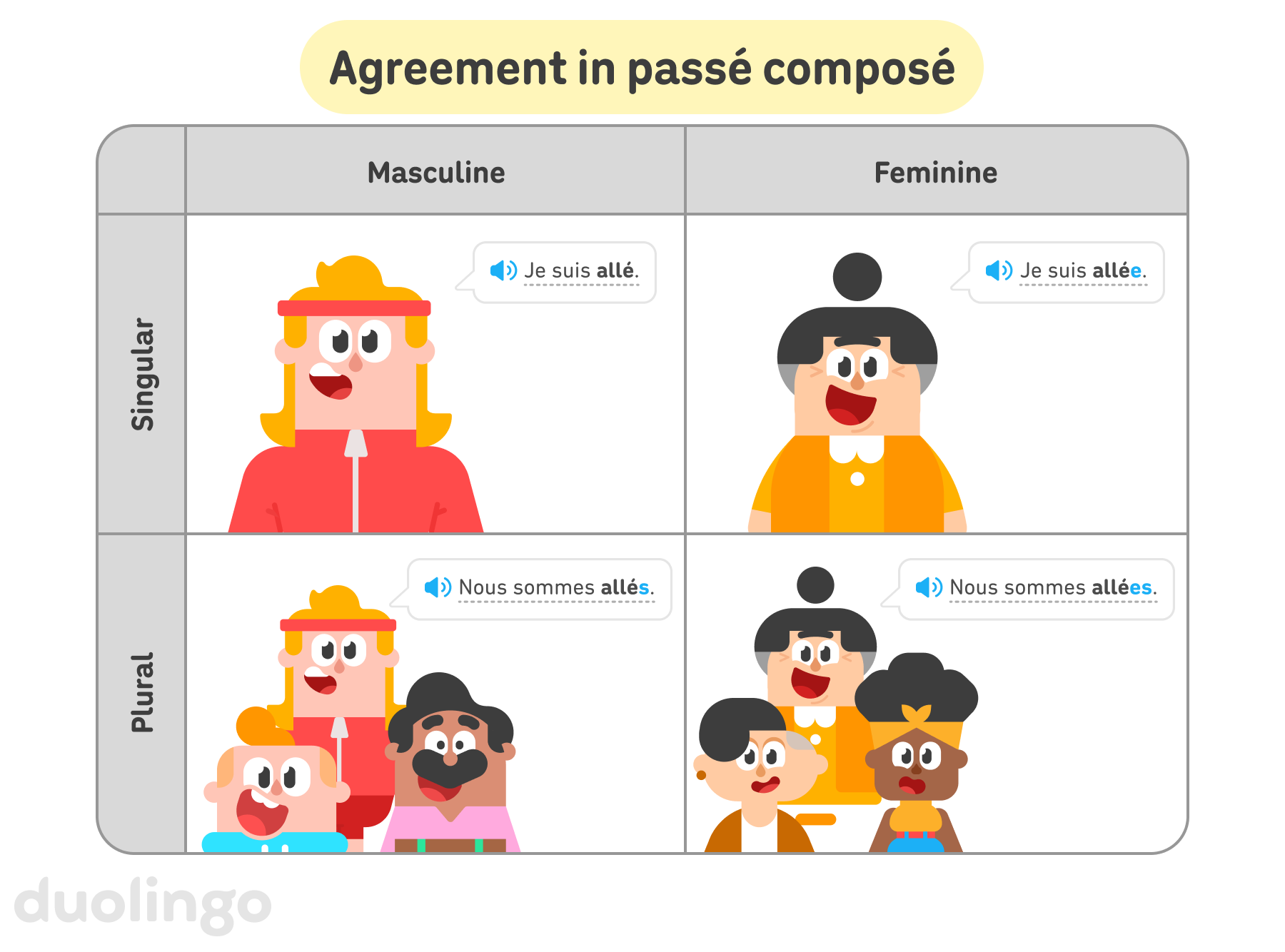
There’s one more important thing to know about the past participles above that go with être in the passé composé: If the subject is feminine or plural, their endings change to reflect this!
| Original sentence | Subject | New sentence | Subject |
|---|---|---|---|
| Je suis devenu comptable. I became an accountant. |
 |
Je suis devenue comptable. I became an accountant. |
 |
| Je suis sorti me balader. I went out to go for a walk. |
|
Nous sommes sortis nous balader. We went out to go for a walk. |
 |
| Je suis né à Paris. I was born in Paris. |
|
Nous sommes nées à Paris. We were born in Paris. |
 |
Here’s a comparison showing each form the past participle allé (from aller, to go) can take, depending on the gender and number of the subject:
Verbs that can take avoir or être
Transitive vs. intransitive verbs
Even though the “Dr. & Mrs. Vandertrampp” verbs generally take être, there is one context where they take avoir instead: If they have a direct object (in other words, if they’re transitive), they’ll go with avoir!
Here are some examples:
| Intransitive verb with être | Transitive verb with avoir |
|---|---|
| Je suis monté au quatrième étage. I went up to the fourth floor. |
J’ai monté l’escalier jusqu’au quatrième étage. I went up the stairs to the fourth floor. Direct object: l’escalier (the stairs) |
| Je suis sorti me balader. I went out to go for a walk. |
J’ai sorti la voiture du garage. I took the car out of the garage. Direct object: la voiture (the car) |
| Je suis passé par ton bureau ce matin. I passed by your office this morning. |
J’ai passé du temps avec mon frère. I spent time with my brother. Direct object: du temps (time) |
Pronominal verbs
There is also one context in which verbs that typically take avoir in the passé composé take être instead: when they become reflexive or reciprocal (together, these are called pronominal verbs)—in other words, when the subject and the direct object are the same person or thing.
For example, Je lave la vaisselle (I wash the dishes) isn’t reflexive—the subject is je (I) and the direct object is la vaisselle (the dishes), but Je me lave les cheveux (I wash my hair) is reflexive in French, because the subject is je (I), and the object—mes cheveux (my hair)—is something that inextricably belongs to you.
Reciprocal verbs work similarly: J’aime mon chien (I love my dog) isn’t reciprocal, because the subject is je (I) and the direct object is mon chien (my dog), but Mon chat et mon chien s’aiment (My cat and my dog love each other) is reciprocal, because mon chat (my cat) and mon chien (my dog) represent both the subjects and the direct objects of the sentence.
Note: When a pronominal verb is in the passé composé, the past participle has to agree with the subject, just like any other verb that uses être in the passé composé!
Here are some examples of how this works in the passé composé:
| Non-pronominal verbs with avoir | Pronominal verbs with être |
|---|---|
| J’ai regardé les photos. I looked at the photos. |
Je me suis regardée dans le miroir. I looked at myself in the mirror. |
| Tu as cassé la fenêtre. You broke the window. |
Tu t’es cassé le bras. You broke your [own] arm. |
| Elle a réveillé sa colocataire. She woke up her roommate. |
Elle s’est réveillée à huit heures. She woke [herself] up at eight o’clock. |
| Nous avons compris la leçon. We understood the lesson. |
Nous nous sommes compris immédiatement. We immediately understood each other. |
| Vous avez rencontré ma tante. You (all) met my aunt. |
Vous vous êtes rencontrés en 2007. You (all) met each other in 2007. |
| Elles ont téléphoné au maire. They called the mayor. |
Elles se sont téléphonées tous les jours. They called each other every day. |
Negation of passé composé
Now we know how to talk about what did happen in the past, but what about what didn’t happen? Since the passé composé requires two different parts (a form of avoir or être, plus a past participle), negation in the passé composé works a little bit differently than in many other tenses!
If there’s an object pronoun in the sentence, like me (me or to me), te (you or to you), etc., those go after the ne as well!
Here are some examples:
| Affirmative passé composé | Negated passé composé |
|---|---|
| Alice a écrit un livre. Alice wrote a book. |
Alice n’a pas écrit un livre. Alice didn’t write a book. |
| Paolo est parti tôt. Paolo left early. |
Paolo n’est pas parti tôt. Paolo didn’t leave early. |
| Hélène m’a parlé. Hélène talked to me. |
Hélène ne m’a pas parlé. Hélène didn’t talk to me. |
| Laurent s’est brossé les dents. Laurent brushed his teeth. |
Laurent ne s’est pas brossé les dents. Laurent didn’t brush his teeth. |
But there are other important negation phrases besides ne… pas! There’s ne… jamais (never), ne… plus (not anymore), ne… rien (nothing), ne… que (only, no more than), and ne… personne (nobody). Of these, ne… jamais, ne… plus, and ne… rien go around the auxiliary verb only, while ne… que and ne… personne go around the auxiliary verb and the past participle. Here are some examples:
| Affirmative passé composé | Negated passé composé | Position of negation |
|---|---|---|
| Marie est allée en Italie. Marie went to Italy. |
Marie n’est jamais allée en Italie. Marie never went to Italy. |
Around être or avoir only |
| Karim est retourné au Canada. Karim went back to Canada. |
Karim n’est plus retourné au Canada. Karim didn’t go back to Canada anymore. |
|
| Sandrine a cuisiné ce plat. Sandrine cooked this dish. |
Sandrine n’a rien cuisiné. Sandrine didn’t cook anything. |
|
| Antoine a lu trois livres. Antoine read three books. |
Antoine n’a lu que trois livres. Antoine only read three books. |
Around être or avoir and the past participle |
| Céline a vu sa famille. Céline saw her family. |
Céline n’a vu personne. Céline didn’t see anybody. |
Note: Remember that you’re most likely to see ne in written or formal French. It’s often dropped in everyday, casual, or spoken French!
Leave your doubts in the passé!
The passé composé might seem like a lot of rules, but the more you practice, the easier it gets! And you can refer to this post or any of our other tips for learning French whenever you need a refresher 😉
- 8 slang words you’ll hear in France
- How French accent marks can help improve your pronunciation
- 3 ways to form questions in French
- How do you know what sounds French letters make?
Common regular past participles
Here’s a table of some of the most common verbs in French with regular past participles. Just keep in mind the patterns for -er, -ir, and -re verbs, and you’ll be able to form these past participles with no problem!
| Infinitive | Past participle *Forms with an asterisk go with être in the passé composé |
|---|---|
| acheter to buy |
acheté |
| adorer to love |
adoré |
| aider to help |
aidé |
| aimer to like, to love |
aimé |
| ajouter to add |
ajouté |
| aller to go |
allé* |
| appeler to call |
appelé |
| arrêter to stop |
arrêté |
| arriver to arrive |
arrivé* |
| attendre to wait (for) |
attendu |
| brosser to brush |
brossé |
| casser to break |
cassé |
| changer to change |
changé |
| chercher to look for |
cherché |
| choisir to choose |
choisi |
| commencer to start, to begin |
commencé |
| cuisiner to cook |
cuisiné |
| danser to dance |
dansé |
| descendre to go down, to descend |
descendu* |
| demander to ask (for) |
demandé |
| donner to give |
donné |
| dormir to sleep |
dormi |
| écouter to listen (to) |
écouté |
| entendre to hear |
entendu |
| entrer to go in, to enter |
entré* |
| essayer to try |
essayé |
| étudier to study |
étudié |
| fermer to close |
fermé |
| finir to finish |
fini |
| gagner to win |
gagné |
| garder to keep |
gardé |
| inviter to invite |
invité |
| jouer to play |
joué |
| laisser to leave (behind) |
laissé |
| laver to wash |
lavé |
| manger to eat |
mangé |
| marcher to walk |
marché |
| monter to go up |
monté* |
| montrer to show |
montré |
| nettoyer to clean |
nettoyé |
| oublier to forget |
oublié |
| parler to speak, to talk |
parlé |
| partir to leave |
parti* |
| passer to spend, to pass |
passé* |
| payer to pay |
payé |
| penser to think |
pensé |
| perdre to lose |
perdu |
| porter to carry, to wear |
porté |
| préparer to prepare |
préparé |
| regarder to watch, to look at |
regardé |
| rencontrer to meet |
rencontré |
| rendre to give back, to return |
rendu |
| rentrer to go back |
rentré* |
| répéter to repeat |
répété |
| répondre to respond, to reply |
répondu |
| rester to stay, to remain |
resté* |
| retourner to go back, to return |
retourné* |
| réveiller to wake (someone) up |
réveillé |
| sentir to feel, to smell |
senti |
| sortir to go out, to leave |
sorti* |
| téléphoner to call (on the phone) |
téléphoné |
| tomber to fall |
tombé* |
| travailler to work |
travaillé |
| trouver to find |
trouvé |
| vendre to sell |
vendu |
| visiter to visit |
visité |
Common irregular past participles
The verbs in this table all have irregular past participles, but they’re some of the most common verbs in French, so you’ll get plenty of practice with them!
| Infinitive | Past participle *Forms with an asterisk go with être in the passé composé |
|---|---|
| apprendre to learn |
appris |
| avoir to have |
eu |
| boire to drink |
bu |
| comprendre to understand |
compris |
| conduire to drive |
conduit |
| connaître to know, to be familiar with |
connu |
| courir to run |
couru |
| croire to believe |
cru |
| devenir to become |
devenu* |
| devoir to have to, must |
dû |
| dire to say, to tell |
dit |
| écrire to write |
écrit |
| être to be |
été |
| faire to make, to do |
fait |
| lire to read |
lu |
| mettre to put, to put on |
mis |
| mourir to die |
mort* |
| naître to be born |
né* |
| pouvoir to be able to, can |
pu |
| prendre to take |
pris |
| recevoir to receive |
reçu |
| revenir to come back |
revenu* |
| rire to laugh |
ri |
| savoir to know |
su |
| venir to come |
venu* |
| vivre to live |
vécu |
| voir to see |
vu |
| vouloir to want |
voulu |