📣 Certify your English today with Duolingo English Test—anytime, anywhere.
The simple present is one of the most common tenses in English. While it may at first seem pretty, well, simple, there’s still plenty to understand.
Here’s everything you need to know about the simple present tense!
In this post:
- When to use the English present tense
- How to conjugate the simple present
- Keywords for the simple present
- List of English verbs in the simple present
What is the English present tense and when do you use it?
The simple present tense is used for:
1. Actions that happen regularly or habitually
I do laundry on Wednesdays.
We watch a movie once a week.
Eddy goes to the gym every day.
2. General truths and stative verbs (for example want, think, and have)
They never eat meat.
Junior loves ice cream.
I have a sister.
3. Scheduled events
My train arrives at 5 o’clock.
That new bookstore opens this weekend.
The wedding is at noon tomorrow.
How do you conjugate English verbs in the simple present?
Luckily, verbs in the simple present tense mostly stay the same no matter the subject of the sentence. In fact, for the subjects I, you, we, and they, you use the base form of the verb to form the simple present.
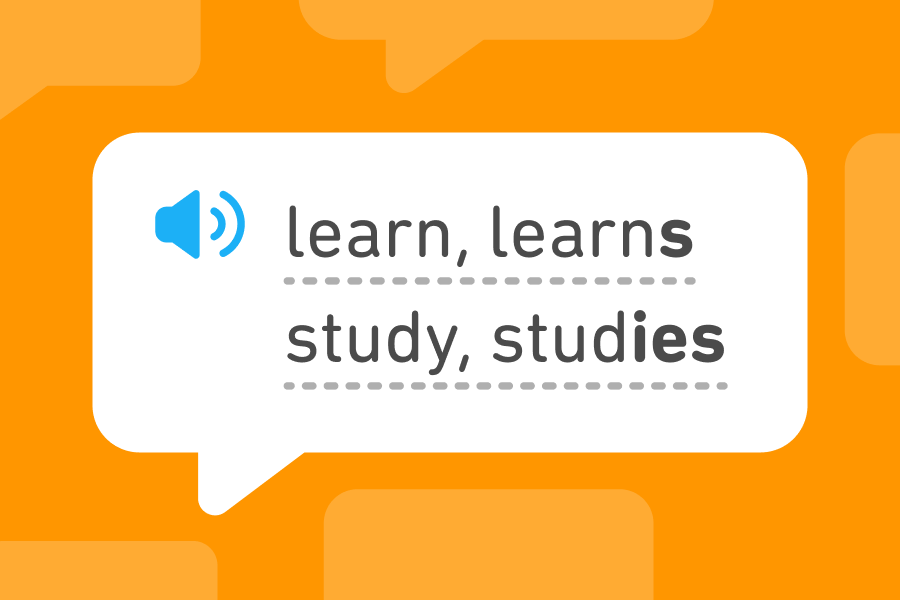
However, there is one important exception:
For example:
| SUBJECT | VERB to work |
|---|---|
| I | work |
| you | work |
| he/she/it | works |
| we | work |
| you (plural) | work |
| they | work |
Spelling changes for the third person singular
There are special spelling rules that must be followed for certain verbs in the third person singular (he/she/it).
| SUBJECT | EXAMPLE |
|---|---|
| I, you, we, they | I brush my teeth. |
| he/she/it | He brushes his teeth. |
Pronunciation of the third person singular
The pronunciation of the third person singular -s can be tricky because it changes depending on the sound that comes before it. (Remember to think about the last sound and not the last letter—they won’t always be the same in English!)
If a verb ends in a voiced sound (one in which you vibrate your vocal folds, such as “b”), the -s at the end of the word is pronounced like the “z” in zoo.
If a verb ends in a voiceless sound (one in which you don’t vibrate your vocal folds, like “p”), the -s at the end of the word is pronounced like the “s” in sun.
Finally, if a verb ends in a sibilant sound (such as “s”), the third person singular ending is a whole syllable, pronounced “-iz”, like the word is.
| FINAL SOUND: VOICED -s pronounced as “z” (like in zoo) |
|
|---|---|
| SOUNDS | EXAMPLES |
| “b” “d” “g” “l” “m” “n” “r” “th” (as in the) “v” “w” “y” all vowel sounds |
grabs reads begs falls aims runs cheers bathes waves knows buys sees |
| FINAL SOUND: VOICELESS -s pronounced as “s” (like in sun) |
|
|---|---|
| SOUNDS | EXAMPLES | “p” “t” “k” “f” |
hopes starts likes stuffs |
| FINAL SOUND: SIBILANT -es pronounced as “iz” (like the word is) |
|
|---|---|
| SOUNDS | EXAMPLES |
| “s” “sh” “ch” “dj” “z” |
kisses wishes watches judges buzzes |
The verb to be in the simple present tense
The verb to be is irregular in the simple present tense:
| SUBJECT | FORM OF TO BE | EXAMPLES |
|---|---|---|
| I | am | I am happy. |
| you (singular) | are | You are my brother. |
| he/she/it | is | It is Monday today. |
| we | are | We are at school right now. |
| you (plural) | are | You are my friends. |
| they | are | They are on the floor. |
Negation of the simple present tense
Negative sentences in the simple present are formed as follows:
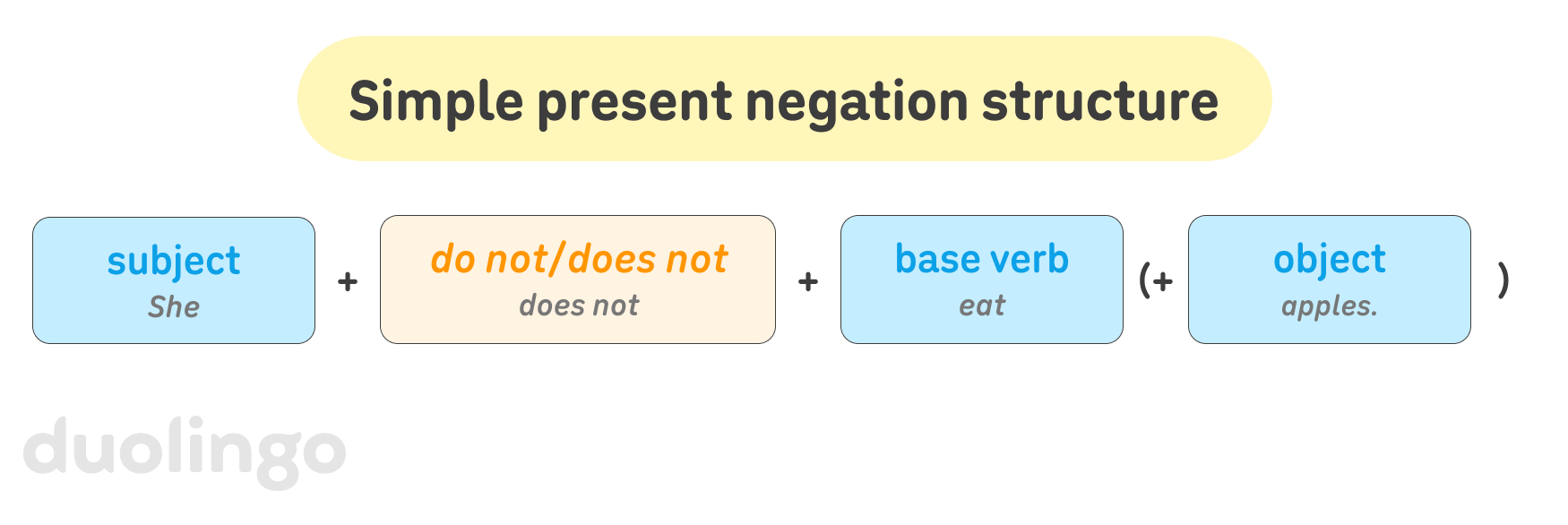
Do not is used for the subjects I, you, we, and they, and does not is used for the subjects he/she/it.
| SUBJECT | NEGATIVE SIMPLE PRESENT | EXAMPLE |
|---|---|---|
| I | do not + base verb | I do not watch TV. |
| you | do not + base verb | You do not watch TV. |
| he/she/it | does not + base verb | She does not watch TV. |
| we | do not + base verb | We do not watch TV. |
| you (plural) | do not + base verb | You do not watch TV. |
| they | do not + base verb | They do not watch TV. |
In addition, do not is often contracted to form the word don’t, and does not is often contracted to form the word doesn’t.
| SUBJECT | NEGATIVE SIMPLE PRESENT WITH CONTRACTION | EXAMPLE |
|---|---|---|
| I | don’t + base verb | I don’t like winter. |
| you | don’t + base verb | You don’t like winter. |
| he/she/it | doesn’t + base verb | She doesn’t like winter. |
| we | don’t + base verb | We don’t like winter. |
| you (plural) | don’t + base verb | You don’t like winter. |
| they | don’t + base verb | They don’t like winter. |
Questions in the simple present tense
English has different rules for forming different types of questions, and there are present tense versions of each question type!
Questions with to be
In yes/no questions with to be, the subject follows the form of to be:
| QUESTION | Are you hungry? |
|---|---|
| ANSWER | Yes, I’m hungry. |
Wh-questions with to be begin with a question word, followed by a form of to be and the subject:
| QUESTION | When is the concert? |
|---|---|
| ANSWER | The concert is on Friday. |
Questions with other verbs
Yes/no questions with other verbs begin with do/does, followed by the subject and the base verb:
| QUESTION | Does Junior like ice cream? |
|---|---|
| ANSWER | Yes, Junior likes ice cream. |
Wh-questions with other verbs begin with a question word, followed by do/does, the subject, and finally the base verb:
| QUESTION | When does Vikram come home from work? |
|---|---|
| ANSWER | Vikram usually comes home from work at 6 pm. |
Keywords that signal the simple present
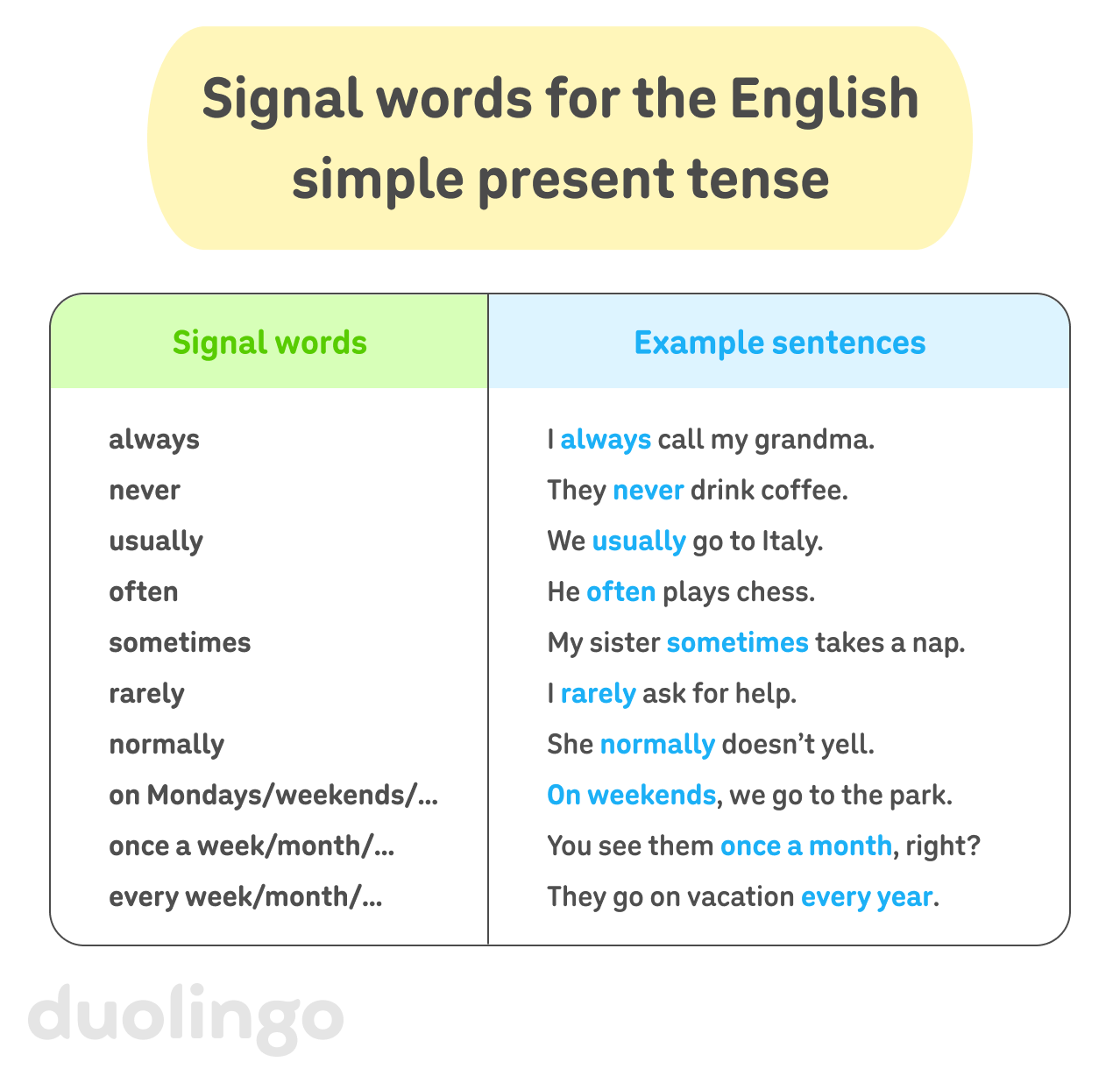
There are certain words that are often used with the simple present. These signal words are great clues to help you know when to use this tense.
- always
- never
- usually
- often
- sometimes
- rarely
- normally
- on ___
- on Mondays(on Tuesdays,on Wednesdays, etc.)
- on weekends
- once a ___ (twice a ___, three times a ___, etc.)
- once a day
- twice a week
- three times a month
- once a year
- every ___
- every day
- every morning
- every month
- every year
- every Monday(every Tuesday,every Wednesday, etc.)
- every week
List of English verbs in the simple present tense
The table below will help you understand how verbs change in the simple present tense!
| BASE VERB | I, YOU, WE, THEY | HE/SHE/IT |
|---|---|---|
| argue | argue | argues |
| ask | ask | asks |
| become | become | becomes |
| begin | begin | begins |
| believe | believe | believes |
| bite | bite | bites |
| blow | blow | blows |
| break | break | breaks |
| bring | bring | brings |
| build | build | builds |
| burn | burn | burns |
| buy | buy | buys |
| call | call | calls |
| carry | carry | carries |
| catch | catch | catches |
| change | change | changes |
| choose | choose | chooses |
| clean | clean | cleans |
| climb | climb | climbs |
| come | come | comes |
| continue | continue | continues |
| cook | cook | cooks |
| cost | cost | costs |
| cry | cry | cries |
| decide | decide | decides |
| die | die | dies |
| do | do | does |
| draw | draw | draws |
| drink | drink | drinks |
| drive | drive | drives |
| drop | drop | drops |
| dry | dry | dries |
| eat | eat | eats |
| enjoy | enjoy | enjoys |
| fall | fall | falls |
| feed | feed | feeds |
| feel | feel | feels |
| fight | fight | fights |
| find | find | finds |
| finish | finish | finishes |
| forget | forget | forgets |
| fly | fly | flies |
| get | get | gets |
| give | give | gives |
| go | go | goes |
| grow | grow | grows |
| hang | hang | hangs |
| hate | hate | hates |
| have | have | has |
| hear | hear | hears |
| help | help | helps |
| hit | hit | hits |
| hurt | hurt | hurts |
| invite | invite | invites |
| join | join | joins |
| jump | jump | jumps |
| keep | keep | keeps |
| kick | kick | kicks |
| kill | kill | kills |
| kiss | kiss | kisses |
| know | know | knows |
| laugh | laugh | laughs |
| lay | lay | lays |
| lead | lead | leads |
| learn | learn | learns |
| leave | leave | leaves |
| lend | lend | lends |
| let | let | lets |
| lie | lie | lies |
| like | like | likes |
| live | live | lives |
| look | look | looks |
| lose | lose | loses |
| love | love | loves |
| make | make | makes |
| marry | marry | marries |
| mean | mean | means |
| meet | meet | meets |
| melt | melt | melts |
| miss | miss | misses |
| mix | mix | mixes |
| move | move | moves |
| need | need | needs |
| open | open | opens |
| pass | pass | passes |
| pay | pay | pays |
| play | play | plays |
| promise | promise | promises |
| put | put | puts |
| read | read | reads |
| remember | remember | remembers |
| return | return | returns |
| ride | ride | rides |
| ring | ring | rings |
| rise | rise | rises |
| run | run | runs |
| say | say | says |
| see | see | sees |
| seem | seem | seems |
| sell | sell | sells |
| send | send | sends |
| shake | shake | shakes |
| shout | shout | shouts |
| sing | sing | sings |
| sink | sink | sinks |
| sit | sit | sits |
| sleep | sleep | sleeps |
| smell | smell | smells |
| smile | smile | smiles |
| speak | speak | speaks |
| spell | spell | spells |
| start | start | starts |
| stay | stay | stays |
| steal | steal | steals |
| stick | stick | sticks |
| stop | stop | stops |
| study | study | studies |
| swim | swim | swims |
| take | take | takes |
| talk | talk | talks |
| teach | teach | teaches |
| tell | tell | tells |
| think | think | thinks |
| throw | throw | throws |
| touch | touch | touches |
| travel | travel | travels |
| try | try | tries |
| turn | turn | turns |
| understand | understand | understands |
| use | use | uses |
| wake | wake | wakes |
| want | want | wants |
| watch | watch | watches |
| wear | wear | wears |
| win | win | wins |
| wish | wish | wishes |
| work | work | works |
| write | write | writes |
There’s no time like the present
Keep looking out for certain keywords, and with a little practice, you’ll be prepared to use the simple present tense with confidence!
Bookmark these other posts about the most common verb forms:
Feeling more confident with your grammar? Take the next step by certifying your English proficiency with the Duolingo English Test. It’s fast, affordable, and accepted by thousands of institutions worldwide.