Welcome to another week of Dear Duolingo, an advice column just for learners. Catch up on past installments here.
Hello, language lovers! I’m Lindsey Lange-Abramowitz, stepping in for this week’s Dear Duolingo. You may have seen my posts about English verbs, adjectives, and adverbs, but today I’ll be talking about a common misconception about language teaching—so common, in fact, that I once believed it too. No shame here!
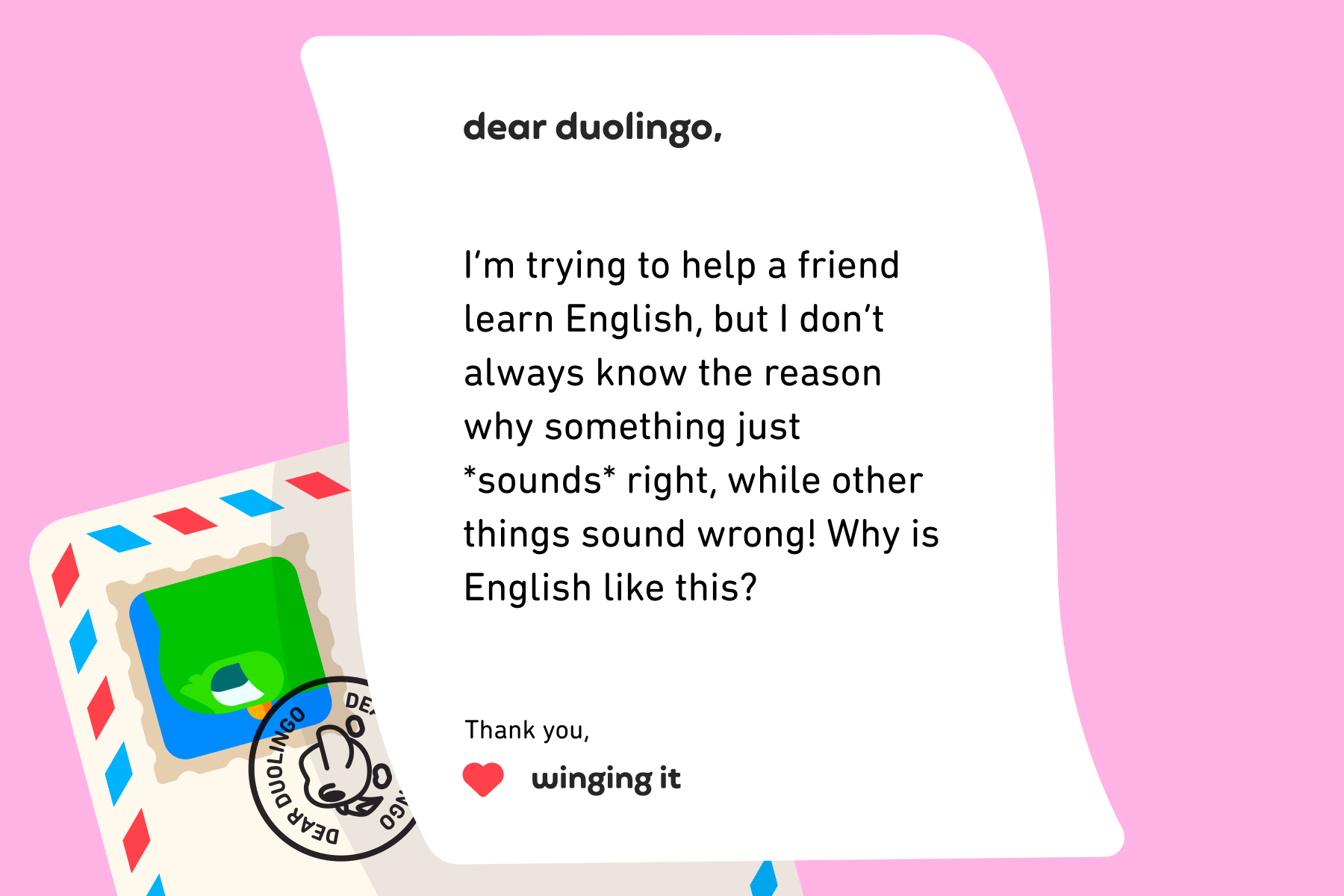
Our question this week:
I found this out the hard way! In fact, when I applied for my first teaching job almost twenty years ago with no language teaching experience whatsoever, I thought to myself, “I speak English. What else would I need to know?”
However, when I got an interview and the school director asked: “What is the difference between the simple past and the present perfect?”, a bead of sweat inched down my back as I stammered through a long, nonsensical answer.
I did not get the job.
After that, I bought a book for teachers of English as a new language. As I studied the guide, I realized with each new chapter how little I knew about the inner workings of my mother tongue. It was like discovering that somehow I was able to play Rachmaninoff’s Piano Concerto No. 3 without ever learning a single chord simply because I had heard it in concert.
As it turns out, every language has quirks that go unnoticed by the people who grow up speaking it, but cause huge headaches for those who learn it later in life. Here are a few of my favorite examples from English!
Learning the many quirks of English
Verbs
I was fascinated by all the quirks of this language I had spoken my entire life—and astonished by the linguistic secrets my brain had been keeping from me all these years. For example, did you know that some English verbs transform into nouns by simply shifting the stress to the first syllable? If you’ve spoken English since you were a kid, this might be news to you… but English learners are used to studying this explicitly! (Try saying this sentence out loud: I can’t permit you to get your driver’s permit. Or: They’ll record your new world record.)
Meanwhile, other verbs metamorphosize just by adding a preposition to the end of them. You might understand the word make and the word out, but put them together, and you’ve suddenly got a meaning very different from these words on their own! (Switch out the preposition a few more times to create make up, make off with, and make over, and you suddenly have the trappings of a stellar soap opera plotline.)
Adjectives
After spending a week studying what I thought I already knew about English, I was convincing enough in an interview to be hired by a director desperate for teachers. Once in front of a classroom, though, I was still comically ill-prepared! Even the ordering of words, a seemingly simple enough task, was enough to leave me stumped. Why was a gigantic yellow spider a perfectly grammatical (if not horrifying) phrase, but a yellow gigantic spider somehow sounded wrong? Questions like this left me muttering strings of adjectives to myself over and over hoping to stumble upon an answer.
I turned back to my guidebook where there was a whole chapter on adjective order. Apparently, in my earliest days tottering around the Earth, my subconscious had discreetly tucked away a list dictating the order of adjectives, like an efficient 1950s secretary filing away important notes for her bumbling boss. From this list, my brain knew that size adjectives (like gigantic) generally appear before color adjectives (like yellow). Hence why we say gigantic yellow spider and not the other way around.
In English, the order of adjectives usually goes: determiners, opinion, size, age, shape, color, origin, material, purpose. For someone like me who can rarely retain a stranger’s name at a cocktail party for more than seven seconds, the fact that I keep this list in my head felt like the most improbable of feats.
But it wasn’t. Every native English speaker does it! Still, a hit of dopamine surged through my body with this new linguistic awakening.
Nouns
Now, after a master’s degree in the subject, a decade or so in the classroom, and four years writing for Duolingo, my favorite discovery will forever be this: In English, certain things (like pencils, fingers, and ex-husbands) are countable. Others (like champagne, mud, and pickle juice) cannot be counted. This part you perhaps already realize.
But here’s where things get admirably zany: Certain items are countable in some situations but not others. Like when you visit your local chicken farm, you might inquire, “How many chickens do you have in this coop?” and the farmer might reply “14” or perhaps “132.” But if you serve those same birds for dinner, then bam! Chicken is now a noncount noun.
This is why over a platter of chicken fricassee I would never ask my dining partner, “How many chickens would you like?” Instead, I subconsciously know to ask the noncount equivalent, “How much chicken would you like?” Because even though I had never given it a single thought, I understood that in English, live chickens are countable, but dead ones on a dinner plate? Strictly uncountable!
Teaching your own language can be tricky—and rewarding!
These surprising little quirks (and not little surprising quirks 😅) about English are one reason teaching English—or any language—might not be as straightforward as at first it seems. But it also can be one of the most interesting, enriching jobs you have. It certainly is for me! And that’s something you just can’t, well, make up! 😉
For more answers to your language and learning questions, get in touch with us by emailing dearduolingo@duolingo.com.