
If you’re studying Spanish, you’ve probably already noticed that there are multiple ways to say you. We’ve talked about vosotros (which often takes the place of ustedes in Spain), but what about when you’re just addressing one person?
Read on to learn the basics of tú, usted… and another important regional pronoun, vos!
In this post:
What’s the difference between tú and usted?
What about vos?
How do I know when to use tú, usted, or vos?
What if I use the wrong pronoun?
How to conjugate tú, usted, and vos
What’s the difference between tú and usted?
Generally, tú is an informal way to address someone, like a close friend or family member. Meanwhile, usted is formal, reserved for strangers, authority figures, or anyone you need to show a little extra respect to. Other languages (including French, German, Japanese, and many others) have similar ways of addressing people based on how formal or informal the relationship is, but in English, we don’t have an easy equivalent!
Tú and usted also take different verb forms. Tú is conjugated in the second-person singular, while usted is conjugated in the third-person singular. That’s because usted comes from a shortened version of the phrase vuestra merced, literally your mercy, similar to phrases like your grace or your honor!
So while you’ll say tú eres (you are) when speaking informally, you’d say usted es when speaking formally—and es is the same verb you’d use when saying él es (he is) and ella es (she is).
What about vos?
Vos is synonymous with tú: It’s a second-person singular pronoun used in informal situations. But if you’ve never heard it before, don’t fret! It’s much more common in some Spanish-speaking countries than others, and even among the countries that use vos, it’s sometimes limited to certain regions or contexts.
Vos is most closely associated with Argentina, Uruguay, and Paraguay, but you can also hear it in other regions throughout Latin America! In some places—like Argentina—it’s the most common way to say you, but in others it’s stigmatized as “incorrect” (even though we know language attitudes like this are harmful and completely arbitrary!).
Vos also has different conjugations than tú and usted in the present tense and command verb forms, which we’ll discuss in more detail at the end of this post.
How do I know when to use tú, usted, or vos?
There’s a lot of variation in the Spanish-speaking world, so there’s no one-size-fits all answer to this question! The best way to get comfortable with these pronouns is to listen to the people around you and learn the customs of the dialect you’ll be speaking the most.
However, the table below applies to most situations:
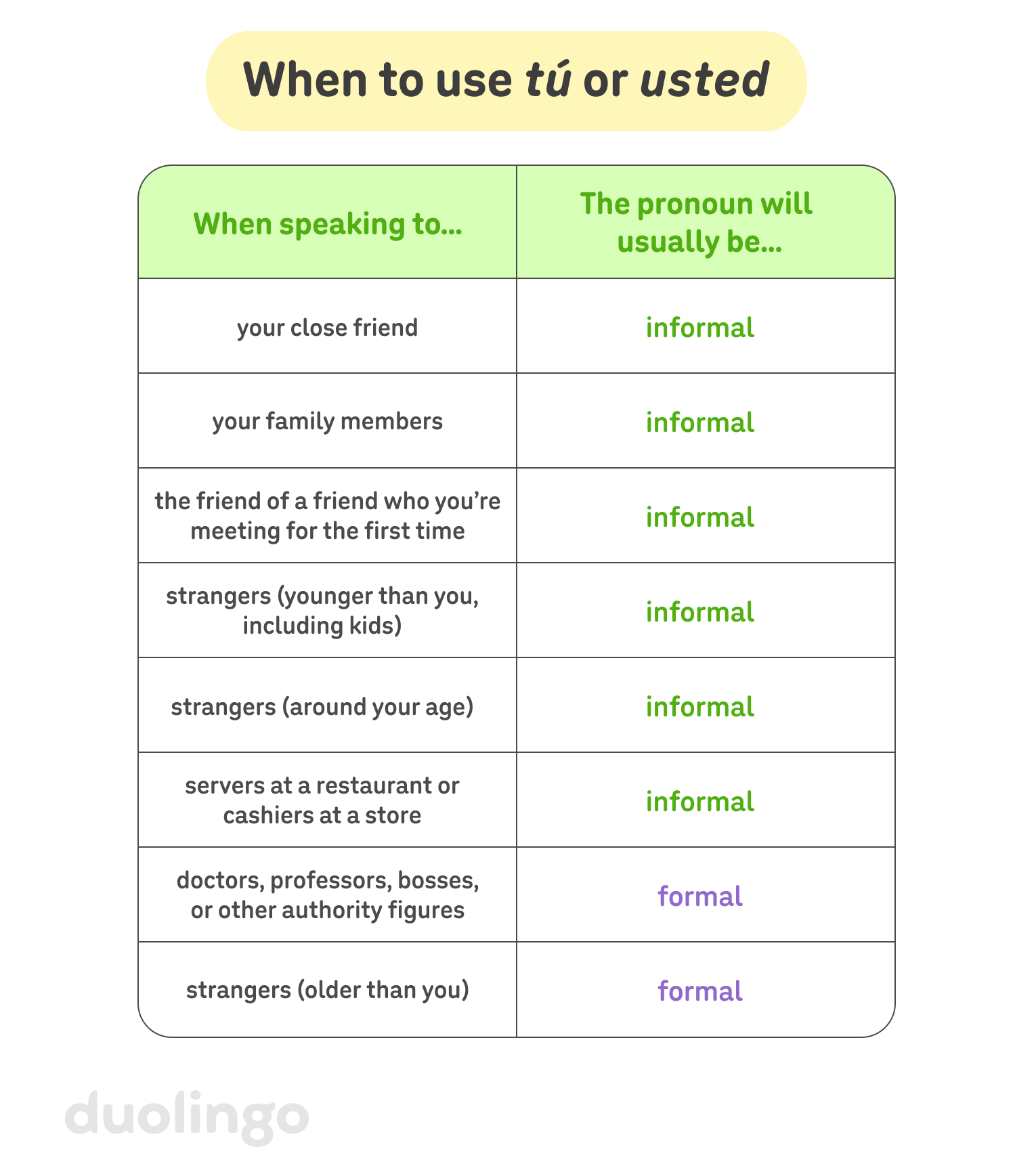
Depending on the dialect of Spanish you’re learning, you might notice that the table above differs slightly from what you’re hearing! Here are a few common exceptions:
- Costa Rican Spanish is known for being more formal than other dialects, so you might even hear close family members or spouses refer to each other as usted.
- Speakers in Spain have a reputation for using tú more often than other dialects, reserving usted for only the most formal interactions. However, there is variation even within Spain! Speakers in the Canary Islands and in the southern region of Andalucía often use usted more than in other regions.
- Certain parts of Colombia use usted as a form of affection among close friends and family members.
In other words, you may come across exceptions wherever you go, which brings us to another common question…
What if I use the wrong pronoun?
When this happens (and it almost certainly will!), don’t panic—mistakes are a necessary part of language learning, and people will generally be understanding. Plus, since different dialects have different norms when it comes to using (or not using) tú, usted, and vos, even two people who have spent their whole lives speaking Spanish might not always agree on when to use which pronoun!
Here are some tips for specific situations:
You used a formal pronoun when the informal pronoun was expected
If you use usted when the situation doesn’t call for extra formality, it might feel a little stiff, but it’s not a big deal. The person you’re talking to might even let you know you can be informal with them by saying something like Puedes tutearme (You can address me as tú).
You used an informal pronoun when the formal pronoun was expected
If you use tú or vos in a situation where the other person would prefer usted, there’s a chance they might feel like you’re speaking too casually to them, but in most cases, they’ll understand that you’re still learning. They might even hint that they’d prefer to keep things formal by referring to you as usted. If this happens, just switch back to usted, and continue the conversation normally!
You used vos in places that use tú, or vice versa
Since both vos and tú are informal pronouns, you won’t offend anyone by swapping one with the other. However, since vos is so strongly associated with specific Spanish-speaking regions, it can serve as a marker of where you’re from or where you learned Spanish. The best strategy is to listen to what’s being said around you—for example, don’t resist using vos because you learned tú in school if vos is the pronoun you’re hearing the most!
How to conjugate tú, usted, and vos
Tú and usted have different verb conjugations, which can give you an extra clue if you’re trying to figure out how to address someone by listening to them talk!
This is especially important since it’s common to drop subject pronouns in Spanish, so paying attention to verb forms matters a lot! (For example, to say you are tall, you’ll often say eres alto, es alto, or sos alto instead of tú eres alto, usted es alto, or vos sos alto.)
Tú conjugations usually end in ‑s, while the usted form is conjugated the same way as él (he) and ella (she). Meanwhile, vos has a conjugation all its own, but only for two forms: the present tense (for example, I am in Mexico) and affirmative commands (for example, Make a cake!). For all other conjugations, verbs with vos are identical to verbs with tú!
Here are some examples of the most common verbs:
Present tense
| tú | usted | vos | Meaning |
|---|---|---|---|
| eres | es | sos | you are from infinitive ser |
| estás | está | estás | you are from infinitive estar |
| tienes | tiene | tenés | you have from infinitive tener |
| haces | hace | hacés | you make or you do from infinitive hacer |
| puedes | puede | podés | you can or you are able to from infinitive poder |
| dices | dice | decís | you say or you tell from infinitive decir |
| sabes | sabe | sabés | you know from infinitive saber |
| quieres | quiere | querés | you want from infinitive querer |
For example, here’s how you would say You have a big house depending on how you’re addressing the person you’re speaking to:
- tú: Tienes una casa grande.
- usted: Tiene una casa grande.
- vos: Tenés una casa grande.
Affirmative commands
| Infinitive | tú | usted | vos |
|---|---|---|---|
| ser | sé | sea | sé |
| estar | está | esté | está |
| tener | ten | tenga | tené |
| hacer | haz | haga | hacé |
| poder | puede | pueda | podé |
| decir | di | diga | decí |
| saber | sabe | sepa | sabé |
| querer | quiere | quiera | queré |
For example, to give the command Tell the truth! in Spanish, here’s how it would look depending on the pronoun you’re using:
- tú: ¡Di la verdad!
- usted: ¡Diga la verdad!
- vos: ¡Decí la verdad!
Negative commands
| Infinitive | tú | usted | vos |
|---|---|---|---|
| ser | no seas | no sea | no seas (or no seás)* |
| estar | no estés | no esté | no estés |
| tener | no tengas | no tenga | no tengas |
| hacer | no hagas | no haga | no hagas (or no hagás)* |
| poder | no puedas | no pueda | no puedas (or no podás)* |
| decir | no digas | no diga | no digas (or no digás)* |
| saber | no sepas | no sepa | no sepas (or no sepás)* |
| querer | no quieras | no quiera | no quieras (or no querás)* |
For example, to give the negative command Don’t be selfish!, here’s how it would look for tú, vos, and usted:
- tú or vos: ¡No seas egoísta!(or¡No seás egoísta!in some Central American dialects)
- usted: ¡No sea egoísta!
To tutear or not to tutear?
It’s important to know each of these verb forms if you’re learning Spanish, but learning when to use them comes with practice, patience, and lots of listening!
Special thanks to our Spanish Localization experts Gonzalo Botindari and Karina Illescas for their contributions to this post!