K-dramas, K-pop, and kimchi have taken the world by storm in recent years—and so has Korean on Duolingo! With over 1.9 million learners around the globe and Korean ranking as the #6 most popular language to study in 2025, we knew it was time to give this fan-favorite course a major glow-up.

Why Korean is worth the hype
Whether you’re into dramas and thrillers, pop music and fantasy, or fashion and cosmetics, the global impact of Korean culture has something for everyone. And since language and culture are inextricably linked, learning Korean will help deepen your understanding and appreciation of the culture.
But even if you’re new to the Korean cultural phenomenon, Korean is a fascinating, challenging, and highly rewarding language to learn. Here are just a few reasons why:
- Korean is essentially a language isolate. It belongs to the small Koreanic family, which consists only of Korean and the language of Jeju Island, meaning that no matter what your first language is, Korean is likely to be very different from it in many ways!
- The Korean writing system, Hangeul, is unique. It’s not related to any other script or alphabet because it was developed by King Sejong and his scholars in the 15th century. And even though it may look daunting, it was designed specifically to be easy to learn! Each shape represents where in the mouth it’s pronounced.
- Korean has a special category of words called particles, and these words typically don’t have simple translations into English. One example is 을, which is used to identify the object of the sentence, like in the example저는 김밥을 먹어요(I eat kimbap).
- There are also plenty of culturally-specific words, like 떡볶이(a popular Korean dish made from chewy cylinder-shaped rice cakes in a sweet and spicy red sauce) and찌개(stew typically made with meat, seafood, and/or vegetables in a broth along, with popular variations like김치찌개, or kimchi stew, and된장찌개, or soybean paste stew). These words don’t have a direct translation, but knowing them will give you a deeper understanding of the language—and the cuisine 😋
These unique traits of Korean are exactly why we’ve redesigned the content and features of our Korean course to give learners all the tools they need to learn the Korean language and culture.
How we rebuilt the Korean course
In the 10+ years since we first launched the Korean course, our courses have gotten smarter and more fun, so we wanted to bring all these improvements to our Korean learners.
Here’s what’s different!
- Fresh content: In addition to redesigning our existing content, we added brand-new advanced content—our course now teaches all the way up to B2!
- Available to more learners: We’ve made our course available to over 9 million more users. In addition to English, Japanese, and Chinese speakers, Korean is now available to speakers of 27 different languages, including Spanish, Portuguese, German, and French!
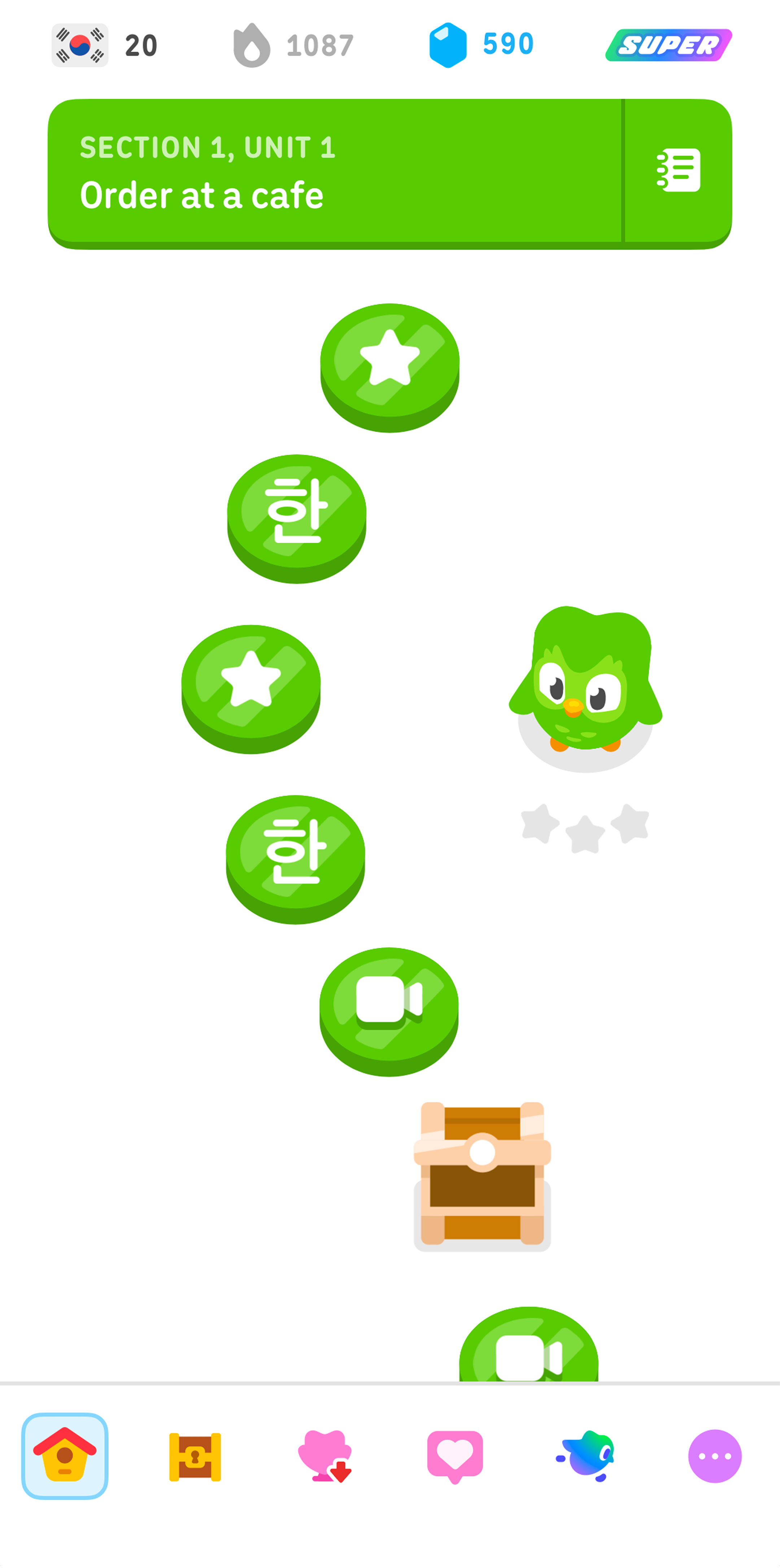
- Focus on Hangeul: The Korean writing system has its own tab and we added alphabet teaching sessions along your learning path to give you all the practice you need.
- Smarter grammar teaching: Our new approach focuses on clear grammar goals and we’ve added new types of exercises to help you build on each skill step by step.
- Transliterations: No more guessing when you can’t remember Hangeul! If you need them, we’ve provided transliterations for every sentence—turn them on or off by tapping the gear symbol during a lesson.
 |
Try our new Korean course today!
The Korean course is just one example of how Duolingo is evolving to bring language learning to life, and we’re so excited for you to dive into the new lessons. 화이팅! (You’ve got this!)