
The queen is the most powerful piece in chess and is often the most tempting to use early. But wielding the queen isn’t just about power—it’s about timing, coordination, and precision.
In this post:
Chess 101: the queen
The queen is easy to spot. It wears a spiked crown and is typically the second-tallest piece, with the king being the tallest.
The queen hasn’t always been the powerhouse we know today. In early versions of chess, this piece was called the farzin, which was later shortened to ferz, meaning advisor or counselor in Persian, and it had very limited movement. Only after reaching medieval Europe did it evolve into the modern queen, gaining its full range of motion and becoming the strongest piece on the board.
Each player starts with one queen, placed on the starting rank, opposite each other on the same file (or column), called the d-file. This means White’s queen starts on d1 and Black’s queen begins on d8. Many beginners make mistakes when placing the king and queen, but luckily, there’s an easy way to remember the correct placement: Always put the queen on its own color. This means that the white queen begins on a white square (d1), and the black queen begins on a black square (d8), with the king by its side.

In terms of piece value, the queen is worth 9 points, making it the most valuable piece in the game. Because of this, winning or losing a queen often decides the outcome of an entire game. Sometimes, queen sacrifices happen, but they’re typically only played when they lead to a clear, immediate win.
How the queen moves
The queen moves any number of squares either horizontally, vertically, or diagonally, as long as no pieces block its path.
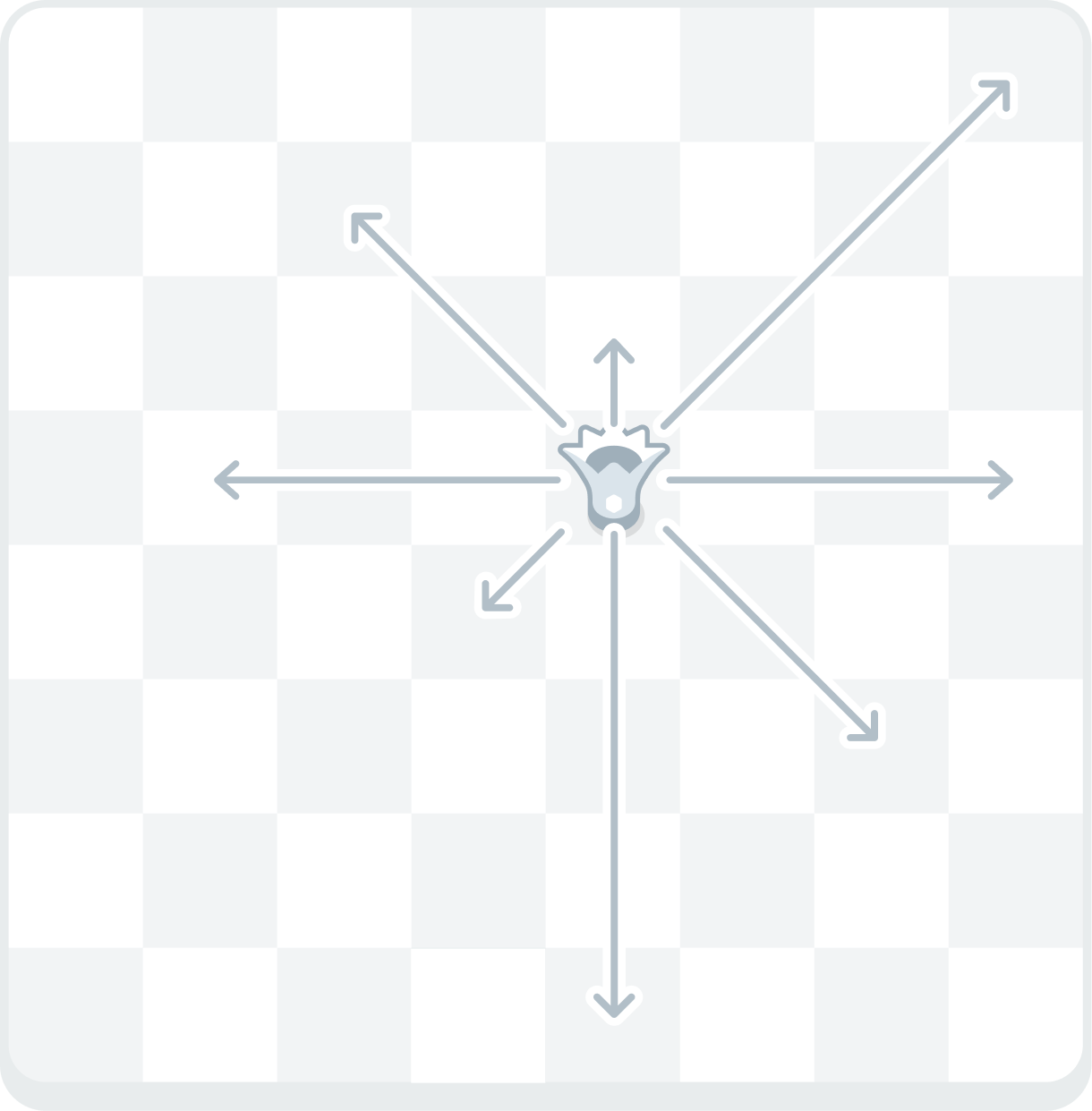
The queen combines the movement of the rook and the bishop together, making it the most powerful piece in chess.
Because the queen can control more squares than any other piece and influence large parts of the board at once, it is a key attacking tool.
Do’s and don’ts with the queen
Because the queen is so valuable, it’s important to use it wisely.
Do:
💡 Do use your queen as part of a team.
The queen shines when working with other pieces—combining its power with coordinated support.
💡 Do trade queens when you’re clearly winning.
In winning games, trading queens can simplify the position and reduce your opponent’s chances of creating counterplay or perpetual checks.
Don’t:
🚫 Don’t bring your queen out too early.
This is one of the most common beginner mistakes. Early queen attacks (like attempts at Scholar’s Mate) might work occasionally, but they often backfire and are objectively poor choices against strong players. Opponents can chase your queen around with lower-value pieces, gaining time and development. Relying on early queen tricks can also slow your long-term improvement.
🚫 Don’t attack with the queen alone.
A lone queen usually isn’t enough to deliver checkmate by itself. Successful attacks almost always involve coordination with other pieces.
🚫 Don’t assign your queen defensive chores.
Using your most valuable piece to defend a less valuable one is usually inefficient. Let your lower-value pieces handle defense when possible.
🚫 Don’t trade queens if you’re attacking.
If your opponent’s king is exposed or under attack, keeping queens on the board increases your chances of delivering checkmate.
Strategy tips
To get the most out of your queen, focus on coordination, timing, and positioning.
Pair your queen with other pieces.
The queen forms powerful combinations with nearly every piece:
- With the rook (or even two rooks, in a setup called Alekhine’s gun): to dominate open ranks or files
- With a bishop or knight: to create dangerous mating threats
- With any other piece: to deliver checkmate while the other piece defends the queen—this is called an assisted checkmate
Centralize your queen—carefully.
The queen is strongest when it influences the center, especially in the late opening or middlegame. However, avoid placing it too deep into enemy territory too soon, where it can become an easy target.
Take advantage of open positions.
Queens thrive when the board is open and lines are clear. Their long-range movement allows them to quickly switch from one side of the board to the other.
Execute tactics.
Queens are excellent at forking multiple pieces at once, skewering valuable targets, or forming attacking batteries with other pieces.
Look for ways to deliver perpetual check.
Queens are great at delivering repeated checks to an exposed king. If you’re losing, look for ways to create perpetual check, which forces a draw.
Watch out for stalemate.
One of the most common beginner mistakes is accidentally stumbling into a stalemate when trying to checkmate with a queen. Always make sure your opponent’s king has at least one legal move right until the final checkmate so you don’t accidentally turn a win into a draw.
Go off queen
The queen is chess’s most powerful piece—but power alone isn’t enough. Use it at the right time and in coordination with your army to turn its strength into decisive victories. 👑