If you study French, you probably already know that there are three ways to form French questions. But even if you feel pretty confident using a change in intonation and est-ce que, you may still come across a few advanced patterns when it comes to inversion!
Here’s a guide to using inversion for French questions!
In this post:
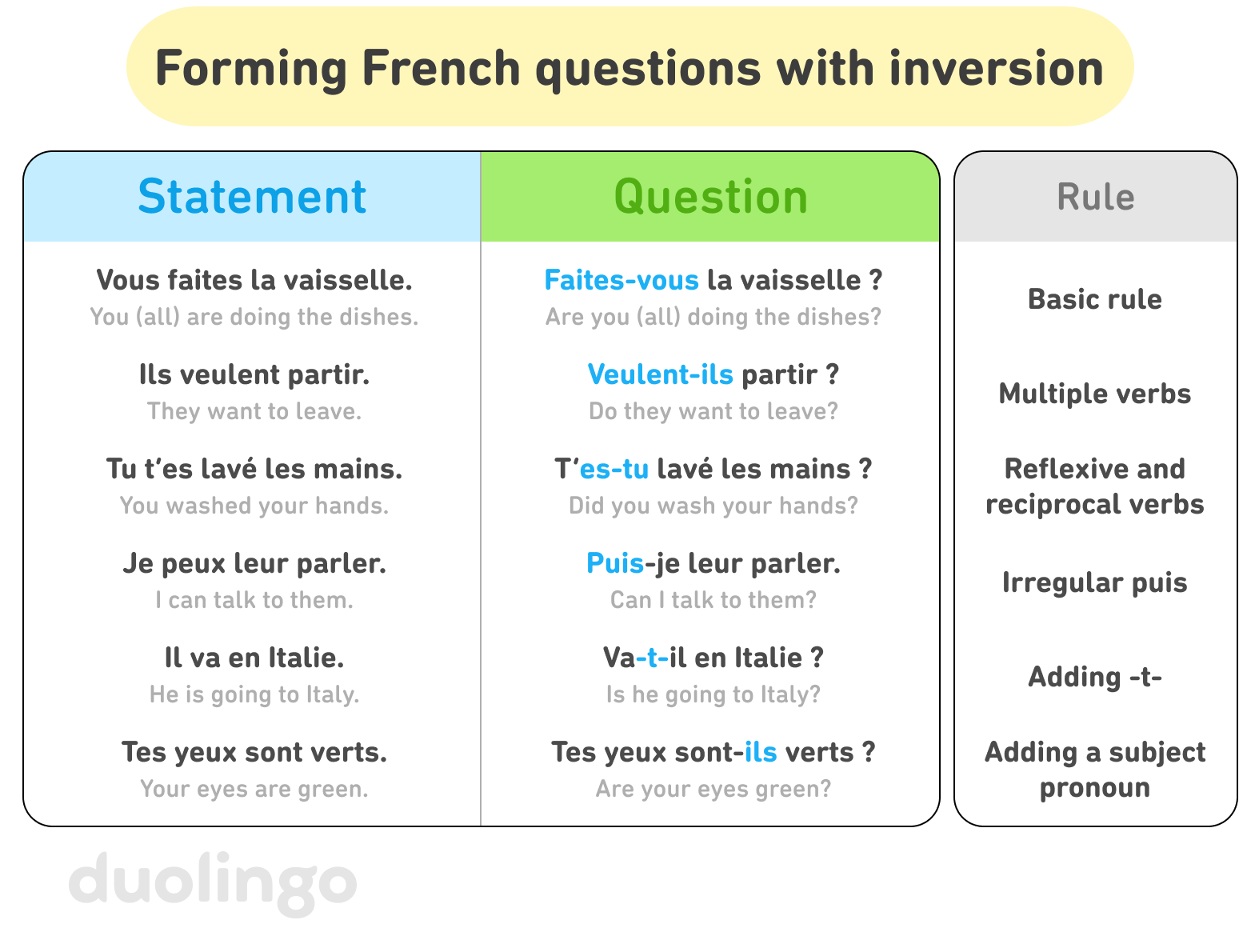
What’s inversion?
The first two involve either a change in intonation or the addition of the question phrase est-ce que. The last one, known as inversion, is the most formal of the three types of question structures in French.
In fact, if your only goal in French is just to chat with friends or get around a city, you might not hear inverted questions at all! But if you’ll be studying, working, or doing any kind of administrative tasks in a French-speaking country, this structure will be helpful to understand and recognize.
(If the question doesn’t have a subject pronoun, then inversion will look a little different! We’ll discuss that rule below.)
Here’s how the basic rule works for yes/no questions when the subject is a pronoun:
| Statement | Inverted question |
|---|---|
| Vous saviez que Marc serait là. You (all) knew that Marc would be there. |
Saviez-vous que Marc serait là ? Did you (all) know that Marc would be there? |
| Tu veux une part de gâteau. You want a piece of cake. |
Veux-tu une part de gâteau ? Do you want a piece of cake? |
| Je suis ton meilleur ami. I am your best friend. |
Suis-je ton meilleur ami ? Am I your best friend? |
| Ils travaillent en Belgique. They work in Belgium. |
Travaillent-ils en Belgique ? Do they work in Belgium? |
Simple! Everything stays the same, except the order of the verb and subject pronoun.
If you need to add a question word, it will go at the beginning of the question (along with any prepositions like à (to), de (of/from), avec (with), pour (for), etc.:
| French | Translation |
|---|---|
| Que fais-tu aujourd’hui ? | What are you doing today? |
| Comment connaissez-vous sa sœur ? | How do you (all) know his sister? |
| À qui parlaient-ils ? | Who were they talking to? |
| Pourquoi écrit-elle autant de lettres ? | Why is she writing so many letters? |
Those are the basics, but there are some extra rules and exceptions to know if you want to perfect your skills!
Inversion with multiple verbs
Sometimes, a question will have multiple verbs in a row, like in the passé composé or the future with aller (to go). Don’t panic—just invert the first verb, and the rest of the phrase comes after! Any question words go at the beginning, as usual:
| Statement | Inverted question |
|---|---|
| Elle est partie avec Camille. She left with Camille. |
Est-elle partie avec Camille ? Did she leave with Camille? |
| J’ai reçu une bonne note. I got a good grade. |
Ai-je reçu une bonne note ? Did I get a good grade? |
| Elles viennent d’arriver. They just got here. |
Viennent-elles d’arriver ? Did they just get here? |
| Vous voulez manger des pâtes. You (all) want to eat pasta. |
Que voulez-vous manger ? What do you (all) want to eat? |
| Il doit les appeler. He has to call them. |
À quelle heure doit-il les appeler ? (At) what time does he have to call them? |
Inversion with reflexives
Reflexive verbs are common in French, and since they require two pronouns, it can be tricky to know the right word order when you combine them with an inverted question! But the rule is easy: Switch the order of the subject pronoun and the verb, just like we’ve done in the rest of the examples so far. That means that the reflexive pronoun will remain before the verb, along with any question words.
| Statement | Inverted question |
|---|---|
| Je me suis déjà lavé les cheveux. I already washed my hair. |
Me suis-je déjà lavé les cheveux ? Did I already wash my hair? |
| Tu te brosses les dents deux fois par jour. You brush your teeth twice a day. |
Te brosses-tu les dents deux fois par jour ? Do you brush your teeth twice a day? |
| Elle s’habillait rapidement. She was getting dressed quickly. |
S’habillait-elle rapidement ? Was she getting dressed quickly? |
This is also true for reciprocal verbs, which use the same pronouns as reflexive verbs, but they mean each other instead of oneself.
| Statement | Inverted question |
|---|---|
| Vous vous connaissez depuis longtemps. You (all) have known each other for a long time. |
Vous connaissez-vous depuis longtemps ? Have you (all) known each other for a long time? |
| Ils s’aiment. They love each other. |
S’aiment-ils ? Do they love each other? |
| Nous nous disons beaucoup de choses. We tell each other a lot of things. |
Nous disons-nous beaucoup de choses ? Do we tell each other a lot of things? |
Irregular puis
The verb pouvoir (can or be able to) has an irregular form in inversion questions when it’s used with je (I): puis instead of peux. Here’s how the question Can I come? will look in the three different levels of formality:
- Change in intonation: Je peux venir ?
- Adding est-ce que: Est-ce que je peux venir ?
- Inversion: Puis-je venir ?
Adding ‑t‑
When a third-person singular verb—in other words, one that goes with il (he), elle (she), or on (one/we)—ends in a vowel, the inverted question will add a ‑t‑ between the verb and the pronoun. This rule is for ease of pronunciation, so that the last vowel in the verb and the first vowel in the pronoun don’t run together!
| Statement | Inverted question |
|---|---|
| Il aime ses cours. He likes his classes. |
Aime-t-il ses cours ? Does he like his classes? |
| Elle va au Brésil. She’s going to Brazil. |
Va-t-elle au Brésil ? Is she going to Brazil? |
| On mange souvent du riz. One often eats rice. We often eat rice. |
Mange-t-on souvent du riz ? Does one often eat rice? Do we often eat rice? |
Adding a subject pronoun
If the subject of your question isn’t a pronoun (like je, tu, il, elle, etc.) keep the subject before the verb, and add the matching subject pronoun directly after the verb. Any question words will go at the beginning, as always!
| Statement | Inverted question |
|---|---|
| Le repas est prêt. The meal is ready. |
Le repas est-il prêt ? Is the meal ready? |
| Sophie part demain matin. Sophie is leaving tomorrow morning. |
Quand Sophie part-elle ? When is Sophie leaving? |
| Les voitures sont fabriquées en France. The cars are manufactured in France. |
Où les voitures sont-elles fabriquées ? Where are the cars manufactured? |
Cure your aversion to inversion!
You’ve got all the tools you need to feel confident about inverted questions, but don’t stop there! Keep improving your speaking and listening skills in French with these guides:
- Dear Duolingo: How do you know what sounds French letters make?
- 6 unique words to help you learn about French culture
- Dear Duolingo: How can I learn to form sentences in my new language?
- 8 French phrases you’ll need in Paris
Comparison of French question structures
| Informal (change in intonation) | Neutral (est-ce que) | Formal (inversion) |
|---|---|---|
| Vous saviez que Marc serait là ? | Est-ce que vous saviez que Marc serait là ? | Saviez-vous que Marc serait là ? |
| Tu veux une part de gâteau ? | Est-ce que tu veux une part de gâteau ? | Veux-tu une part de gâteau ? |
| Je suis ta meilleure amie ? | Est-ce que je suis ta meilleure amie ? | Suis-je ta meilleure amie ? |
| Ils travaillent en Belgique ? | Est-ce qu’ils travaillent en Belgique ? | Travaillent-ils en Belgique ? |
| Tu fais quoi aujourd’hui ? | Qu’est-ce que tu fais aujourd’hui ? | Que fais-tu aujourd’hui ? |
| Vous connaissez sa sœur comment ? | Comment est-ce que vous connaissez sa sœur ? | Comment connaissez-vous sa sœur ? |
| Ils parlaient à qui ? | À qui est-ce qu’ils parlaient ? | À qui parlaient-ils ? |
| Pourquoi elle écrit autant de lettres ? | Pourquoi est-ce qu’elle écrit autant de lettres ? | Pourquoi écrit-elle autant de lettres ? |
| Elle est partie avec Camille ? | Est-ce qu’elle est partie avec Camille ? | Est-elle partie avec Camille ? |
| J’ai reçu une bonne note ? | Est-ce que j’ai reçu une bonne note ? | Ai-je reçu une bonne note ? |
| Elles viennent d’arriver ? | Est-ce qu’elles viennent d’arriver ? | Viennent-elles d’arriver ? |
| Vous voulez manger quoi ? | Qu’est-ce que vous voulez manger ? | Que voulez-vous manger ? |
| Il doit les appeler à quelle heure ? | À quelle heure est-ce qu’il doit les appeler ? | À quelle heure doit-il les appeler ? |
| Je me suis déjà lavée les cheveux ? | Est-ce que je me suis déjà lavée les cheveux ? | Me suis-je déjà lavée les cheveux ? |
| Tu te brosses les dents deux fois par jour ? | Est-ce que tu te brosses les dents deux fois par jour ? | Te brosses-tu les dents deux fois par jour ? |
| Elle s’habillait rapidement ? | Est-ce qu’elle s’habillait rapidement ? | S’habillait-elle rapidement ? |
| Vous vous connaissez depuis longtemps ? | Est-ce que vous vous connaissez depuis longtemps ? | Vous connaissez-vous depuis longtemps ? |
| Ils s’aiment ? | Est-ce qu’ils s’aiment ? | S’aiment-ils ? |
| Nous nous disons beaucoup de choses ? | Est-ce que nous nous disons beaucoup de choses ? | Nous disons-nous beaucoup de choses ? |
| Je peux venir ? | Est-ce que je peux venir ? | Puis-je venir ? |
| Il aime ses cours ? | Est-ce qu’il aime ses cours ? | Aime-t-il ses cours ? |
| Elle va au Brésil ? | Est-ce qu’elle va au Brésil ? | Va-t-elle au Brésil ? |
| On mange souvent du riz ? | Est-ce qu’on mange souvent du riz ? | Mange-t-on souvent du riz ? |
| Le repas est prêt ? | Est-ce que le repas est prêt ? | Le repas est-il prêt ? |
| Sophie part quand ? | Quand est-ce que Sophie part ? | Quand Sophie part-elle ? |
| Les voitures sont fabriquées où ? | Où est-ce que les voitures sont fabriquées ? | Où les voitures sont-elles fabriquées ? |