Welcome to another week of Dear Duolingo, an advice column just for learners. Catch up on past installments here.
Hi, learners! Dr. Cindy Blanco here, back with a great question that affects every person, in every language, whether it’s the one you grew up using or a new one you’re studying.
Our question this week:
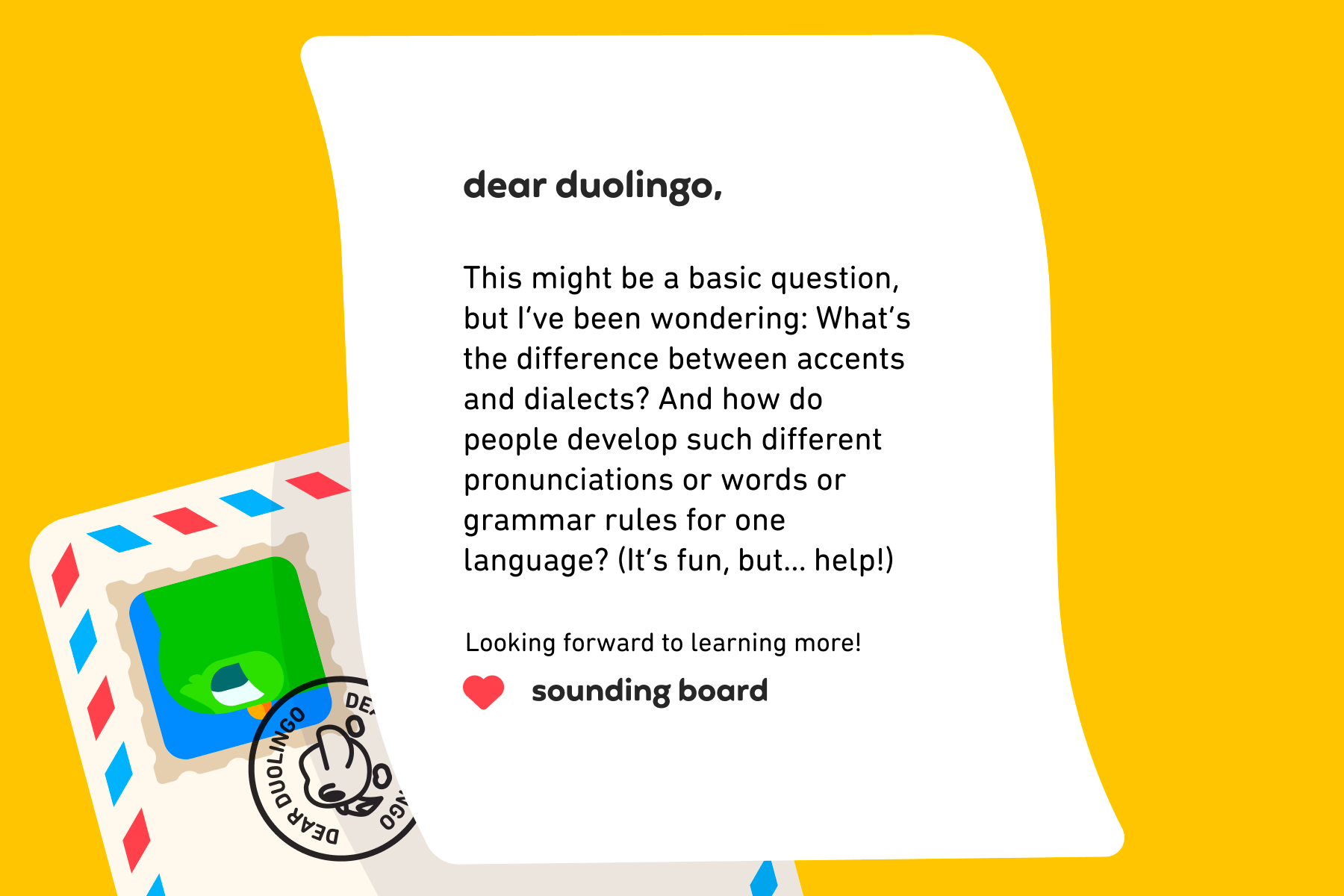
This question may sound basic, but you’re far from the only one who’s wondered about it! Let’s take a closer look 🔍
Everyone has at least one accent and one dialect—yes, even you!—and it’s also possible to have more than one. Accents and dialects can represent the region you’re from, your ethnicity or race, your age, your religious group, and many other dimensions—even your college experience, as Dr. Jessi Grieser explained at Duocon 2021! It’s also common for people to switch their accents or dialects, either unintentionally or deliberately, as they move through the world, depending on who they’re talking to, where they are, and what they want to convey about their identity. (Is this someone I want to show closeness to and so sound more like? Or do I want to show that I’m not a part of this group and so I want to sound less similar?)
And this is just thinking about the language you grew up using—but these layers are likely present in your second, third, and fourth languages, too. You can also have a “foreign” accent in one language that reflects the other languages you know. (In fact, the line between “native” and “foreign” accents can be really blurry!)
Today, let’s focus on accents and dialects in the language you grew up using. By the way, this is just an introduction—there’s a lot more to say about accents and dialects! Let us know what else you’re curious about.
What’s the difference between an accent and a dialect?
Alright, Sounding Board, the short answer:
- Accent generally refers to pronunciation
- Dialect generally refers to a whole group of language features, including pronunciation, but also differences in vocabulary, grammar, and how the language gets used (like the rules of what counts as polite)
So if you and I speak different dialects of English, we probably have some differences in what words we use (maybe I say zucchini and you say courgette), some grammatical rules (maybe I say Do you have any tea? when asking a question instead of Have you any tea?), and how we use those words (some English dialects say Pardon? and I could too… but more natural for me is Excuse me?). And these are far from the only differences across English dialects!
If you and I have different accents in English, we very probably have other differences too, like the ones mentioned above, but if we’re specifically mentioning our accents, we mean only the pronunciation differences.
Communities that use a particular dialect or accent can range in size; some dialects include millions of people, and others only a hundred (and some probably even fewer!). For example, North American English refers to the dialect of English used in much of the U.S. and Canada by hundreds of millions of people—but within that enormous super-region are lots of smaller dialects of varying sizes, including African American English, Pittsburgh English, and Southern English.
How accents and dialects work
If you use language, you have an accent. And if you use language, you are using a dialect of the language. That includes everyone!
It’s not uncommon for people to feel that *they* don’t have an accent, particularly if most people around them speak the same way, and especially if the people in power around them speak similarly to them. Instead, a language can be thought of as a collection of dialects, all more or less understandable to each other. Or, as internet linguist and 2021 Duocon speaker Gretchen McCulloch put it, “A language is just some dialects in a trenchcoat.”
Ok, so where do they come from, all these accents and dialects? First, it’s useful to remember that language is one of many parts of shared culture and traditions that we have as humans, and so people use language in ways that match their communities and identities. Our clothes, interests, gestures, hair styles, and aspirations are shaped by our surroundings (even when those surroundings lead us to want to rebel against them and leave our community behind!). And as for language, we—consciously or not—use it to connect to the community we feel closest to, and make adjustments based on how we want to be perceived.
The second thing to know is that accents and dialects typically evolve gradually, so any drastic differences you notice today probably started as smaller differences or were only used by a part of the community before they spread. Remember that game Telephone, where someone whispers a word to you, and you have to whisper it to the next person? Typically, after a word gets through the whole group, it’s turned into another word entirely! You can think of language and dialects like a large-scale game of Telephone: Two neighboring communities might have a small difference in a word, and the next two communities might have another small difference in that word, and the next two have yet another difference, etc. And if that can happen for every single word, imagine how different dialects can get when you account for phrases, grammar, conversation rules, and—yes—accents!
Over time, dialects can become so divergent, or different from one another, that they stop being easily understood by each group. This often coincides with other changes, culturally and politically, and you might end up calling them different languages. In fact, Romance languages started as just different dialects of Latin!
Four unbelievable facts about accents and dialects
1. No accent is inherently easier to pronounce or understand than any other
Of course, some accents are definitely easier *for you* to pronounce or understand, but it’s all about your personal language experience! Your brain is best at understanding what it has been exposed to, no matter the actual sounds involved or what other people may think of the accent or its speakers. The same is true for pronouncing an accent: If you didn’t grow up pronouncing a word a certain way, does that make the different pronunciation actually inherently hard, or is it hard *for you*, given your language experiences?
2. Your accent is always changing, even if just a little bit
We are constantly tweaking our accents, in ways we probably don’t even notice. That’s because our accents (and really, lots of features of our language!) are very susceptible to peer pressure: Our brains track tons of details of the language around us (how exactly a vowel is pronounced, how often a particular word or phrase is heard, who uses which new words), and we often can’t help but subtly change our own accents in response to what’s commonly used around us. One really interesting example of this is Queen Elizabeth’s speech: Linguists have analyzed her yearly Christmas broadcasts and tracked how her vowels became more like those of regular people in southern Britain over the course of her life!
3. “Standard” accents and dialects are kind of a myth
Which accent or dialect gets treated as “standard” has everything to do with the people who use it, and nothing to do with the linguistic features of the language. You might sometimes hear people explain why the “standard” makes more sense or does something more logically, but the real rationale actually goes the other way: Whatever pronunciation, word, phrase, or grammar the people in power use, there ends up being an explanation why that is a better way of speaking. But there isn’t some neutral or inherently “better” sound, word, phrase, or grammar. And it’s no accident that many “standard” varieties happen to coincide with whatever region or city ends up being politically powerful, like the capital of a country.
4. Accents can work differently in different languages
Accents have the same underlying principles in all languages, but the result can look different depending on the language! In English, the biggest difference between one accent and another is typically in how people pronounce the vowels. Can you think of any examples? Fred Astaire and Ginger Rogers sang a whole song about differences in English pronunciation, including tomato (more common in the U.S.) and tomato (more common in the U.K.). You can hear the difference between the vowels (especially the “a” vowel), while the consonants “t,” “m,” and “t” are basically pronounced the same. (Note that this is a huge generalization about a global language spoken in dozens of countries around the world, and there are definitely lots of consonant differences across English dialects, too!)
On the other hand, many dialects of Spanish have pretty consistent vowels, and it’s the consonants that can sound really different. Most Spanish speakers from Spain pronounce “z,” “ce,” and “ci” with a “th” sound (like in English think), so casa (house) and caza (he or she hunts) sound different, whereas they would sound the same in most dialects of Spanish outside of Spain: casa vs. caza. “R” is also pronounced differently depending on the accent, so in the Caribbean, the “r” sound will be more like an “l” or even an “h,” depending on the word and what accent the speaker has (Cuban, Puerto Rican, Dominican, etc.). And the Argentinian and Uruguayan accents typically pronounce “ll” and “y” as a “sh” sound (a little like English sheep), like in the word calle (street), which might sound like calle in other Spanish-speaking regions! (Same caveat here: There definitely can be vowel differences across Spanish dialects! This is a generalization for sure.)
Spoken languages aren’t the only ones that have accents. People who use signed languages, like American Sign Language (ASL), also have accents! Signs can be described by the shape the hand(s) are in, the movement of the hand(s), which way the hand(s) are facing, the location of the hand(s), and other features of the body and face when producing the sign. So an accent in a signed language is when one of these features is a little different for one signer versus another. So just like I said for English that the vowels in tomato and tomato can differ, in ASL one user might have a slightly different shape of the hand than another.
Sounds good to us!
There’s your intro to accents and dialects, Sounding Board. This is such a rich topic that touches on linguistics, history, anthropology, politics, and language learning, and although we’ve covered the basics, there’s still so much more to discuss—or observe! Keep an eye (or an ear!) out for dialects and accents in your friend group, family, community, and beyond, and you’re bound to discover something interesting you’ve probably never thought about before.
For more answers to your language and learning questions, get in touch with us by emailing dearduolingo@duolingo.com.