
The knight’s unusual movement pattern lets it leap over pieces, create unexpected threats, and deliver some of the most unpredictable tactics in the game.
Here’s everything you need to use your knights to your advantage!
In this post:
- Chess 101: the knight
- How the knight moves
- Tactics with the knight
- Strategy tips for the knight
- Do’s and don’ts for the knight
Chess 101: the knight
The knight is instantly recognizable on a chess board—it’s the piece shaped like a horse’s head! Each player starts with two knights on the first row of the board, between each rook and bishop.
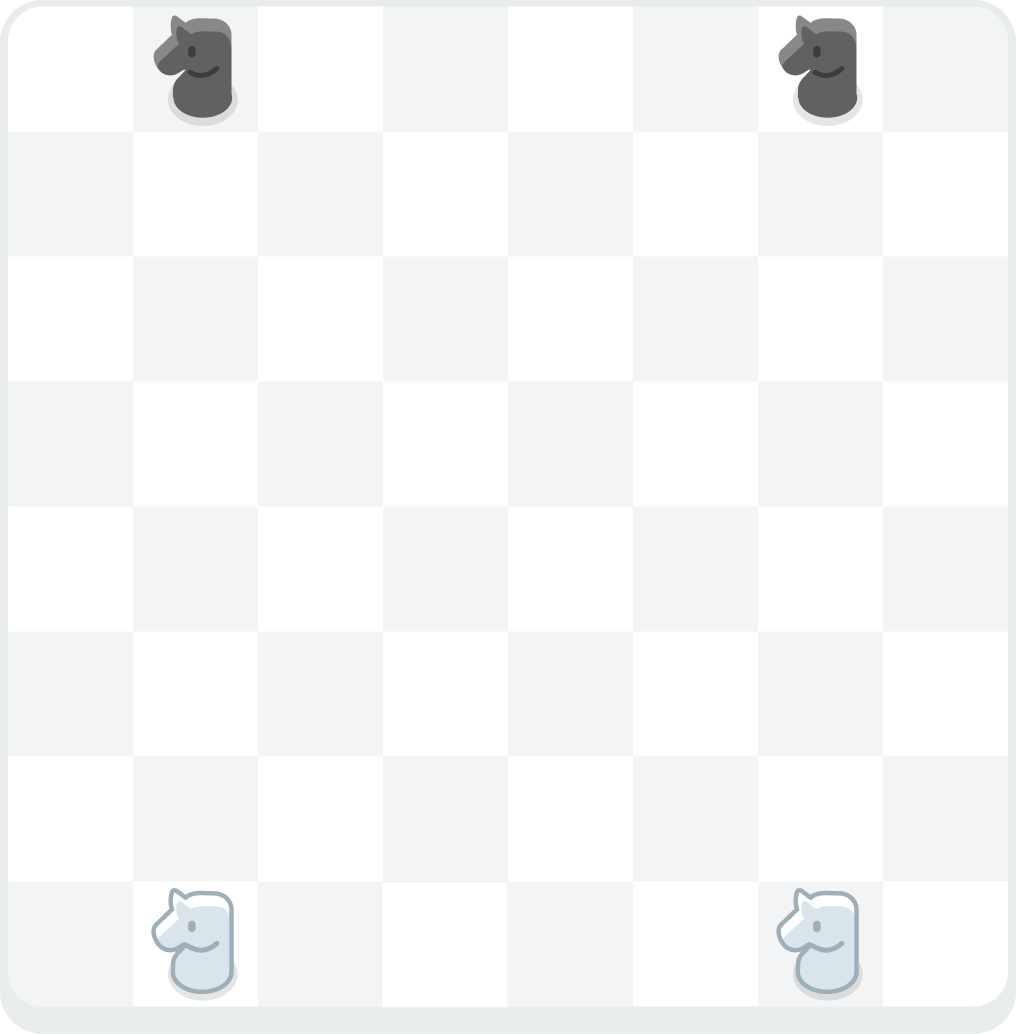
What’s especially interesting about the knight is that its movement pattern remains unchanged over centuries. In fact, the knight moves exactly the same way today as it did in chaturanga, the predecessor of modern chess.
In terms of piece value, knights are generally considered to be worth 3 points, the same as bishops.
Because of their identical piece value, bishops and knights are grouped together as minor pieces. They’re less powerful than the major pieces (rooks and queens), but are still useful and versatile chess pieces.
Like the bishop, a single knight cannot deliver checkmate by itself, but unlike two bishops, two knights working together cannot force checkmate!
How the knight moves
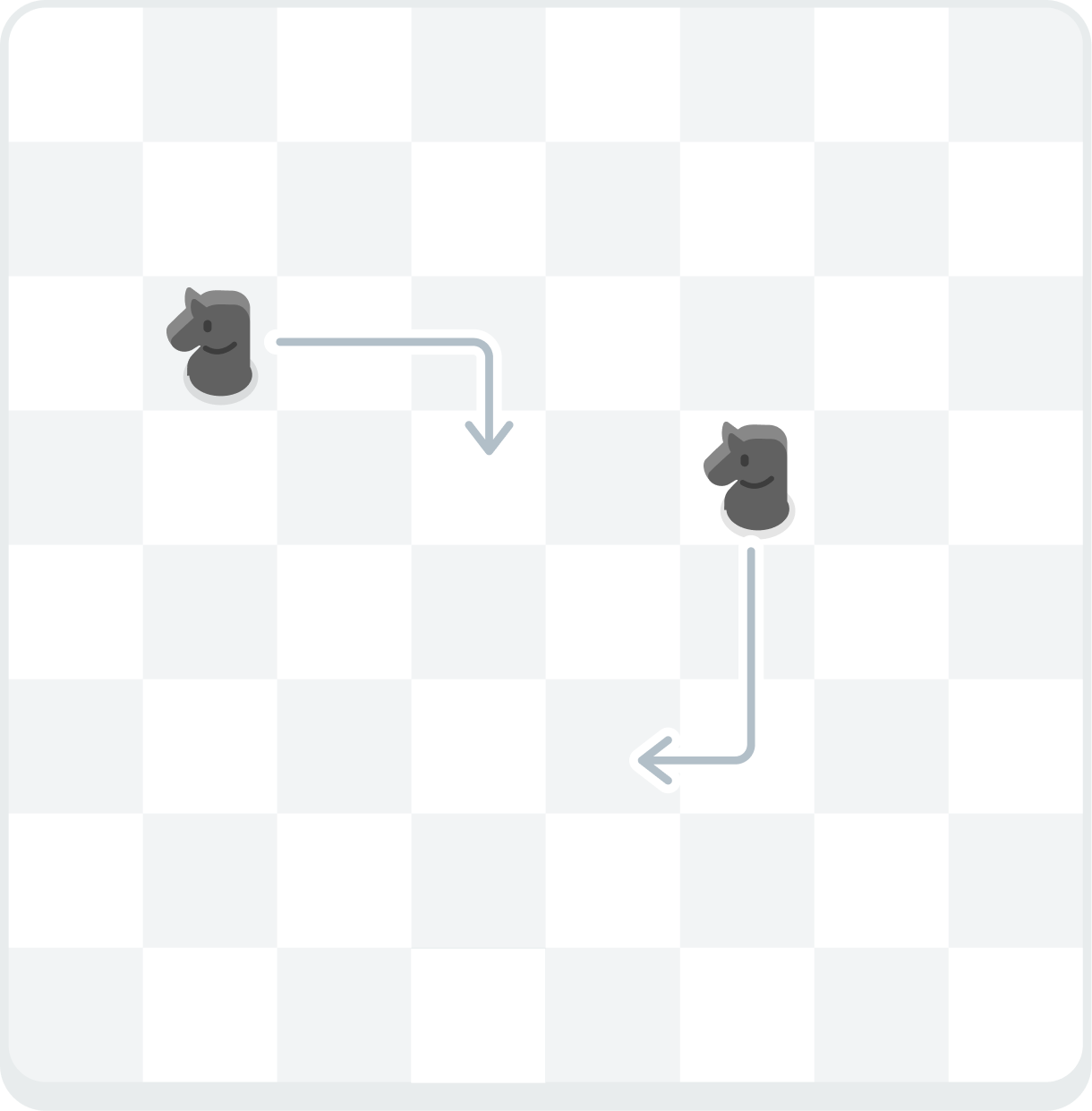
You can think of the knight’s L-shaped movement pattern in several ways:
- Two squares vertically, then one square horizontally
- Two squares horizontally, then one square vertically
- One square vertically or horizontally, then one square diagonally outward
These are all different ways of visualizing the same one way the knight moves. Use the description that makes the most sense to you!
This distinctive movement gives the knight another unique ability: It’s the only chess piece that can jump over other pieces. This means a knight can move even when pieces are blocking its path!
Because of the L-shaped movement, knights alternate square colors with every move. If a knight starts on a dark square, its next move will always be to a light square, and vice versa. Over time, knights can reach every square on the board.
Knights capture exactly how they move. They only capture the piece on the square they land on—not anything they jump over along the way.
Tactics with the knight
One of the knight’s most powerful tactical weapons is the fork, which is one piece attacking two enemy pieces at once. A single knight fork can win major material (a higher combined point total when adding up the values of both players’ pieces on the board)—or even decide the game.
The knight is able to attack in eight different directions simultaneously, often making its moves harder to visualize than other pieces’. Because of this, players frequently miss their opponents’ forks and other tactics involving knights, especially when they’re low on time. In fact, if your opponent is facing time pressure, it’s often smart to keep your knights on the board rather than trade them away, because your opponent may miss some tactics!
Aside from forks, knights can also execute several other notable tactics:
- Smothered checkmates, where the knight delivers checkmate while the enemy king is trapped by its own pieces
- Double checks, where two pieces attack the king simultaneously
- Windmill tactics, involving repeated checks that win material
These tactical possibilities are yet another reason the knight is such a dangerous piece.
Strategy tips
Knights are short-range pieces. Compared to long-range pieces (bishops, rooks, and queens), they move more slowly across the board. A bishop, rook, or queen is capable of crossing the entire board in one move, while a knight needs several moves to travel the same distance.
Because knights work from close ranges, they need to be near the enemy in order to attack. This makes one of the best places for a knight an outpost—a square protected by a pawn where the knight cannot easily be attacked by enemy pawns. In particular, central outposts are especially powerful because they allow the knight to maximize its attacking range.
Knights vs. bishops
Knights and bishops are both minor pieces worth 3 points, but they different significantly in their strengths:
| Knights | Bishops | |
|---|---|---|
| Square coverage | Both colors | Only one color |
| Positions they do best in | Closed | Open |
| Attacking range | Short-range | Long-range |
| Endgames they do best in | Pawns on just one side of the board | Pawns on both sides of the board |
Here are the reasons why bishops and knights complement each other well:
- Knights tend to excel in closed positions because they may jump over pawns or pieces and maneuver onto any color square.
- In open positions or in endgames, knights are often weaker than bishops, particularly when pawns are on both sides of the board. This is in part because bishops have longer-range mobility and can control both sides of the board simultaneously, whereas knights are limited to short-range control and need several moves to reach distant areas.
The exchange
One final concept involving knights is the exchange: an imbalanced trade of a knight or bishop for a rook. You win the exchange when you capture your opponent’s rook (worth 5 points), and lose either a knight or bishop (worth 3 points) while doing so. You lose the exchange when you give up a rook in return for a knight or bishop.
While winning the exchange is usually considered a significant material advantage, in certain circumstances it can be favorable to sacrifice the exchange. For instance, if an enemy knight is a key defender or controls important squares, it may be worth it to give up a rook for this piece.
Do’s and don’ts for the knight
Like every piece in chess, knights work best when used properly.
Do:
💡 Develop your knights early.
Knights are often developed within the first few moves of the game. In fact, it’s often advised to develop knights before bishops, because knights have fewer possible developing moves compared to bishops.
💡 Place your knights in the center.
A knight in the center can control up to eight squares, which is its maximum influence. From the center, they can also easily jump to either side of the board if required.
💡 Look for outposts.
A knight anchored in an outpost can become a powerful, long-term attacking piece that’s often tricky to dislodge.
Don’t:
🚫 Don’t put knights on the edge of the board.
There’s a famous saying: “A knight on the rim is dim.” From the edge of the board, a knight controls only half of its possible squares.
🚫 Don't move your knights to the corners of the board.
A knight placed in the corner controls only two squares, making it extremely ineffective and out of the action.
Let the knight help you ride to victory
The knight’s movement pattern may be complicated to learn at first, but in the hands of a skilled player the knight can be one of the most dangerous pieces on the board.