Welcome to another week of Dear Duolingo, an advice column just for learners. Catch up on past installments here.
Hi again! If you’ve ever thought about learning a new language, there’s a good chance this week’s question has crossed your mind before. The answer is more complex than you may think!
Our question this week:
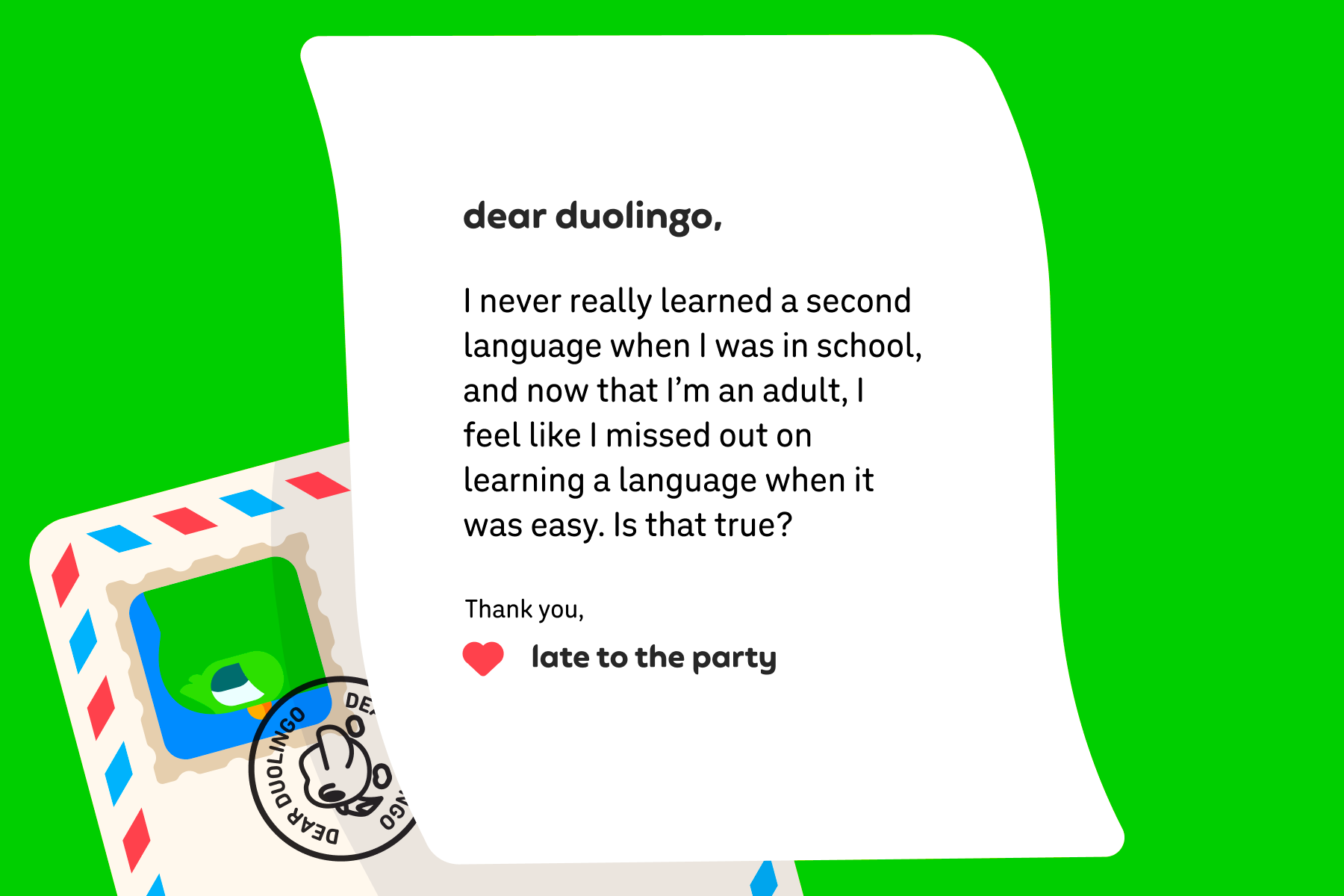
Late to the Party, you are not late to the party! While it’s true that there’s a period during childhood when our brains seem better adapted to absorb a language (experts call this the “critical period”), there’s a lot more to it than that—as well as a lot of reasons why it shouldn’t stop you! Let’s take a look.
What is the critical period?
The “critical period” refers to a period during childhood in which language learners seem to have the easiest time picking up a language. Kids’ brains are built to learn language—that much we know! But some big questions remain:
When does the critical period end?
Just like with walking or losing your first tooth, we all hit our milestones at different times, so there’s no easy answer to this! Many researchers, however, have put the end of the critical period for learning a second language somewhere between seven and thirteen years of age. (There may be multiple critical periods, including a different, earlier one for learning a first language, as well as for many other parts of human development.)
What happens after the critical period?
In general, we talk about the critical period as a window of time in which learning a second language will be easier for you, not a window of time where it is possible. Just like you can learn new vocabulary in your first language throughout your entire life, you can learn a new language at any age!
When (and if) the critical period ends, however, you aren’t suddenly unable to learn a new language (lots of adults still do!)—you just might need to change how you learn.
The bottom line
Many researchers attribute the critical period, at least partially, to neural plasticity: your brain’s ability to absorb and adapt to new information. This makes sense—young kids are learning and changing so much every day, and their brains need to be ready for it!
However, this ability to absorb information and form new connections doesn’t just dry up in adulthood. Not only that, but certain activities and experiences can promote neural plasticity in adulthood, including—you guessed it!—learning a language 🤯
You can emulate kids in many aspects of the language-learning process, but you also have some advantages that kids don’t have! Here are a few of the factors that affect language learning, and how you measure up to kids:
Exposure
This is how much you’re surrounded by the language. It’s hard to beat kids at their level of exposure, since they’re immersed in their language, quite literally, from day one—but there are still ways to maximize your exposure to the language you’re learning: You can challenge yourself while traveling, use social media to your advantage, watch movies and TV shows with subtitles, or change your phone language.
Need
We talk a lot about exposure and need, but “need” really just means motivation. Kids have an incredible source of motivation: As humans, language is our most efficient mode of communication, and without it, kids risk being misunderstood! As an adult, however, motivation can still come from plenty of places: You might want to communicate better with a loved one, help a friend achieve their goals, understand your favorite music or TV shows, or simply keep your brain active!
Willingness to make mistakes
Mistakes are necessary for language learning, but as adults, we tend to avoid making them—often to our own detriment! If you have children in your life, you know that they’re usually quicker to express their thoughts, emotions, and ideas than the average adult (sometimes at the most inopportune moments 😳). Channel your inner child, and know that trying and messing up is better than not trying at all!
An understanding of explicit learning
Before they begin school, kids learn almost exclusively through implicit learning, meaning they learn from experience rather than explicitly being taught rules. Implicit learning is great (it’s a big part of our method at Duolingo!), but you, as an adult, have the benefit of being able to form questions about exactly what’s confusing you in your new language, and ask for help from a friend, teacher, or the internet.
Real-world experience
Kids are learning *so much* in addition to language! For example, in addition to learning the word dog, they also have to figure out exactly what dog refers to: Is it all furry animals? Specifically their furry animal at home? Something else entirely?! While this means they don’t have to worry about L1 transfer (the name for when you accidentally use rules from your first language in the language you’re learning) like you do, they also don’t have the experience that lets them guess the meaning of a new word or use context clues to fill in the blanks.
Specific goals
Kids don’t set out with the intention of “becoming fluent,” so don’t make that your goal, either! Why? Fluency is a vague goal with many definitions, and these definitions are often far too strict to reflect what you can actually achieve with intermediate (or even beginner!) proficiency. Instead, focus on tangible learning milestones, celebrate every little achievement, and remember that it doesn’t take a lot to begin reaping the many benefits of language learning.
You never know until you try!
No matter your age, you already have all the tools you need to start learning a new language. And once you’ve started, you might find that you never want to stop!
For more answers to your language and learning questions, get in touch with us by emailing dearduolingo@duolingo.com.